
Herbicide and UAN tank mixed for top-dress
Spring is the time that many wheat producers apply herbicide and nitrogen (N) fertilizer. For many this can be accomplished in a single pass by tank mixing the herbicide and UAN. In most cases this is an effective practice which eliminates one pass over the field. There are some scenarios in which this practice is ill advised. One such scenario is high temperatures which would lead to excessive leaf burn and crop damage. The other scenario is no-till and that will be the focus of this article. Ruling out warm temperature tank mixing herbicides and nitrogen, assuming the herbicide can be tank mixed, is a good practice. No-till on the other hand can be a different issue.
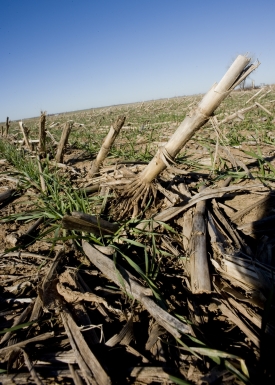
Situations with a lot of residue and smaller wheat is common during top-dress.
The problem in no-till comes from the liquid application method needed to apply herbicides, flat flan. To get a good kill with the herbicide the spray pattern needs to have good coverage, i.e a lot of small droplets to ensure maximum surface area impacted. Unfortunately there are four primary fates of UAN when applied via flat fan nozzles. The UAN could be taken directly up into the wheat plant via absorption through the leaves, the UAN could reach the soil and go into the soil solution or absorbed onto the soil itself, the UAN can be taken up by weeds, or the UAN droplet may hit dead plant tissue and be adsorbed into the residue.
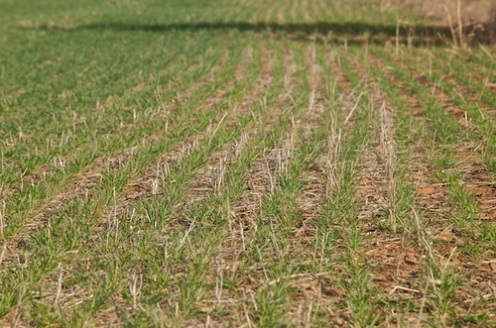
UAN applied with a flat fan will hit a growing plant, the soil, or residue.
The fourth fate of UAN presented is what can make the tank mix less efficient than a two pass system. In a no-till system any UAN that hits residue should be counted as lost, for the short term. The decision to go with a one pass or two pass system can be aided by evaluating the amount of canopy coverage. For example if the no-till field has 50% canopy coverage then one could estimate 50% of the UAN applied via a one pass system would be tied up in the residue. The cost of a second application could then be compared to the lost N. If 15 gallon of 28-0-0 was being applied then approximately 22.5 lbs of N would be tied up by the straw. At a price of $0.40 per lb on N, that is $9.00 worth of N. Conversely if the canopy coverage was 80% only 20% or 9 lbs of N would be tied up in the residue. Saving the $3.60 in nitrogen would not justify a second trip over the field. Luckily OSU recently released the Canopeo app which uses a cell phones camera to take pictures and quickly and accurately determine % canopy coverage. Canopeo is available for iOS and android http://canopeoapp.com/.


In fields with a high amount of residue or limited canopy coverage UAN should be applied with streamer nozzles. This will concentration the fertilizer into streams which will allow the UAN to have enough volume to move off the residue and into the soil.


So as the decision is being made to tank mix herbicide and UAN or make two passes take into consideration: % canopy coverage, rate of UAN (how much could be lost), cost of UAN per pound, and cost of a second trip over the field.
Below is an excerpt from the publication Best Management Practices for Nitrogen Fertilizer in Missouri; Peter C. Scharf and John A. Lory. http://plantsci.missouri.edu/nutrientmanagement/nitrogen/practices.htm
Broadcasting UAN solution (28 percent to 32 percent N) is not recommended when residue levels are high because of the potential for the N in the droplets to become tied up on the residue. Dribbling the solution in a surface band will reduce tie-up on residue, and knife or coulter injection will eliminate it. Limited research suggests that the same conclusions probably apply for grass hay or pasture. Broadcast UAN solution is also susceptible to volatile loss of N to the air in the same way as urea, but only half as much will be lost (half of the N in UAN solution is in the urea form).


Canola fertilizer rates when skip row seeding.
When drilling canola a common strategy to improve seeding rate accuracy is to only use every other row which effectively doubles the rate of seed going through each meter. There are also many producers who utilize air seeders and just prefer the wider spacing. Every season I get several questions about determining total fertilizer rates if the seed is dropped every other row but fertilizer is dropped every row. Regardless of whether or not fertilizer goes down every row it is important that the amount of salts placed with seed does not exceed the limit. The table below provide the limits in terms of lbs of salt per acre. If using 18-46-0 (DAP) or 11-52-0 (MAP) this is equivalent to pounds of N per acre. However if the fertilizer you use contains potassium (K) or sulfur (S), those have to be considered. An easy rule of thumb for determining total salt level of a fertilizer is pounds of N + K + 1/2 S.

Maximum amount of salt that can be applied in furrow with canola seed. Application rate should be at or below this value.
In a scenario in which canola is seeded in skip rows but every row will get fertilizer the total amount of fertilizer can be doubled. For example on a 15″ row spacing the max salt rate is 5 lbs per acre. If you were using DAP as your starter that maximum rate to place in furrow would be 28 lbs of DAP per acre. If using a drill set of 7.5″ spacing and putting fertilizer down every row the max rate would increase up to 56 lbs DAP per acre.

Seed, colored blue, is placed in every other row while an equal amount of fertilizer, dark grey circles, is placed in every row.
Some producers may have the capability of applying different rate in every other row. In this scenario it is important to maintain that safe rate in the seed furrow. In the opposite row, fertilizer rate can go as high as you wish or the equipment can handle.
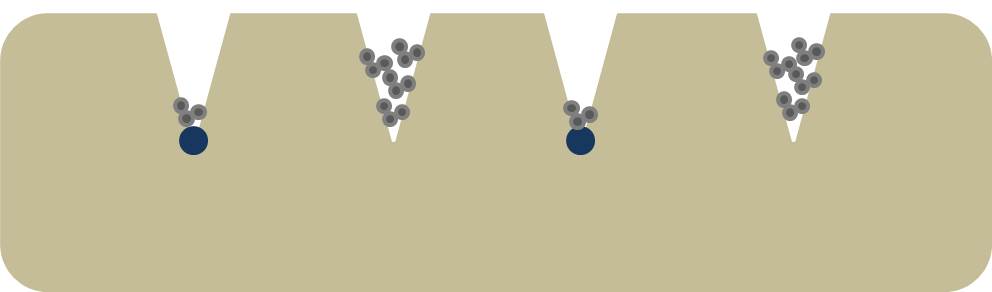
Seed, colored blue, is placed in every other row while fertilizer, dark grey circles, is placed in every row. In this scenario a high rate is placed in the row without seed.
Now the big question is, “Is between row fertilization a good idea?” While we do not have results on this style of application (trials will be going out this year) we can draw upon upon similar work in other crops. For me the best win would be the second scenario in which a higher rate could be place between the rows. In this row I would use a urea and DAP blend. Any time we can put urea below the soil surface its a win and in fields with very soil soil test phosphorus (P) it would create something similar to the deep P bands once popular in corn production. Now if the field had adequate soil test P, I would focus on urea between rows. Keep in mind it is never a good to place urea in furrow with canola seed. For the average producer who is using a box drill the first scenario is the only option. In this case the rate of the between row bands will be reduced however I still believe on fields with very low soil test P this is potentially a great way to get the rest of it on. Remember if on 15″ and using DAP max rate only gets 12.9 lbs of P2O5 down. If fertilizer is dropped down every tube that number increases to about 26 lbs P2O5, which is still not enough for fields with low soil test P, but is better. With hope we will have some good results to share from the 2015-2016 canola crop.
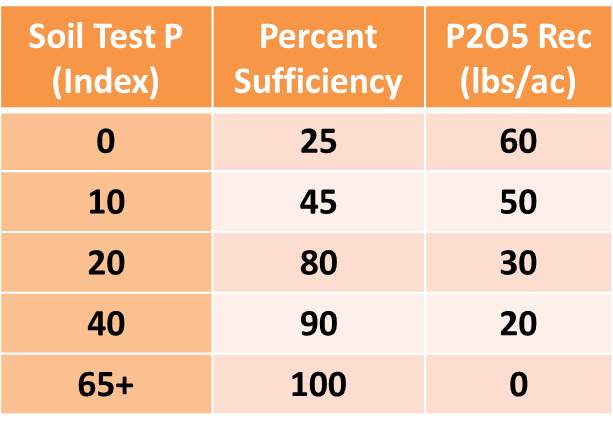
Phosphorus fertilizer recommendations based upon Mehlich 3 P test, reported as STP index (ppm * 2)
Canola Planting Considerations.
Pre- and Early-Season Weed Management-
Dr. Angela Post- Small Grains Extension Weed Scientist
Winter canola is an excellent rotational partner with wheat. Integrating canola into a wheat system allows for the cleanup of weedy fields with primarily grassy weed problems. Conventional and Roundup Ready (RR) varieties are excellent choices for managing most grassy weeds including ALS-resistant populations, because grass-only herbicide options can be used in canola without crop injury. For specific grasses that are very difficult to control, like cereal rye and jointed goatgrass, it is advisable to use canola in year one of your rotation and Clearfield wheat in the second year of your rotation before going back to conventional wheat varieties. Due to sensitivity of canola, Clearfield wheat varieties should not be used the year prior to rotating into canola.
Canola planting time is just around the corner and many are going out now with preplant burndown applications. Remember that canola is sensitive to dicamba, 2,4-D, and MCPA and these products should not be used inside of 30 days before planting. Glyphosate, glufosinate and paraquat are all potential options for removing broadleaf weeds in no-till systems prior to planting. These products have no planting restriction for canola. Tillage is the best option to remove weeds in conventionally tilled systems.
It is important to consider your previous herbicide choices when planning for canola in the fall. Many herbicides used for spring weed control in wheat can limit rotation to winter canola. These include all Group 2 herbicides all of which have long rotation restrictions to canola, meaning you cannot plant canola in these fields for 18-24 months depending on the product. See Table 1 for a list of specific restrictions. If you have used one of these products in wheat in the spring, you must plant a canola variety with the SURT trait. Examples of varieties with this trait include: DKW 45-25, DKW 46-15, DKW 47-15, HyClass 115W, HyClass 125W. All of these varieties are also RR. Kansas State also has an open-pollinated non-RR variety called Sumner with the SURT trait for growers that prefer to grow conventional canola. Note that the SURT trait is not a genetically modified trait.
No additional in-season herbicide options have been added to the toolbox for winter canola growers in the upcoming season. Both trifluralin (Treflan) and ethalfluralin (Sonolan) can still be used as preemergent weed control options in canola in conventionally tilled systems. Both need to be mechanically worked into the ground and need an activating rainfall to work properly. Quizalofop (Assure II), sethoxydim (Poast), and clethodim (Select and many generics) are the grass control herbicides available for use in canola and can be used on any canola variety including RR varieties. Roundup Ready canola growers are allowed two applications of glyphosate at 22 oz/A each over the top of the emerged crop. Clopyralid (Stinger) is the only over-the-top broadleaf control option other than glyphosate. These weed control applications should be made early in the season between 2- and 6-leaf canola, and prior to bud formation, while weeds are still very small. Applications should be spaced at least 14 days apart. Early applications will eliminate fall weed competition with canola and protect yield. For more information or questions involving weed management in canola contact Extension Weed Specialist Angela Post at 405-744-9588 and follow @OSUWeedScience.
Table 1. Rotation restrictions for planting canola following wheat. For herbicides
applied in crops other than wheat please refer to the herbicide label.

1Minimum interval between herbicide application and seeding canola. Refer to full herbicide labels for specific information as geography, pH, and rainfall may affect this interval.
2Rotation restriction can be overcome with use of a SURT canola variety.
3Rotation intervals depend on geography.
4Rotation interval depends on herbicide rate.
Pre plant fertilizer concerns with Canola
Dr. Brian Arnall- Precision Nutrient Managment Extension Specialist
When it comes to pre-plant fertility issues with canola, I typically have two soap boxes. But at this point in the canola game we are behind in terms of getting soil samples collected or applying lime and getting a boost at emergence. So assuming pH is good and you know what your soil nutrient level is we can move on to planting. One thing that over the past seven or eight years keeps coming up is the importance of starter fertilizers and the rates and sources used. Getting that little canola plant off to a good start is extremely important however with that little bitty seed a little goes a long way.
The figure below shows the impact of DAP (18-46-0) placed in row, on relative canola stands, when canola was planted in 15” rows. At 5 lbs/A of N or 28 lbs/A of DAP, the canola stand is reduced to 75%. While this seems like a great loss, the compensating nature of canola and the fairly high seeding rates used, this is a manageable level. The benefits of the additional nitrogen and phosphorus applied with the seed also help out-weigh the loss of stand. The addition of the P near the germinating seed is vital. The phosphorus aids in early root and shoot growth, helping the crop to get off to a good start. In areas where soil pH is of concern the P near the young seedling will reduce aluminum toxicity and allow the plant to tolerate the low pH. Keep in mind, while banding P will help in acidic soils, canola is still very sensitive and will not tolerate the same low pH conditions as our winter wheat’s.

Impact of DAP (18-46-0) placed in-row on canola stand in terms of lbs N ac-1.
One very important factor to keep in mind is the impact of the critical rate and row spacing. The 5 lbs of N per acre critical level set for 15” row spacing is increased to 10 lbs on 7.5’s and cut to 2.5 lbs on 30’s. The change in rate is because we use lbs per acre. So if you apply the same amount of material per acre on a 15” spacing and a 30” spacing there is actually twice as much material in the 30” row. Table 1, shows the equivalent amount of N placed in row for popular row spacing’s.

Equivalent amount of N based on 15″ row spacing.
Oklahoma State has released a smart phone app, available for both apple and android devices, to aid in determining maximum in-furrow rates. Canola Starter app provides guidelines based upon the nutrient concentrations of the fertilizers you plan to use. The final note on in-furrow fertilizer with Canola, avoid using urea. The likelihood of injury from the urea converting to ammonia greatly outweighs any potential benefits. For further information, comments, or questions please contact Dr. Brian Arnall Extension Precision Nutrient Specialist 405-744-1722 or following me on Twitter @OSU_NPK.
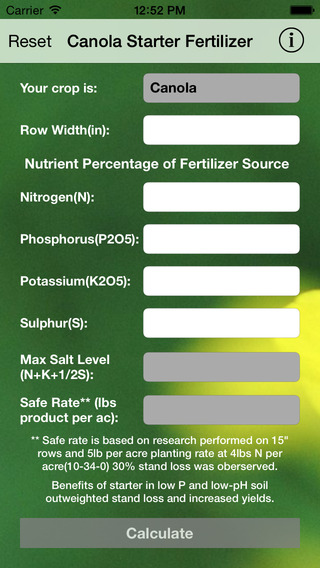
Canola Starter available on iOS and Android. For more information see http://www.dasnr.okstate.edu/apps.
Winter canola planting decisions:
Josh Lofton- Cropping Systems Specialist
Josh Bushong- Extension Associate
Stand establishment is one of the most critical practices in canola planting. This is not only because these stands are highly influential to end of the season yields but because getting the crop up with adequate growth will be critical to give the plants the best over-winter survivability possible. To accomplish this, growers need to make sure they make good field selection and follow good planting practices
Field Selection:
Soil nutrients are a critical aspect. Soil samples should be collected on a regular basis to ensure optimum productivity. Also, ensure recommendations for winter canola are followed, as nutrient recommendations for other crops may be invalid. For more information canola fertilizer management refer to the nutrient management section by Dr. Arnall.
Winter canola grows similar to winter wheat. Fields that can adequately produce wheat have the potential to produce canola. These include, well-drained soils with adequate soil nutrients. However, canola can be more sensitive than wheat. One aspect that canola can be more sensitive to is soil pH. While wheat can be grown in soils as low as 5.5 without significant yield loss, canola must be grown on soils with pHs above 5.8. In fact, canola is best grown in soils with soil pHs ranging from 6.0 to 7.0. Therefore, it is essential that if fields have lower pH, lime be applied with adequate time to neutralize the acidic soil pH before rotating into canola.
In addition to all the soil conditions, crop rotation should be considered prior to planting canola. One of the major hindrances in growing canola in rotation with other crops is herbicide carry-over. For detailed information regarding this aspect, refer to table 1 in the weed management section. To account for this, detailed field records should be kept and consulted before rotating with canola.
Planting Date:
Planting time depends on many aspects. Insured growers should plant within the constrained planting dates. For Oklahoma, the earliest planting date is September 10th with the latest date being October 10th. However, within these guidelines, seedbed and environmental conditions should be the driving factor to determine when to plant. The goal of these planting dates is to have the crop germinate, emerge, and establish 6-8 true leaves prior to the first killing freeze. As a general rule, the crop should be planted 4 to 6 weeks before this freeze. To achieve good establishment of the crop, canola should be planted into firm seedbed with adequate soil moisture. If canola is planted into dry soil (dusted in), the effective planting date will be delayed until adequate conditions for germination and emergence exist. In no-till systems, it is important to remember that canola emergence and growth will be slightly delayed. Therefore, if adequate conditions exist, no-till fields should be planted before similar conventionally tilled fields.

Uneven canola emergence. Canola on left emerged later and did not
have enough time to put on adequate growth (Photo courtesy of Josh
Bushong)
Planting depth, plant spacing, and seeding rate:
Since canola is a small seeded crop, shallow planting is required. For best germination and emergence, seeds should be planted between 0.5 and 1 inch. If adequate moisture is available deeper, planting depth can be increased. However, deeper planting has the potential to decrease germination, percent emergence, and early fall growth, so deeper planting should only be used when the planting condition advantage is present and only on certain soils. Therefore, caution should be used in planting deeper than 1 inch. Furthermore, even though moisture may be present deeper, seeds should not be planted deeper than 1.5 inches.
Oklahoma growers have options when deciding row spacing used for planting canola and depend on what equipment there is available and their production system. Since canola is typically rotated within a winter wheat production system, box drills and air seeders are typically widely available. Row-spacing for these can range from 6 to 15 inches. Row spacing within this range has little impact on final yields. As producers move from drills and air seeders to planters, row spacing typically increases from 15 up to 30 inches. All of the row-widths have the potential to produce adequate canola. Some, however, will be more beneficial than others. Narrow row spacing has the potential to result in early canopy closure, reduce potential weed competition, and may help reduce shatter prior to harvest (especially when direct harvested). Wider spacing, however, allows for some flexibility in specialized planter attachments used, especially row-cleaners, which can be greatly beneficial in no-till systems.
Seeding rates for canola in Oklahoma range from 1 to 5 lbs/A. However, row spacing plays a critical role on seeding rates. When canola is planted on less than 15 inch spacing, some flexibility exists for planting rates. Higher seeding rates can produce more uniform stands, uniform maturity, and thinner stalks that can greatly help harvest efficiency. Too high of stands can increase disease incidence, winterkill, and lodging. When row spacing is increased beyond 15 inches, care should be taken not to over seed. High seed populations can increase fall growth and potentially increase hypocotyl height, which in turn can lead to high winterkill. Optimum populations for this wider row spacing typically range from 2 to 3 lbs/A.
For further information, comments, or questions please contact Josh Lofton Extension Cropping Systems Specialist at 405-744-3389 or follow me on Twitter @OSU_oilseeds.
While producers have faced many challenges over the last couple of seasons in Oklahoma agriculture, the outlook for winter canola looks very promising for the upcoming season. Producers should focus on taking all of the right steps to ensure the 2015-2016 crop starts on the right foot and takes full advantage of the promising conditions this season. Good luck to everyone one on their upcoming production season and if anyone from Oklahoma State extension can help or assist in any way, please feel free to contact.
Some thoughts on pre-plant nitrogen and a little outside the box thinking
It is that time of year, every Co-op I drove by the other day had a line of trucks pulling anhydrous tanks and the spinner spreaders were being loaded. For those of you who haven’t applied your nitrogen yet lets discuss the options traditional and nontraditional.
Anhydrous Ammonia, 82-0-0: by far the most widely used N source is the southern Great Plains. While it is not the most enjoyable to work with it is the cheapest per pound of N and that leads to its wide spread use without Oklahoma wheat production. Just a few simple rules with NH3, get it in the ground and close the row behind you. In conventional till this is usually easier unless the ground is too wet or too dry. In no-till this may be a little more challenging but usually easily accomplished. With the rise in low disturbance applicators I am seeing more and more acres of no-till receiving NH3. Last year I was in a field of stripper stubble and I had a hard time finding where the rig had run, minus wheel tracks.
Urea, 46-0-0: is second on the hit list in nitrogen sales in our state. It is a safe source that is easily handled and applied. In a conventional till system where the urea can be worked in shortly after application it is a very efficient and effective source. Unfortunately when it is applied to the soil surface and rain is the method of incorporation we can experience between 5-60% N losses. The losses come from how urea is converted to plant available ammonium (NH4). For urea (NH2)2CO2, to be converted to plant available NH4 it needs the enzyme urease. Urease is present everywhere but in the highest concentrations on plant residue. The figure below shows the reaction, urease converts urea into NH3 as soon as the prill dissolves. In the presence of moisture the NH3 (gas) is turned immediately to NH4 (solid) and is absorbed onto the soil particle.
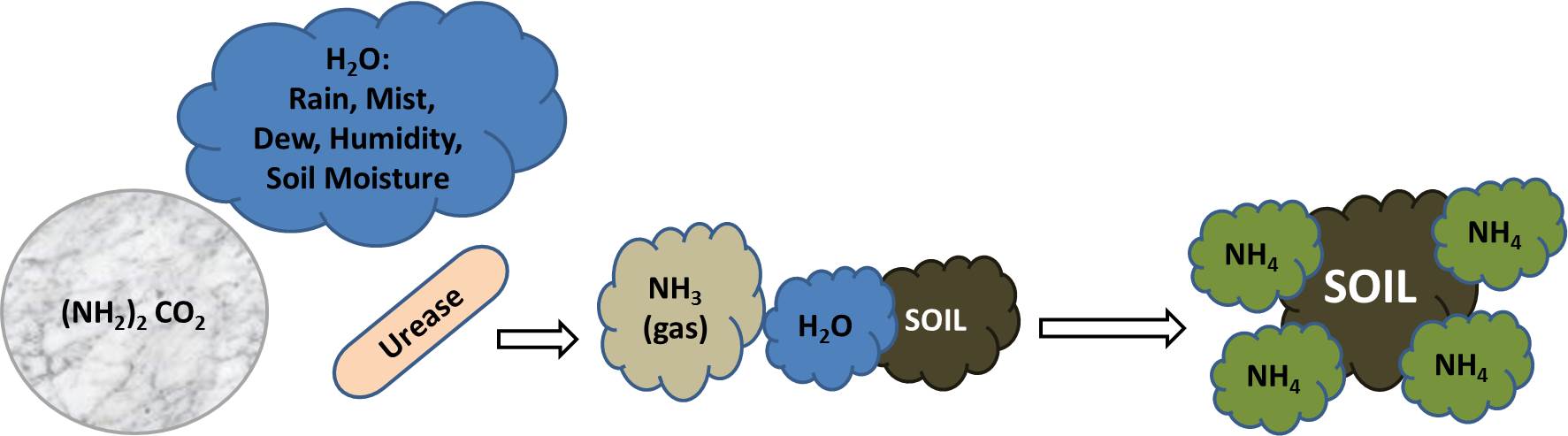
Graphic of Urea’s conversion to plant available ammonium.
The problems come when there is no soil particle for the NH4 to bind with. It usually takes 0.50 inches of rain or irrigation to fully dissolve and incorporate urea into the soil. So if we only get a few tenths or hundredths, even heavy dews, some of the urea will dissolve, be converted to NH3 then NH4 and be left on the plant/residue. When the moisture dries, some or all of the NH4 goes back to NH3 and will gas off into the atmosphere. I have even seen this happen when urea is applied on a wet/damp soil, not incorporated and it doesn’t rain for significant period of time. If the temps are cooler the urease is slower so less of the urea is converted to NH4, but if the temps are warm 60+ degrees these little enzymes can act very quickly.

Urea placed on the surface of a wet soil under two temperature regimes. White text is the number of hours after application.
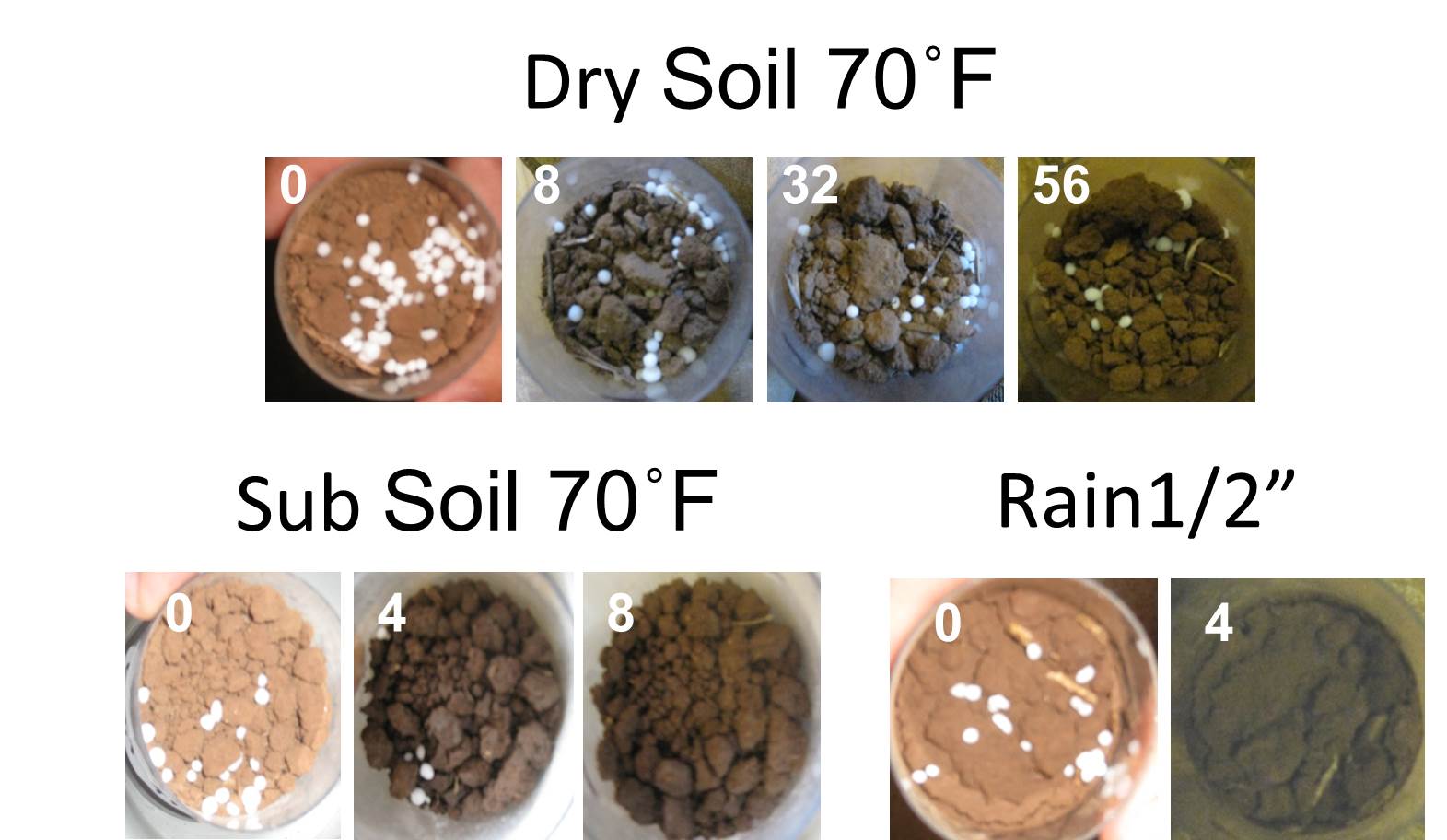
Urea placed on dry soil, Top row: dry soil no water added, Bottom left, moisture added from subsurface, Bottom right : simulated rain fall event of 1/2″. White text is the number of hours after application.
Below is a short video on using urea fertilizer.
While the recent rains are a blessing and will surely help germination, it is not aiding our N use efficiency especially in no-till. That is why in some parts of the state you may see some grain drills running right now. Some of those producers are not planting wheat they are actually applying there pre-plant urea. I have even been told in the SW part of the start some producers are using air-seeders to apply their urea. While this seems like a costly venture I have worked with the Ag Economist to create a calculator to figure up the break even for when it would pay to use an air-seeder over the traditional spinner spreader in no-till. We hope to put the finishing touches on it in the next few days. When it is completed it will be shared on this blog.
Liquid Urea Ammonium Nitrate, 32-0-0 or 28-0-0: while this is one of the more expensive forms of N many producers are utilizing this source because the can pre buy and store on site and as sprayer get larger they can cover a significant amount of ground quickly. For the most part UAN is used in no-till and is a great source. I always recommend that applicators use streamer nozzle or streamer bars to apply UAN. When UAN is applied via a flat fan nozzle it spreads the fertilizer across the residue allowing a significant portion to be tied up. The streamers concentrate the fertilizer into streams/bands reducing contact with residue and increasing the amount of UAN that reaches the soil surface.
Timing and Rates
The cost of anhydrous, about $0.1 to 0.12 less per pound N less than urea is driving its use this year. The lower price is also driving a significant about of producers to go with 100% of their N pre-plant. While this makes for sound economics now having all of your N upfront is like putting all of your eggs in one basket. If we do get that cold and wet winter as some are calling for this presents a great chance for the N to move down the soil profile and down the slope. I have always recommended split application. This allows a producer to judge the crop throughout fall, winter and even yearly spring and adjust his or her N plan accordingly. For those who plan to graze there is still a need to get enough N down to produce fall forage, this may be 50 to 80 lbs of N, but for grain only production planted later in the fall a typical crop may only need 20-30 lbs of N before going into winter. The old rules of thumb, 2 lbs N per bushel and 30 lbs N per 100 lbs of gain still work and are better than a guestimate but we have better ways. Right now is the time to plan to apply N-rich strip, a strip in the field with 40 to 50 lbs more than the rest of the field. These strips can be applied with a variety of applicators, but as long as the N goes down in at least an area 10 ft wide by 300 ft long it is good to go.

Just a few of the applicators used for putting out N-Rich Strips. ATV Sprayer, Receiver Hitch mounted Sprayer, Road sprayer with a rear boom, pull type spinner, large sprayer, push spreader. Not shown is NH3 applicator.
Below is a N-Rich Strip 101 video.
If you have got the N-Rich strips out you can set back and watch to see when and if they develop. If you can see the strip you know you need too fertilize.
While many are not ready to think about top-dressing yet, it is never too early. Don’t be afraid to think outside the box. Oklahoma’s springs tend to present the perfect conditions for N loss when urea is the primary N source. This year in a 4R Top-dress Nitrogen Application Demo, at Lahoma and Chickasha, we are going to apply just about every available commercial source in about every possible manor. Urea will be broadcast, coated with inhibitors, applied with a grain drill, NH3 will be knifed in, and UAN will be applied with flat fan nozzles, streamer nozzles and knifed in. As technologies improve and the cost of N remains relatively high the options for top-dress N application will continue to improve. The economics of wheat production don’t look great right now so don’t be afraid to think outside the box, even if it does raise the eyebrows of your neighbors. Fill free to contact myself or your local extension educator if you have any questions about N application.

John Deere double disk drill used to apply urea in-season.

WAKO NH3 applicator used for in-season application.
Recent Weather Causing Corn (and Sorghum) Injury From Pre-emerge Herbicides
While this is not about fertility in the southern Great Plains I feel it is a very important topic. I will not be surprised if we don’t start seeing this in some of the corn and sorghum that was just planted before the rains. I would also add the over the years I often see bleaching in sorghum, that looks similar to zinc and/or iron deficiency, caused by atrazine injury. This typically occurs when atrazine is applied prior to a heavy rain. The atrazine is washed down slope and into the rows, the injury is almost always seen in low lying areas. The crop usually grows out of it.

Atrazine injury in sorghum. Heavy rains followed application. Pic via Rick Kochenower.
Brian A.
This article is written by Mr. Cody Daft, Field Agronomist Western Business Unit, Pioneer Hi-Bred
Have you noticed any corn leafing out underground prior to emergence? Have you seen tightly rolled leaves or plants that can’t seem to unfurl leaves and look buggy whipped? Almost all of the fields I have looked at recently have shown these symptoms in at least a portion of the field, and some fields this has been very widespread. The common denominator in all the fields I have viewed has been the herbicides applied were a metolachlor (Dual/Cinch type products) and the weather (cooler than normal, wetter than normal). Similar issues can be noted in grain sorghum to some extent.
The recent wet weather and water-logged soils have increased the possibility of corn injury from many popular soil applied herbicides. Corn growing in wet soils is not able to metabolize (degrade) herbicides as rapidly as corn growing in drier conditions. Plant absorption of herbicides occurs by diffusion. What this means is that the herbicide diffuses from locations of high concentration (application site on the soil) to low concentration (plant roots). The diffusion process continues regardless of how rapidly the corn is growing. In corn that is not growing rapidly (cool, wet conditions) corn plants can take up doses of herbicide high enough to show damage and a few differences in symptomology.
The unfortunate aspect of wet soil conditions is that additional stress is put on the plant not only to metabolize herbicide residues, but also to ward off diseases and insects. These additional stresses can impact a corn plant’s ability to metabolize herbicide.
The most common type of herbicide injury observed under these conditions is associated with chloroacetamide herbicides. These herbicides are used for control of grass and small seeded broadleaf weeds, and are seedling root and shoot inhibitors.
These products include the soil-applied grass herbicides such as:
- Dual/Cinch/Medal II
- Degree/Harness
- Microtech/Lasso
- Frontier/Outlook
- Define/Axiom
- And other atrazine premixes like Lumax (a premix of mesotrione (Callisto), s-metolachlor (Dual II Magnum), atrazine and a safener benoxacor).
What About The Injury Symptoms?
Before corn emergence:
- Stunting of shoots that result in abnormal seedlings that do not emerge from soil.
- Corkscrewing symptoms similar to cold/chilling injury.
- Corn plants and grassy weeds may leaf out underground and leaves may not properly unfurl.
After corn emergence:
- Buggy whipping – leaves may not unfurl properly.

Figure . Buggy-whipping symptom from carryover of PPO herbicides to corn.via https://www.pioneer.com/home/site/us/agronomy/library/herbicide-carryover/
What About Safeners?
Products like DUAL II Magnum herbicide contain the safener benoxacor which has been shown to enhance S- Metolachlor metabolism in corn. This enhanced metabolism can reduce the potential of S- Metolachlor injury to corn seedlings when grown under unfavorable weather conditions such as cool temperature or water stress. However, a safener is not the silver bullet, and slow plant growth may still have trouble metabolizing the herbicide even with a safener…but it does help the severity of damage/symptoms.
Will The Plants Recover?
Plants that have leafed out underground or show corkscrewed mesocotyl symptoms are likely to not recover or even emerge from below the soil. Larger plants that are already emerged that show tightly rolled leaves and are buggy whipped will most likely recover once the field sees drier conditions and we have warm weather and sun light to assist in better plant growth.
More Information Discussing Corn Injury From Pre-emerge Herbicides Here:
Cody Daft
Pioneer Hi-Bred
cody.daft@pioneer.com
Variability in Tissue Testing/Plant Analysis
This article is written by Dr. George Rehm, University of Minnesota, Soil Fertility Specialist (retired).
See more of Dr. Rehm’s blogs at http://www.agbuzz.com
During the past two or three years, there has been an increase in the promotion for the use of tissue testing/plant analysis as a management tool in development of fertilizer programs. At times, if you read all of the advertising literature, you might get the idea that the practice of plant analysis/tissue testing is so important that you can’t make a profit without it. So, is this really a new and exciting management tool to be used by every crop producer? A close examination of the facts without all of the advertisement leads to the answer: not really.
There are problems with placing dependence on the use of this management practice. Some of the problems and pitfalls have been identified by Dr. Dan Kaiser, Associate Professor and Extension Soil Scientist at the University of Minnesota. These are briefly described in the paragraphs that follow.
STAGE OF GROWTH at sampling is a major consideration. With corn, for example, it’s impossible to compare analysis of plants sampled at the V5 growth stage with analysis of plants sampled at some later growth stage. As the corn plants grow, nutrient concentration is diluted and concentrations, therefore, decrease. If all other factors are equal, a concentration of nitrogen, for example, may be higher and adequate at V5. The concentration percentage will be lower at V10 and still be adequate. This concept has been verified by substantial research conducted by faculty at Land Grant universities.
In order for tissue testing/plant analysis to be meaningful, the results of analysis of the plant tissue must be compared to some standard. For corn and other crops, these standards have not been developed for every stage of growth. This is usually true for stages early in the growing season. That’s primarily because concentrations are rapidly changing at those times. So, what’s the point of analyzing corn plants at the V5 growth stage if there are no standards for nutrient concentrations at that growth stage? I don’t know. I don’t believe that there is general agreement among researchers knowledgeable about plant analysis as to what the adequate concentrations are in whole plant corn tissue at the V5 growth stage. With corn, accurate interpretation of plant analysis information is possible if plant samples (leaves) are collected at the time of silking.
At silking, however, it’s too late to apply nutrients that might correct a deficient situation. So, analysis of corn leaf tissue at silking cannot be used to predict rates of any nutrients needed during the growing season.
TIME OF DAY used for sampling can also affect concentration of nutrients in specific plant parts.
Research has shown that this is especially true for nitrogen. Nutrients may be more concentrated in plant tissue in the morning; but, as plants grow, the concentration can be diluted by dry matter added during the day that is the result of the normal growth process. This effect of time of sampling just adds to the variability that may be experienced with plant analysis.
HYBRID AND?OR VARIETY can also have a substantial influence on “critical levels” associated with plant analysis. Researchers are finding that the rate of nutrient accumulation is different among modern hybrids or varieties. Therefore, it’s reasonable to expect that nutrient concentration in any plant part at any stage of growth will vary with hybrid or variety. This is yet another source of variability in plant analysis.
It is known that nutrient concentration in plant tissue is affected by stage of growth at time of sampling, time of day used for sampling, and hybrid or variety. There are obviously other factors that contribute to variability in the results of plant analysis.
Many have used the results of plant analysis as an aid in the diagnosis of a problem in a field. Plant analysis was originally developed as a diagnostic tool. When combined with companion soil samples, this tool has helped to solve many problems. It is, however, a stretch to use this practice as a tool to predict the rate of any nutrient that should be applied to any crop. It is simply not a predictive tool that can be used with confidence. There are too may opportunities for error.
While there are several factors that can produce variability in the concentration of nutrients in plant tissue, there is only minimal variability in the laboratory procedures used in the analysis. The analytical procedures have been standardized among laboratories by using “standards” with known concentrations. If there problems with the laboratory analysis, the routine use of these “standards” will identify those problems.
Plant analysis/tissue testing is not something new. The concept has been around for many years. When used appropriately, it has value. However, the ability of this management practice to predict rates of nutrients needed for crop production is now and has been limited. Don’t expect any more than what this practice can deliver.
Dr. George Rehm,
University of Minnesota
Nutrient Management Specialist (retired)
rehmx001@umn.edu
Sampling for pH and liming in continuous no-till fields
This article is written by Dr. David Mengel, Kansas State University Soil Fertility Specialist.
One question that commonly comes up with continuous no-till operations is: “How deep should I sample soils for pH?” The next common question is: “How should the lime be applied if the soil is acidic and the field needs lime?”
Sampling depth in continuous no-till
First, sampling depth. Should two sets of samples be taken, at different depths?
Our standard recommendation for pH is to take one set of samples to a 6 inch depth. On continuous no-till fields where most or all of the nitrogen (N) is surface applied, we recommend taking a second sample to a 3-inch depth. We make the same recommendation for long-term pasture or grass hayfields, such as a bromegrass field that has been fertilized with urea annually for several years.
Nitrogen fertilizer is the primary driving force in lowering soil pH levels, so N application rates and methods must be considered when determining how deep to sample for pH. In no-till, the effects of N fertilizer on lowering pH are most pronounced in the area where the fertilizer is actually applied. In a tilled system, the applied N or acid produced through nitrification is mixed in through the action of tillage and distributed throughout the tilled area.
Where N sources such as urea or liquid UAN solutions are broadcast on the surface in no-till system, the pH effects of the acid formed by nitrification of the ammonium will be confined to the surface few inches of soil. Initially this may be just the top 1 to 2 inches but over time, and as N rates increase, the effect of acidity become more pronounced, and the pH drops at deeper depths. How deep and how quickly the acidity develops over time is primarily a function of N rate and soil CEC, or buffering capacity.
Where anhydrous ammonia is applied, or liquid UAN is knifed or coulter banded below the surface, an acid zone will develop deeper in the soil, usually 2-3 inches above the release point where the fertilizer is placed in the soil. So if the ammonia is injected 8 inches deep, there will be acid bands 5 to 8 inches below the soil surface. As with long-term surface applications, these bands will expand over time as more and more N fertilizer is placed in the same general area. The graphic below illustrates the effect of a high rate of ammonia placed in the same general area in the row middle on a high CEC soil for more than 20 years.
The actual depth of the acid zone in fields fertilized with ammonia gets tricky as application depth can vary depending on the tool used to apply the ammonia. Traditional shank applicators generally run 6 to 8 inches deep, so a sample for pH measurement could be taken at 3-6 inches or 5-8 inches deep, depending on how deep the shanks were run. The new low-disturbance applicators apply the ammonia 4-5 inches deep. A sweep plow or V-blade applies ammonia only 3-4 inches deep. So sampling depth for pH should really depend on where the acid-forming N fertilizer is put in the soil.

Mengel and West, Purdue Univ.
Liming application methods in continuous no-till
Now, where do you place the lime in continuous no-till? If you surface apply N, then surface apply the lime. That’s a simple but effective rule. But remember that surface-applied lime will likely only neutralize the acidity in the top 2-3 inches of soil. So if a producer hasn’t limed for 20 years of continuous no-till and has applied 100 to 150 pounds of N per year, there will probably be a 4-5 inch thick acid zone, and the bottom half of that zone may not be neutralized from surface-applied lime. So, if a producer is only able to neutralize the top 3 inches of a 5-inch deep surface zone of acid soil, would that suggest he needs to incorporate lime? Not really. Research has shown as long as the surface is in an appropriate range and the remainder of the acid soil is above pH 5, crops will do fine.
Liming benefits crop production in large part by reducing toxic aluminum, supplying calcium and magnesium, and enhancing the activity of some herbicides. Aluminum toxicity doesn’t occur until the soil pH is normally below 4.8. At that pH the Al in soil solution begins to increase dramatically as pH declines further. Aluminum is toxic to plant roots, and at worse the roots would not grow well in the remaining acid zone.
This implies that the acid zones from ammonia are probably not a major problem. We have monitored ammonia bands in the row middles of long-term no-till for many years and while the pH got very low, below 4.5, we never saw any adverse impacts on the crop that would justify liming and using tillage to incorporate the lime. In fact, some nutrients such as zinc, manganese, and iron can become more available at low pH, which can be an advantage at times.
Yield enhancement is not the only concern with low-pH soils, however. Herbicide effectiveness must also be considered. The most commonly used soil-applied herbicide impacted by pH is atrazine. As pH goes down, activity and hence performance goes down. So in acid soils weed control may be impacted. We do see that in corn and sorghum production.
Liming products for no-till
When choosing a liming product, is there any value to using dolomitic lime (which contains a large percentage of magnesium in addition to calcium) over a purely calcium-based lime product? On most of our soils in Kansas we are blessed with high magnesium content. So as long as we maintain a reasonable soil pH, there normally is enough magnesium present to supply the needs of a crop. Calcium content is normally significantly higher than magnesium, so calcium deficiency is very, very rare in Kansas. The soil pH would need to be below 4.5 before calcium deficiency would become an issue. Before calcium deficiency would occur, aluminum toxicity or manganese toxicity would be severely impacting crop growth. So producers really don’t have to worry about a deficiency of calcium or magnesium on most Kansas soils.
What about the use of pelletized lime as a pH management tool on no-till fields? The idea has been around for a while to use pel-lime in low doses to neutralize the acidity created from nitrogen and prevent acid zones from developing. There is no reason it won’t work, if you apply enough product each year. Pel-lime is a very high-quality product, normally having 1800 to 2000 pounds of effective calcium carbonate (ECC) per ton, and can be blended with fertilizers such as MAP or DAP or potash easily.
But it is costly. As an example, at a cost of $160 per ton and 1,800 lbs effective calcium carbonate (ECC) per ton, 100 pounds of ECC pel-lime costs $8.80. If it costs $25 per ton to buy, haul, and apply a 50% ECC limestone, that equates to $2.50 per 100 pounds ECC.
If you were applying 100 pounds of urea-based nitrogen, it would take approximately 180 pounds of ECC to neutralize the acidity produced by the N. This would require 200 pounds of 1,800 pound ECC pel-lime or 360 pounds of 50% ECC ag lime. The cost would be around $16 per acre with pel-lime or $4.50 per acre with ag lime. So technically, the pel-lime option is fine. But it would cost more than 3 times as much, at least in this example. You can use your own figures regarding costs and ECC of different lime products available to you to do a similar calculation. Deciding which product to use is a simple economic choice.
Summary
Applying N fertilizer to soil will cause the soil to become acidic over time. Placement of the applied N and the level of soil mixing done through tillage determine where the acid zones will develop. Make sure your soil testing program is focused on the area in the soil becoming acidic, and apply the lime accordingly.
Dave Mengel
Kansas State University
Professor Soil Fertility Specialist
dmengel@ksu.edu
Results from 1st year of Soybean Starter Work
In the spring of 2014 we initiated what was to be the first year of a three year project evaluating starter fertilizers for soybean production in the southern Great Plains. The first and second year was and is being funded by the Oklahoma Soybean Board.
Year one was a bit experimental in that with so many products on the market we needed some initial work to help focus the direction for years two and three. I also added a treatment which I knew would have significant negative impact, for extension reasons. Keep in mind two locations in a single year does not make an experiment nor provide enough information to draw a definite conclusion. It is however enough to learn some lessons from and for us to plan for our 2015 trials.
The 2014 trial consisted of 12 treatments, Figure 1 and Figure 2. In these treatments I wanted to see the impact of a standard practice, see if a specific nutrient may be more so beneficial, and evaluate a few popular products. The spring of 2014 started out dry so at one of our two locations we pre-watered. This was done by hauling water to the Lake Carl Blackwell (LCB) 1000 gallons at a time and pumping through sprinklers. The other site, Perkins, we delayed planting until we had moisture.

Treatment Structure and rates for the 1st year of the Soybean Starter Study.

List of fertilizers and products used.

Image taken while planting the Soybean Starter study at Perkins. A CO2 system was used to deliver starter fertilizers with seed.
The two locations were also selected due to differences in soil fertility. The LCB site is has good soil fertility, with exception of phosphorus (P), and the Perkins site pH was an issue. I would have expected a benefit from adding P at both of these locations. Figure 4 shows the soil test results.

Soil Test results from LCB and Perkins.
At LCB as expected some of the treatments (Thio-Sul) reduced stand, some unexpectedly reduced stand (Fe) and others had less impact on stand (APP 5.0) than expected. The growth at LCB was tremendous, the 30 in rows covered over very quickly and the majority of the treatments hit me waist high by early August (I am 6’0”). Many of the treatments showed greater growth than check. But when it comes down to it, grain pays and green does not. Statistically there were no treatments that out preformed the un-treated check, however the K-Leaf and 9-18-9 did make 3 and 2 bpa more than the check respectively. What I am hypothesizing at this site is that the added nutrients, especially those with high P levels, significantly increased vegetative grown and these big plants were delayed into going reproductive and they started setting pods later in much hotter weather. While riding in the combine I could see that the plots with compact plants with clearly defined rows out yielded those were the vines had crossed over and we harvested through more of a solid mat of mature plants. A hot August is not uncommon and I am curious on whether this trend repeats itself. If it does this may direct us into research evaluating ways to force/promote the reproductive stage to start in these big plants. Even if we can force flowering to start earlier, it’s unknown whether yields will increase or not.
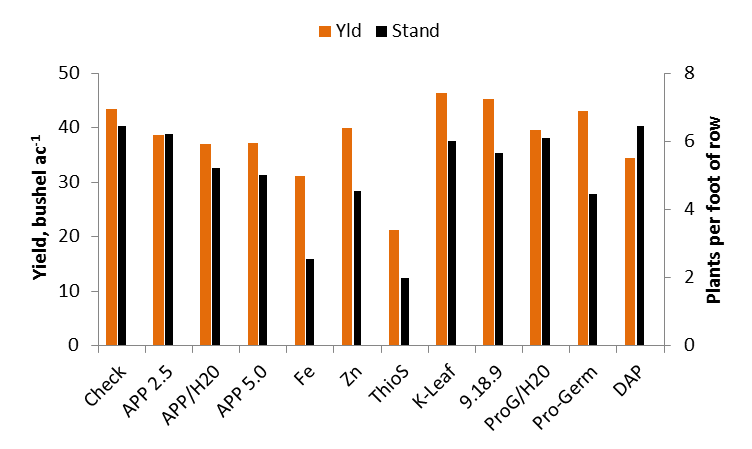
Yield and Stand counts from the 2014 LCB Soybean Starter Study.

The Check plot at LCB were plants noticeably a bit smaller and more yellow than the neighbors with phosphorus.

Soybeans at LCB on August 4th.
The same trends in treatments reducing stand can be seen at Perkins, however the impact was less extreme. Perkins being planted later due to waiting on moisture forced a later flowering date and I believe reduced overall yields. But the addition of P at this low pH site definitely made a difference. While again no treatments were statistically greater than the un-treated check the 2.5 gpa APP, DAP broadcast, APP/H2O, and Pro-Germ/H20 treatments increased yield by 5.6, 4.2, 3.8 and 1.7 bpa respectively.

Yield and Stand Counts from the Perkins 2014 Soybean Starter Study.
Take home from year one was that at LCB the addition of a starter fertilizer had little benefit and if done wrong could cost you yield while at the low pH site of Perkins an addition 2.5 gallons of APP did get a 5 bpa bump, but do to variability in the trial the increase was not statistically significant. This year we will drop some of the treatments and incorporate a few new treatments. Based on the current weather we look to potentially being able to start with better soil moisture at planting. Again do not take this work and significantly adjust any plans you have for your 2015 soybean crop. This is however some interesting findings that I wanted to share and make everyone aware of. Finally thank you to the Oklahoma Soybean Board for providing funding for this work. www.oksoy.org/
4 Keys to Reaching Grain Sorghums Yield Potential
When I started writing this blog (3.13.2105) Ok grain elevator cash bids for grain sorghum aka milo was 6.61-7.70 cwt (3.7-4.31 per bushel) and corn was at 3.64-4.06 per bushel. Meaning there is currently a premium on sorghum grain. This difference among other things has increased the interest in planting sorghum. Of late I have been quite successful, at least on a small-scale, at producing sorghum yield in the 120-150 bpa range, thanks to the advice of Rick Kochenower former OSU sorghum specialist. Both of us believe that every year many producers are leaving significant bushels on the table due to one or two miss steps. I wanted to take this opportunity to share what is in my opinion the keys in producing a bumper sorghum crop. I should note that the primary key is out of our control, rain.
Key 1. Planting date, the optimum planting date for grain sorghum is generally when soil temperatures reach 60° F and increase after planting. For much of the region that I believe is best suited for sorghum this falls between April 1 and April 15 for south of I40 and April 15 and May 1 north of I40. graph below shows the long-term average daily 4″ soil temp (bare soil) for Apache, Blackwell, Cherokee, and Vinita. It is easy to see how your location within the state can impact soil temps.
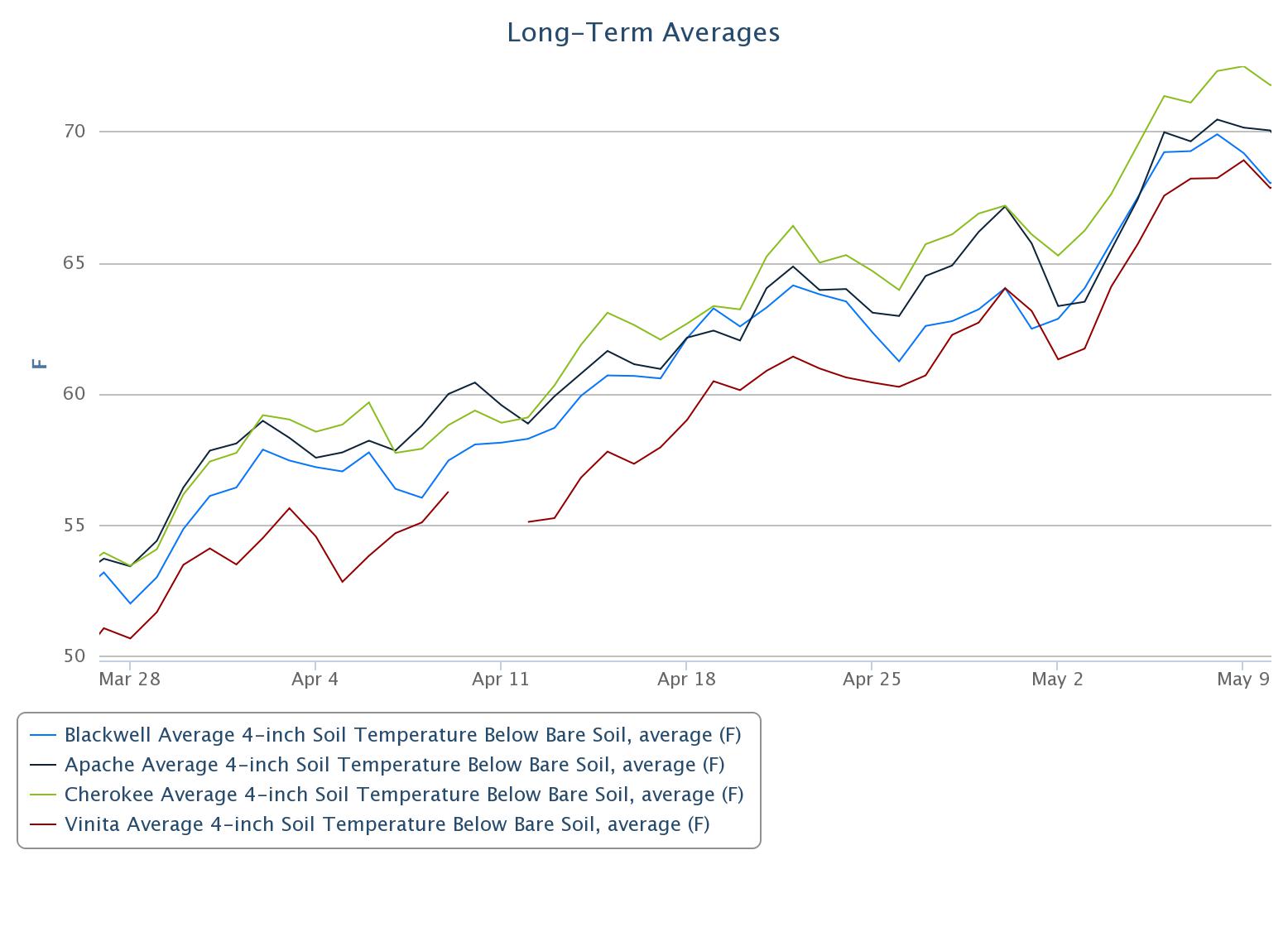
Long term average 4 inch soil temps from Blackwell, Apache, Cherokee, and Vinita for bare soil. Data from the Mesonet.org.
You should not forget however that tillage practices will also impact soil temps. The two graphs below show the long-term average daily 4″ soil temp for Cherokee and Blackwell for both bare soil and under sod. Note that when the soil is covered by residue it warms slower. The two figures also show that residue will have more impact in some areas more so than others.
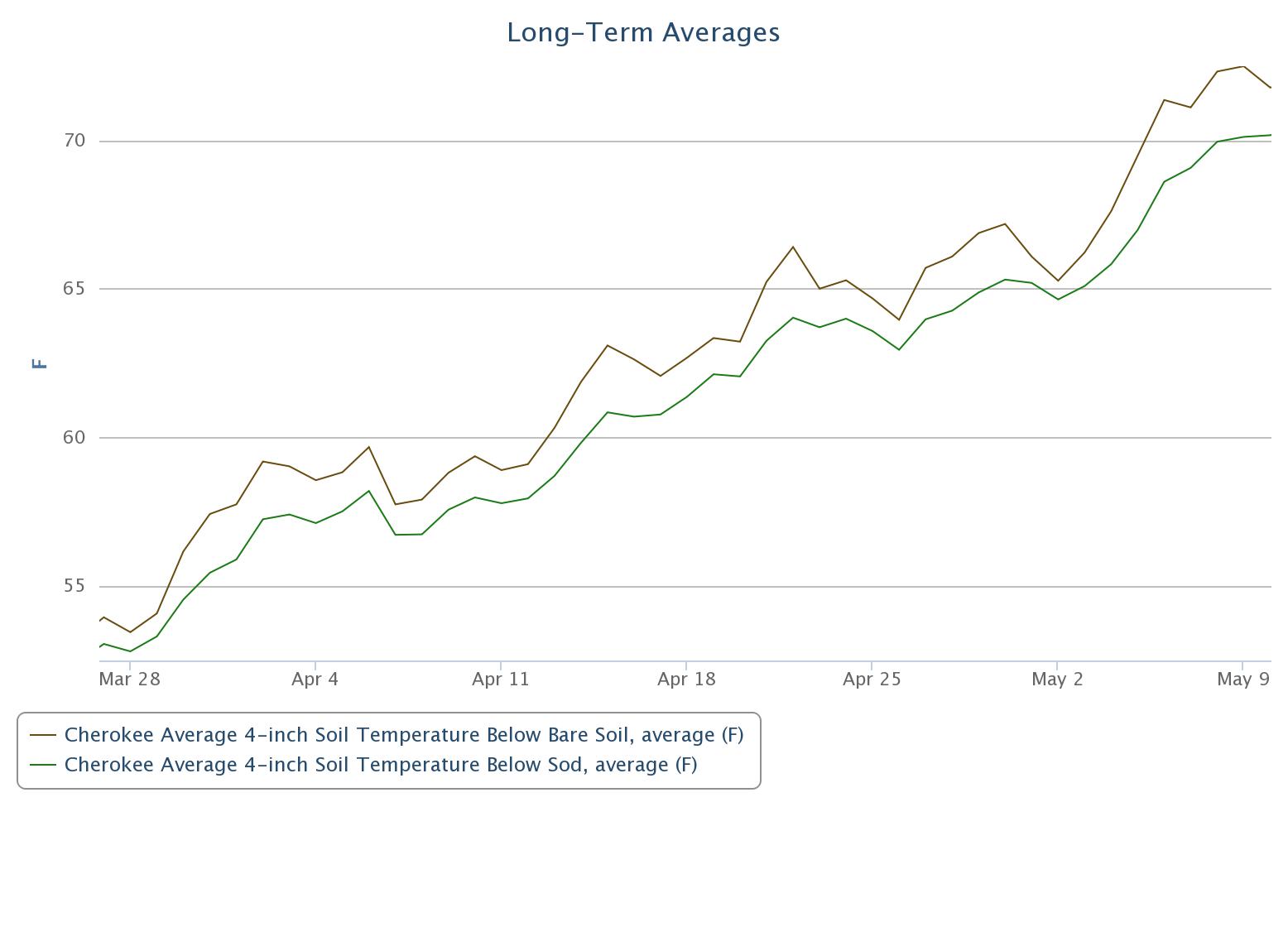
Long term average 4 inch soil temps at Cherokee for bare soil and under sod. Data from the Mesonet.org.
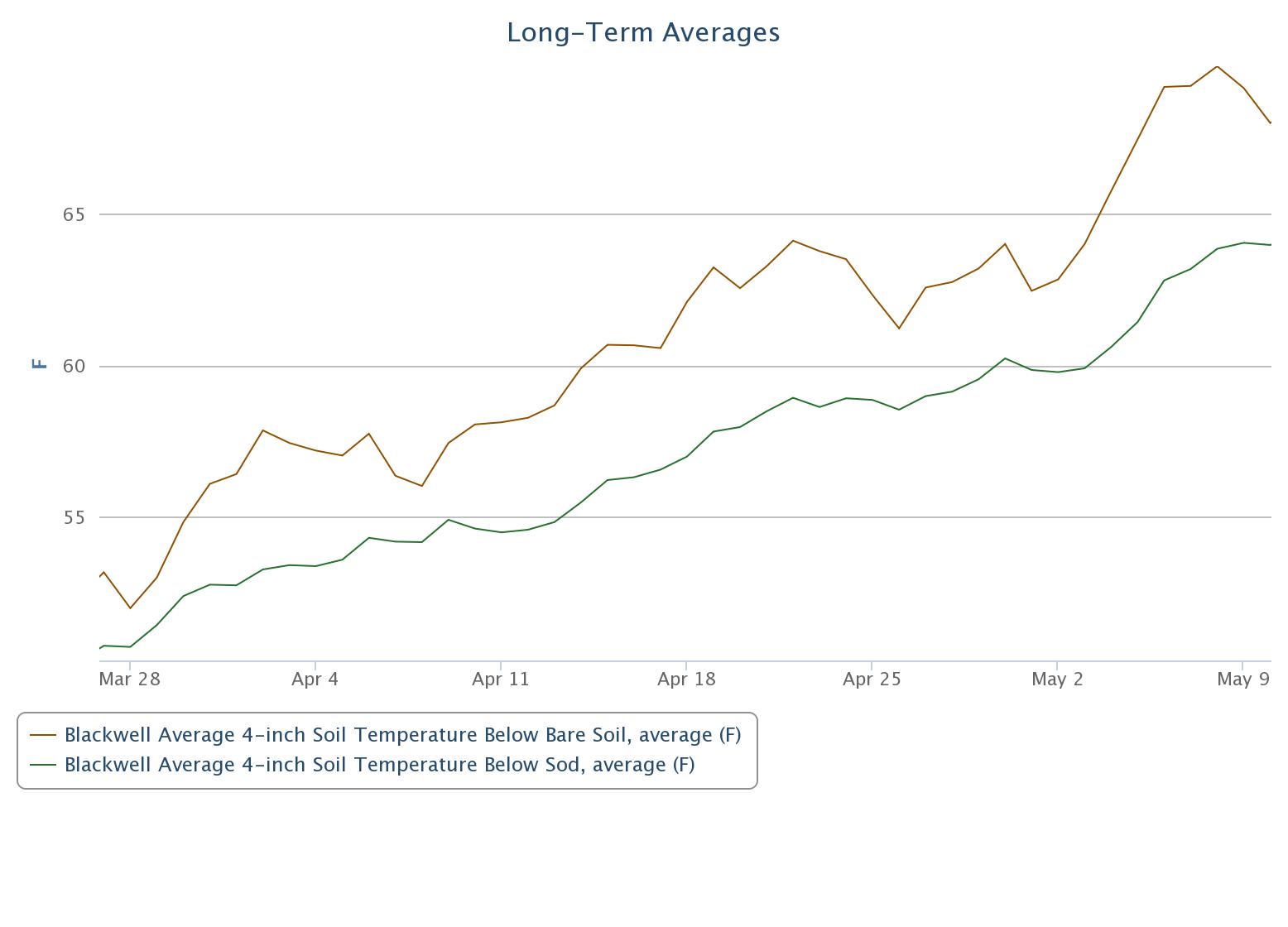
Long term average 4 inch soil temps at Blackwell for bare soil and under sod. Data from the Mesonet.org.
My best word of advise is to keep a watchful eye on the Mesonet. While the long-term average is nice to know here in Oklahoma the difference in weather from one year to the next can be huge. The figure below shows the average daily 4″ soil temp (below sod) from Blackwell for the past five years. Link to Mesonet Soil Temp page Click here.
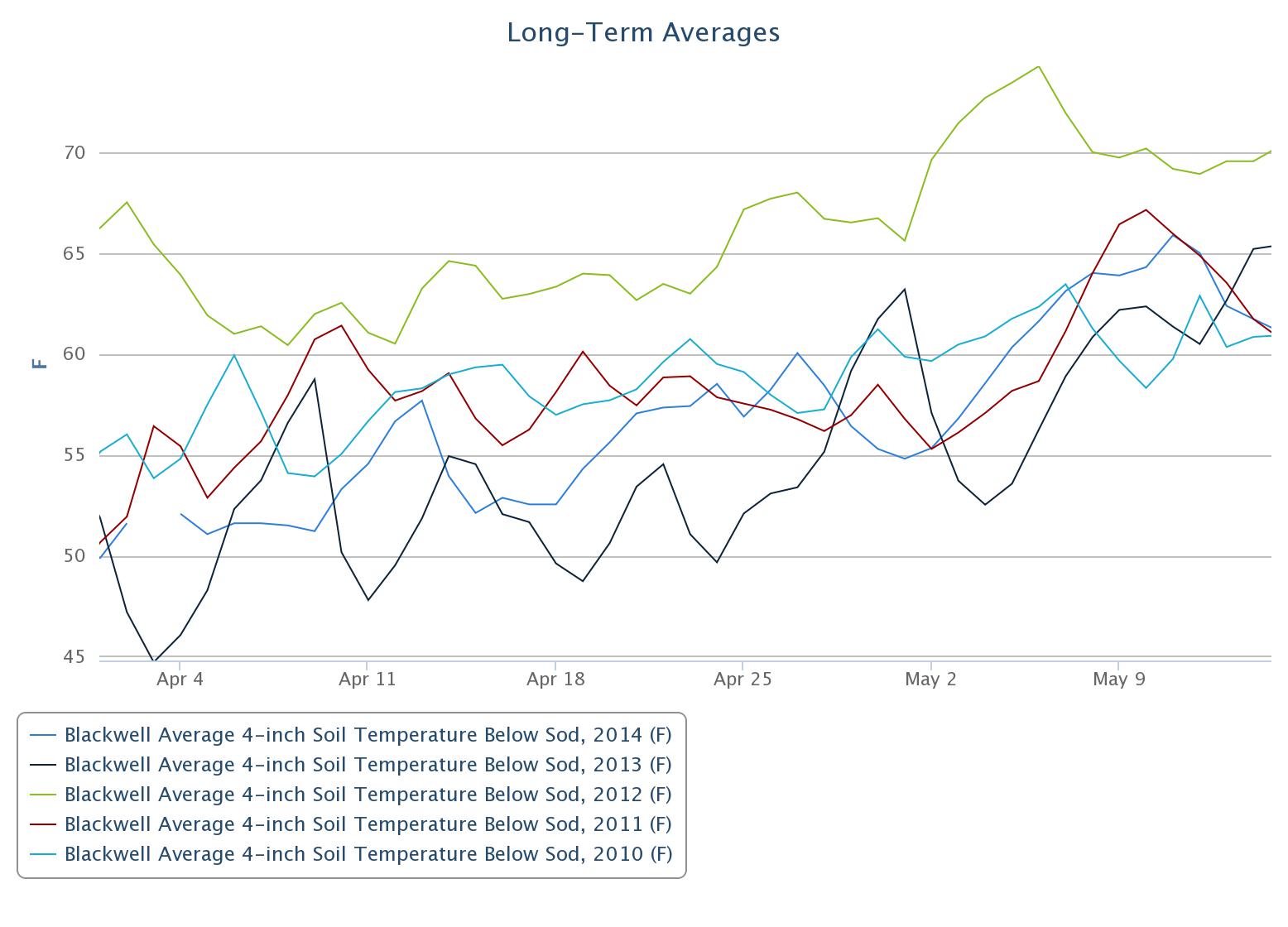
Average 4 inch soil temps at Blackwell for 2010, 2011, 2012, 2013, and 2014 for under sod. Data from the Mesonet.org.
Another great resource is a report on planting date written by Rick Kochenower presented to RMA. Link to report.
Key 2. Hybrid selection, primarily maturity group selection. Rick has created a great graphic that helps put a planting date window with maturity group. It is always important to visit with your local seed dealer to find out what has been performing best in your region and consider the importance of stay-green, standablilty and disease packages. But for me the number one key is the selection of maturity group. This should be based upon planting date and harvest strategies. Below is a great graphic created by Rick, while this may not be scientific it is a great guide created via years of experience. I also recommend that if you are planting a significant amount of acres you should diversify your maturity groups. Not only does this spread out he harvest window but it also you to spread the risk of high temps coming early or late. An additional resource is the Sorghum Performance trial summary located on the Ok Panhandle Research and Extension Center website. Click here.
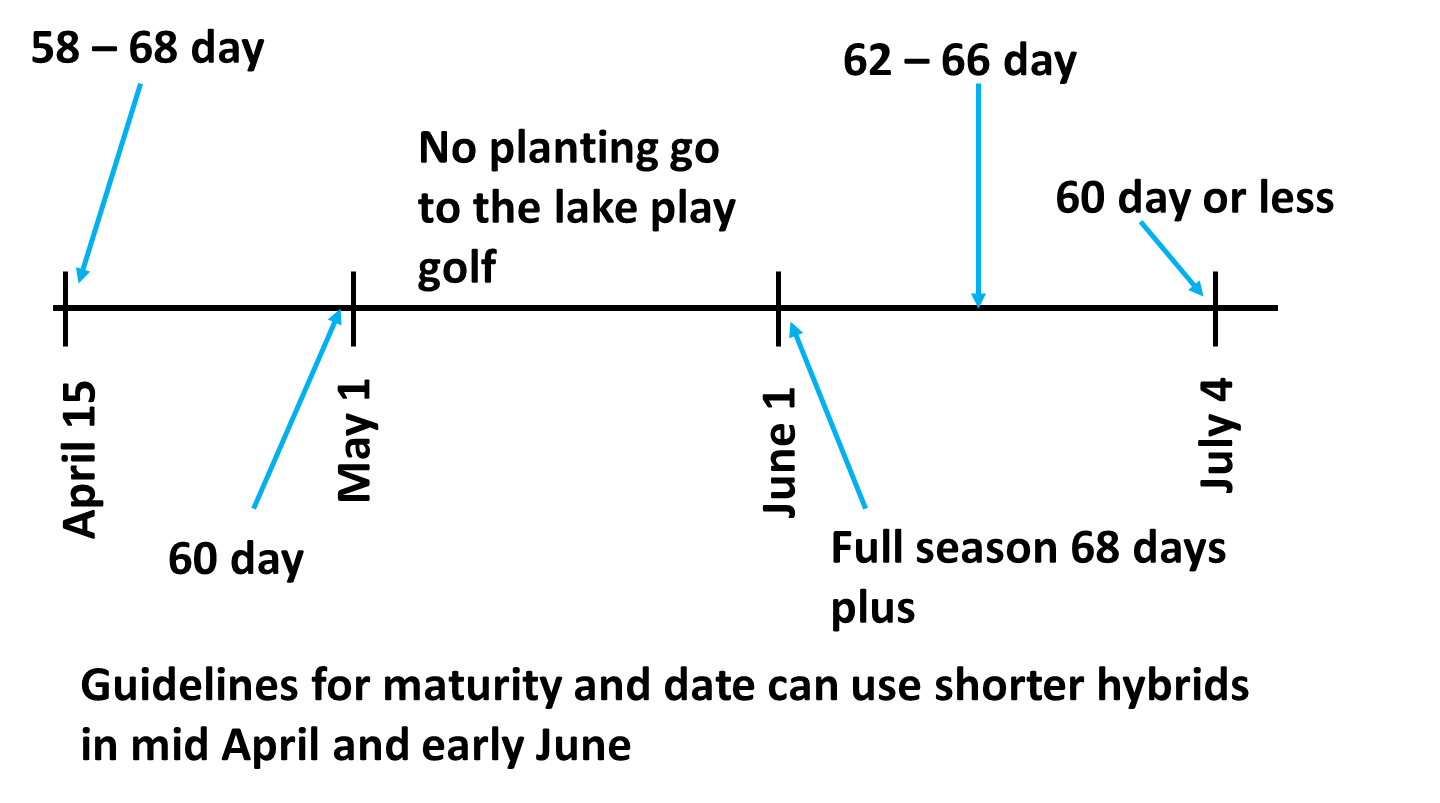
Timeline for optimum planting date (N of I-40) and proper maturity groups. Developed by Rick Kochenower (Chromatin seed)
Key 3. Soil Fertility, while soil pH plays a big role on sorghum productivity but it is too late in the game to do much about it this year. So the most important things to keep in mind on fertilizing sorghum are your macro-nutrients nitrogen (N), phosphorous (P) and potassium (K). It is my opinion that historically producers have underestimated the yield potential of sorghum and therefore lost yield due to under application on N. You should expect more than 60 to 80 bushel out of your crop if you put the right seed in the ground, at the right time and in the right way.
Ask around look at Rick’s yield data, producers in N. Central Ok on a good soil should be going for 125+ bpa easy. Unfortunately you are unlikely to hit these yield levels if you fertilize for a 75 bpa crop. An easy rule of thumb on N fertilization is 1.2 lbs of N per bushel, for a more exact number take a look at the image below. This comes from the corn and sorghum PeteSheet and is the same table that comes from the Soil Fertility Handbook. (If you would like some Pete Sheets just send me an email requesting them at b.arnall@okstate.edu, Link to PeteSheets page).

Nitrogen, Phosphorus and Potassium Recommendations for corn and sorghum production. Adapted from the Field guide and PeteSheet available at http://www.npk.okstate.edu
Key 4. Weed Control With sorghum utilizing a pre-plant herbicide with residual is extremely important due to the lack of over the top options. Most times proper weed control will be accomplished by utilizing concept treated seed and use of labeled rates of a pre-emergent grass control herbicide combined with atrazine.
While I primarily focus of the four keys above there are a few other important items to consider.
Population: Prefer to think in terms of seeds per acre instead of lbs per acre. This comes into to play with the use of a planter. Rick Kochenower says “for seeding rate(on 30 inch rows), it isn’t as critical as most people think it is. Because most guys in Oklahoma tend to under plant not over plant. I always suggested 45,000 but as you look at the last slide it really don’t matter much. The way I always liked putting it is to make you sure have enough out there to not have to replant, because being late hurts more than having to few too many or too few plants.”
Row spacing: I like 30, but many may not have a planter so I suggest at least plugging every other hole in the drill to be at a 12″-20″ spacing. Make sure your population is correct for your row spacing. For this consult with your local seed dealer to match cultivar with row spacing and proper population.
Insects: Scouting for aphids and head midge is very important, these little critters are yield robbers and can gum up the works at harvest.
Harvest prep: I almost put this as the fifth key. By chemically maturing/terminating your crop you are both able to increase harvest efficiency and preserve moisture for a following winter crop of wheat or canola.
While this is a good start I suggest a visit with your local OSU Extension educator, consultant or seed dealer for information about your specific situation. Just know the crop has great potential to yield big if treated right. I like to say don’t treat your sorghum crop like the stray you adopted, treat it like your hunting dog that you traveled halfway across the country to pick up. Good luck in 2015 and I hope the rains fall when and were needed.
Saline and Sodic Seep Renovation A potential Positive Impact of Drought
This article is written by Dr. Jason Warren, OSU Soil and Water Conservation State Extension Specialist.
The drought has caused numerous negative impacts on Agriculture in Oklahoma. However its impact on our ability to renovate some types of Saline and/or Sodic soils has been a positive. Saline and sodic seeps are referred to by many names, including: salt spots, alkaline spots or slick spots. They are all similar in that they contain excessive amounts of salt or sodium that prevent plant growth. However there are various differences that influence how we renovate these sites.
These areas are classified by the amount and type of salt present. Saline soils are those that contain an EC greater than 4000 μmhos/cm and less than 15% Exchangeable sodium. A Saline/sodic soil contains an EC greater than 4000 μmhos/cm and greater than 15% exchangeable sodium. Lastly, the Sodic soils contain less than 4000 μmhos/cm and greater than 15% exchangeable sodium. Given these differences it is important to have soils from these barren areas tested before a renovation plan is developed. The soil tests will provide recommendations for renovation and more detail on these strategies can be found in factsheet PSS-2226.
Beyond the classifications briefly mentioned above there are different ways in which these saline and sodic soils form. Some of these soils are formed from parent material that contained excessive salt or sodium. Others are formed when ground water moves to the surface through evaporation and deposits salt as the water is lost to the atmosphere. The drought conditions we are current experiencing can impact our ability to renovate the latter.


Figure 1: The upper picture was taken in Feb. 2011 and the bottom picture was taken in April 2013.
Hydraulic seeps, those formed from the movement of groundwater to the surface, are often found in low lying areas of the landscape where the groundwater is close enough to the soil surface that water can be conducted through capillary force to the soil surface. These forces are similar to those that allow use to suck water up through a straw but in the case of a saline seep evaporation from the soil surface provides the hydraulic gradient that pulls water from the water table. The drought has caused the water table in many areas to subside and become too deep for these force to pull water to the surface and deposit salts.
Figure 1 shows a saline/sodic soil in 2011 and again in 2013. This site had been treated with Gypsum as described factsheet PSS -2226 in 2007. However, because of a shallow water table that persisted until the onset of drought in 2011 the renovation effort was not successful because there was insufficient movement of water through the profile to leach the salts down out of the soil surface. These soils are in proximity to Stillwater Creek and Lake Carl Blackwell. The water table has declined which allows limited rainfall experienced at this site in 2012-13 to move the salts down out of the soil surface. This in turn has allowed crop establishment further improves water infiltration by protecting the soil from crusting.
The drop in most water tables across Oklahoma, particularly western Oklahoma where these salt spots are most common, provides for a unique opportunity to renovate hydraulic salt spots. Again the first course of action is to collect a soil sample to determine what types of salts are present. You can also make an effort to determine how the salt spot was formed. This information can be found on the soil survey at http://websoilsurvey.sc.egov.usda.gov/App/HomePage.htm. Your county extension educator or local NRCS can help to interpret this information.
We have observed that our success in renovating a hydraulic seep near Stillwater was greatly improved during this period of drought. However, given the fact that our sub soils are generally dry throughout Oklahoma, which improves our ability to leach salts, the drought should improve our ability to renovate those formed from parent material as well.
 Down and Dirty with NPK