Brian Arnall, Precision Nutrient Management Extension Specialist.
Sulfur has become a much bigger part of the fertility conversation over the last several years, and for good reason. We are producing higher-yielding crops, removing more nutrients from our fields, and receiving less sulfur from atmospheric deposition than we did several decades ago. But that does not mean sulfur fertilizer has become a “have-to” application for every wheat field.

Ms. Kelby Linn’s research provides a good example of why soil testing still matters. Across the environments in this study, sulfur fertilizer did not increase wheat grain yield. The soil was able to supply enough sulfur to meet the yield demand of the crop. When fertilizer margins are tight, that is important. Applying a nutrient that is already present in sufficient amounts is an expense without a yield return. At the same time, these results should not be interpreted to mean that sulfur fertilizer is unnecessary. Sulfur management is ultimately a mass-balance issue. Every bushel we harvest removes nutrients from the field. As yields increase, nutrient removal increases. If we continually remove more sulfur than the soil and other sources can supply, at some point we have to replace it.
That is why I am more concerned about sulfur in intensive, high-yield production systems, particularly on sandier soils and soils with lower organic matter. These soils generally have less capacity to supply sulfur, while a high-yielding crop is removing more of it. That combination increases the likelihood of sulfur becoming limiting. This is where soil testing becomes a valuable management tool. Rather than treating sulfur as something wheat either “always needs” or “never needs,” we should identify the fields where soil supply is unlikely to meet crop demand and put our fertilizer dollars there.
It is also important not to carry the wheat results presented here across every cropping system. Our ongoing work in corn has shown more response to sulfur fertilizer than we have observed in wheat. That fits the larger nutrient-removal discussion, particularly as we push corn yields higher. We will share two years of data after this year’s corn harvest.
Kelby’s research also raises another interesting question. If the soil already contains enough sulfur to maximize wheat grain yield, does additional sulfur do anything? His work suggests that it can. The response may not be additional bushels, but changes in how nitrogen is used and, ultimately, the quality and functionality of the grain.
Understanding Sulfur’s Role Beyond Grain Yield
Kelby Linn and Brian Arnall
Why Nitrogen and Sulfur Must Work Together
Nitrogen (N) has long been recognized as the most important nutrient for winter wheat production. It is a primary driver of vegetative growth, grain yield, and grain protein concentration, making N management the focus of most wheat fertility programs across Oklahoma. Sulfur (S) plays a different but complementary role. Nitrogen supplies the building blocks needed to produce proteins, while S is needed to form sulfur-containing amino acids such as cysteine and methionine. These amino acids contribute to the bonds that strengthen gluten proteins and influence dough strength, elasticity, and overall baking performance. When S becomes limiting, wheat may continue to take up N but may be less efficient at incorporating that N into functional storage proteins. Therefore, the relationship between N and S may become increasingly important as N rates and yield potential increase. The literature suggest that relationship can be wrong in both directions were N is in excess and S is deficient can cause yield loss but also where S is in excess and N is deficient we can experience loss.
Understanding the System
To better understand how S behaves under different N environments, field trials were conducted across north-central Oklahoma and south-central Kansas during the 2023–2025 growing seasons. The objective was to determine whether S responses differed when N was limiting compared with a high-N production environment.
Two N fertilizer rates were evaluated using ammonium sulfate (AMS) and urea:
- 60 lb N/ac, representing a sub-optimal or N-limited environment
- 140 lb N/ac, representing a high-N environment where S could have greater potential to become limiting
Each N rate was combined with five S rates supplied as AMS: 0, 5, 10, 20, and 30 lb S/ac.
Sulfur was applied before jointing, between Feekes 4 and 6, with the top-dresss N application, when wheat nutrient uptake is increasing and the crop is transitioning toward reproductive development. This allowed us to evaluate the influence of S on grain production, N utilization, and grain quality under both N-limited and high-N conditions.
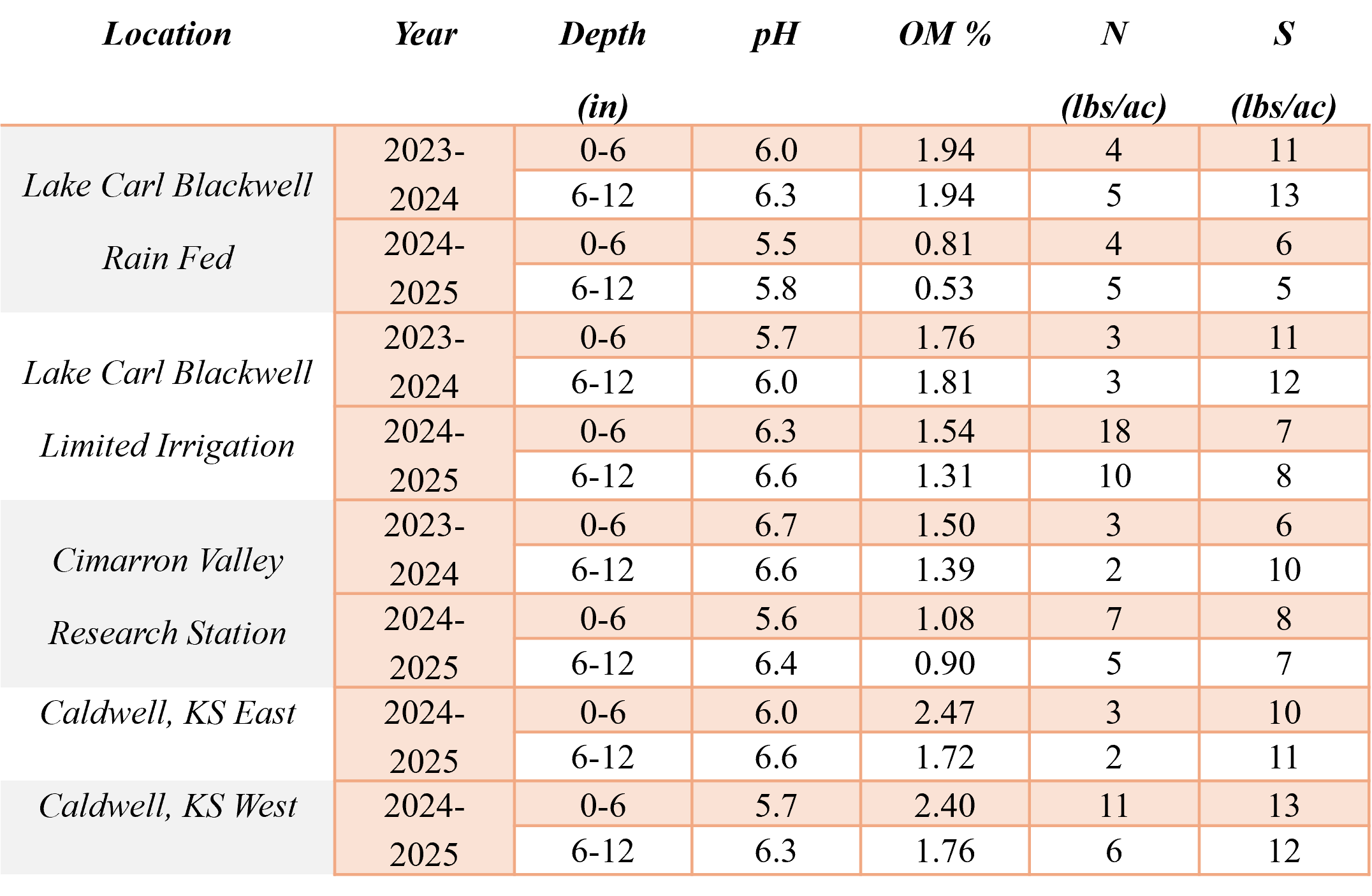
Soil testing was an important part of interpreting the results. Across the locations, sulfate-S was present in the soil profile before fertilizer application. Soil test S varied among sites and depths, reinforcing that the amount of S already available to the crop can differ considerably among fields.
Table 1. Average composite soil sample results of pH, organic matter (OM), nitrate, and SO4 for all locations of the S interaction study.
First, What Happened to Yield?
Nitrogen remained the dominant factor controlling grain yield. Across environments, average wheat yield increased from 46 bu/ac with the lower N rate to 56 bu/ac with the higher N rate. Sulfur, however, did not significantly increase grain yield. Soil tests indicated that the sites generally contained measurable sulfate-S, which correctly predicted the lack of a yield response. If grain yield had been our only measurement, the story could have ended there. But the addition of S affected several characteristics related to how the grain performed during milling and dough development, particularly under the high-N treatment.
Why Wheat Quality Matters
Most Oklahoma wheat producers market wheat based primarily on grain yield and protein concentration. Once wheat moves farther through the grain chain, however, millers and commercial bakeries evaluate additional characteristics that determine how the flour performs. Hard red winter wheat is valued for its ability to produce strong bread flour. That ability depends not only on the amount of protein in the grain but also on the structure and functionality of those proteins. Nitrogen applications generally increases grain protein concentration, while S can influence the composition of those proteins. Adequate S promotes the formation of S-containing proteins involved in strong gluten networks. As a result, two wheat samples with similar protein concentrations can potentially behave differently during milling and baking.
Looking Beyond Grain Protein
Several measurements were used to evaluate wheat and flour quality. Grain protein represents the total protein concentration of the kernel and remains an important factor in wheat marketing. Flour protein measures the protein concentration after the bran and other components have been removed during milling. Other measurements tell us more about milling and baking performance. Milling yield describes how much usable flour can be produced from the grain, while flour ash is an indicator of the amount of mineral material remaining in the flour and can help evaluate milling efficiency. Falling number provides information about alpha-amylase activity and potential preharvest sprouting. Gluten index is particularly useful for evaluating gluten strength. A higher gluten index generally indicates stronger gluten that can better maintain dough structure during mixing and fermentation.
What Happened When We Made Dough?
One of the unique aspects of this study was evaluating flour with DoughLAB analysis. Rather than measuring only grain or flour composition, DoughLAB measures how flour behaves during mixing. Development time measures how long the dough must be mixed to reach optimum consistency. Dough stability measures how long the dough maintains that consistency before beginning to break down. Mixing tolerance index, or MTI, measures how rapidly the dough weakens after optimum development. Water absorption measures the amount of water required to produce dough at a standard consistency.
Of these measurements, dough stability provided one of the more interesting S responses. Under the high-N treatment, average dough stability increased from approximately 6 minutes without S to nearly 15 minutes at the highest S rate. Greater dough stability indicates that the gluten network was able to withstand mixing for a longer period before breaking down. For commercial baking, this can be important because stronger, more stable dough generally provides greater tolerance during mixing and more consistent performance during processing.
What Did We Learn?
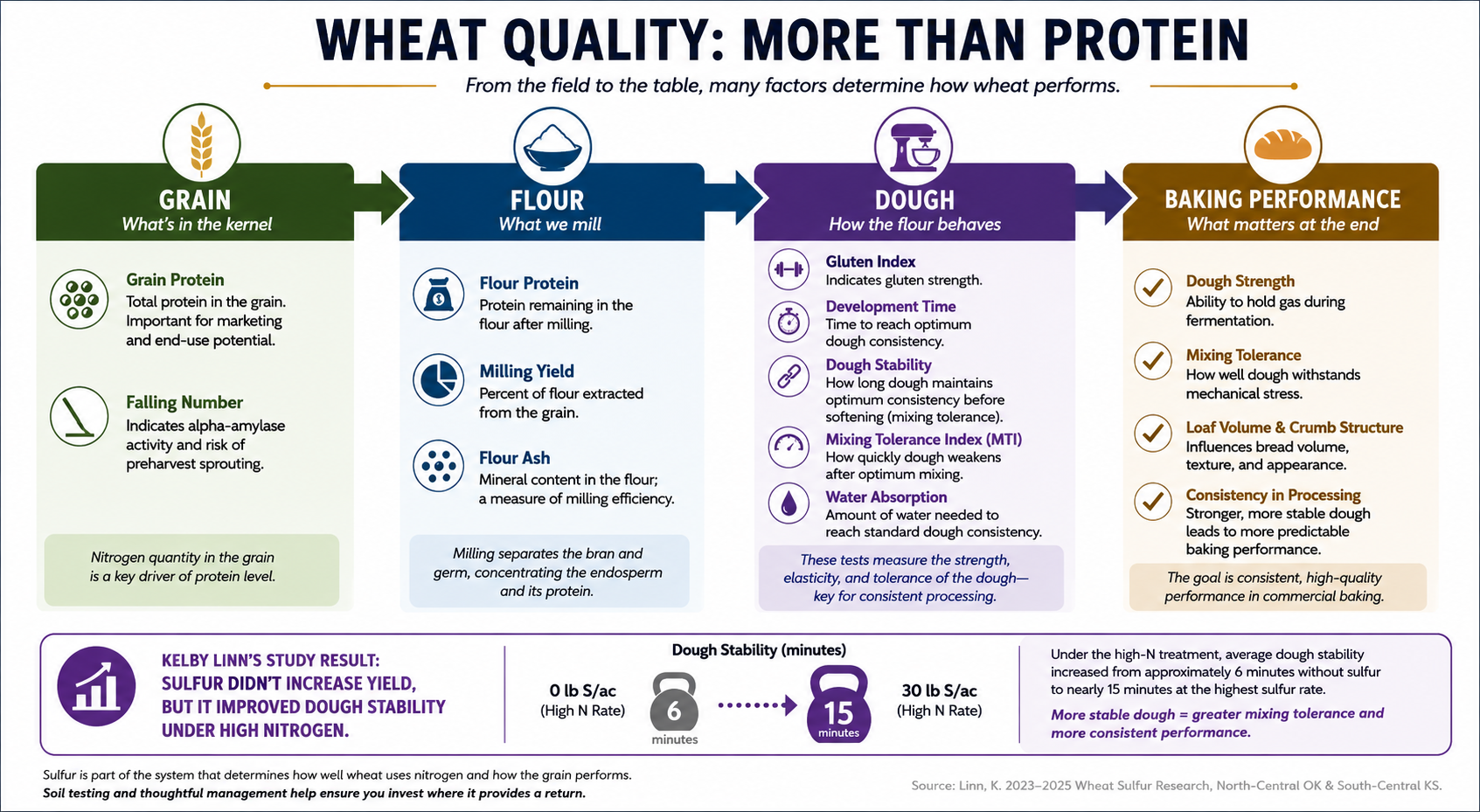
Across these environments, N remained the primary factor controlling grain yield. Increasing N increased average yield, while adding S did not provide a significant yield response. However, the absence of a yield response did not mean S had no effect on the wheat. Under high-N conditions, S improved several measurements associated with grain and dough functionality, including gluten strength, dough development, and dough stability.
These results help separate two questions that are sometimes treated as the same question: Does the crop need S to produce more grain, and does S influence what happens inside the grain?
At the locations included in this study, the answer to the first question was no. The soils supplied enough S that additional fertilizer did not increase yield. The second question was more complicated. Sulfur influenced characteristics associated with protein functionality and end-use quality, particularly when N supply was high. That does not mean S should be applied routinely to improve wheat quality. For producers, the first fertilizer decision should still be based on whether the crop is likely to become S deficient. Soil testing, soil texture, organic matter, yield potential, and production history all provide information that can help make that decision. The larger lesson from this work is that S has a role in wheat beyond simply producing more bushels. Understanding that role helps us make better fertilizer decisions while continuing to put fertilizer where it is most likely to provide a return.
Data drawn from The Influence of Sulfur Under Nitrogen Extremes in Winter Wheat.
Linn, Kelby DeeAnn. Oklahoma State University ProQuest Dissertations & Theses, 2026. 32668685.

