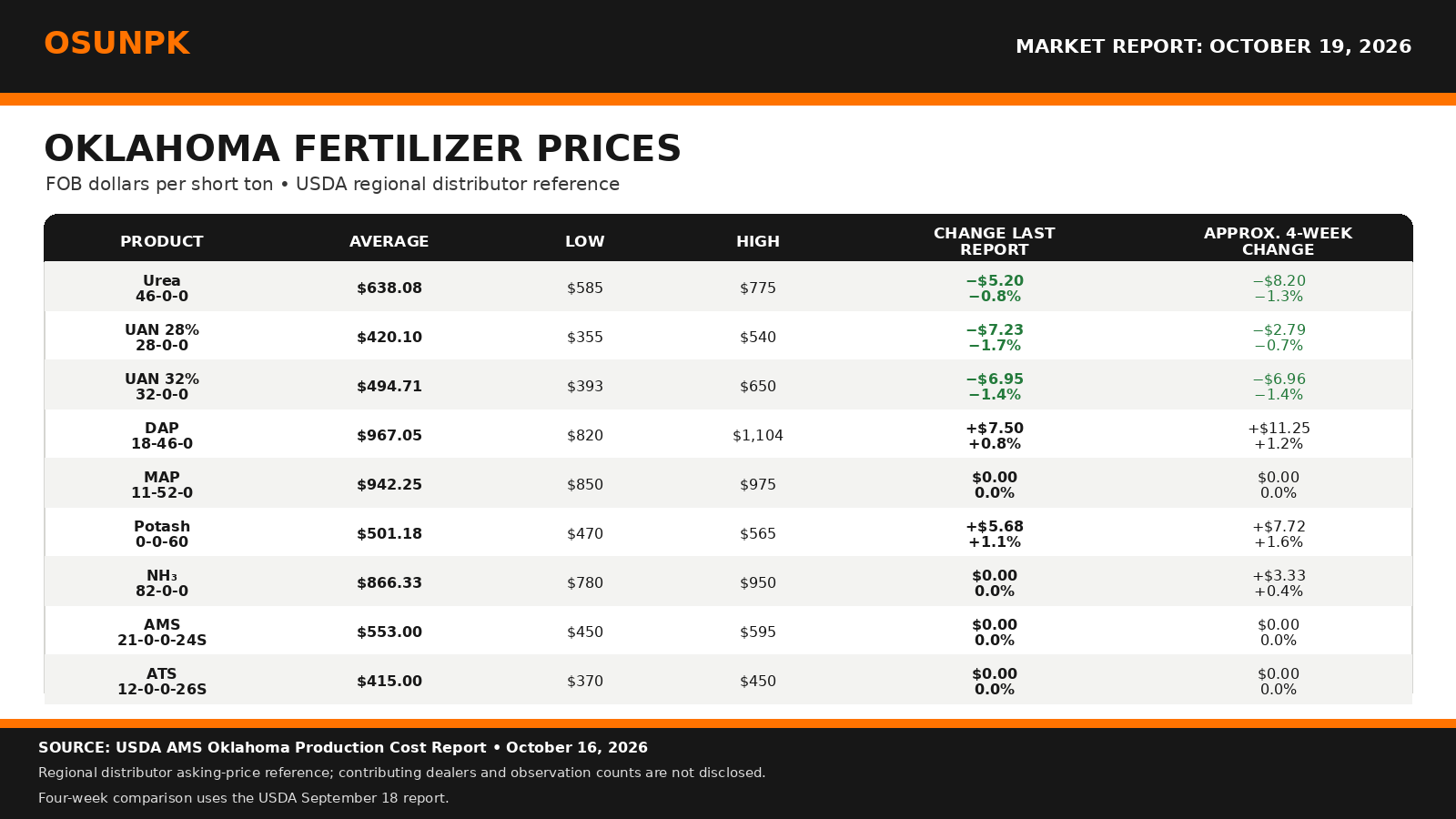
Oklahoma’s latest fertilizer report shows nitrogen moving lower while phosphorus remains firm. UAN 28% declined $7.23 per ton and UAN 32% declined $6.95 in USDA’s October 16 release. Urea also eased, while DAP increased $7.50. These are modest changes, but the different directions matter when comparing products and planning fall purchases.
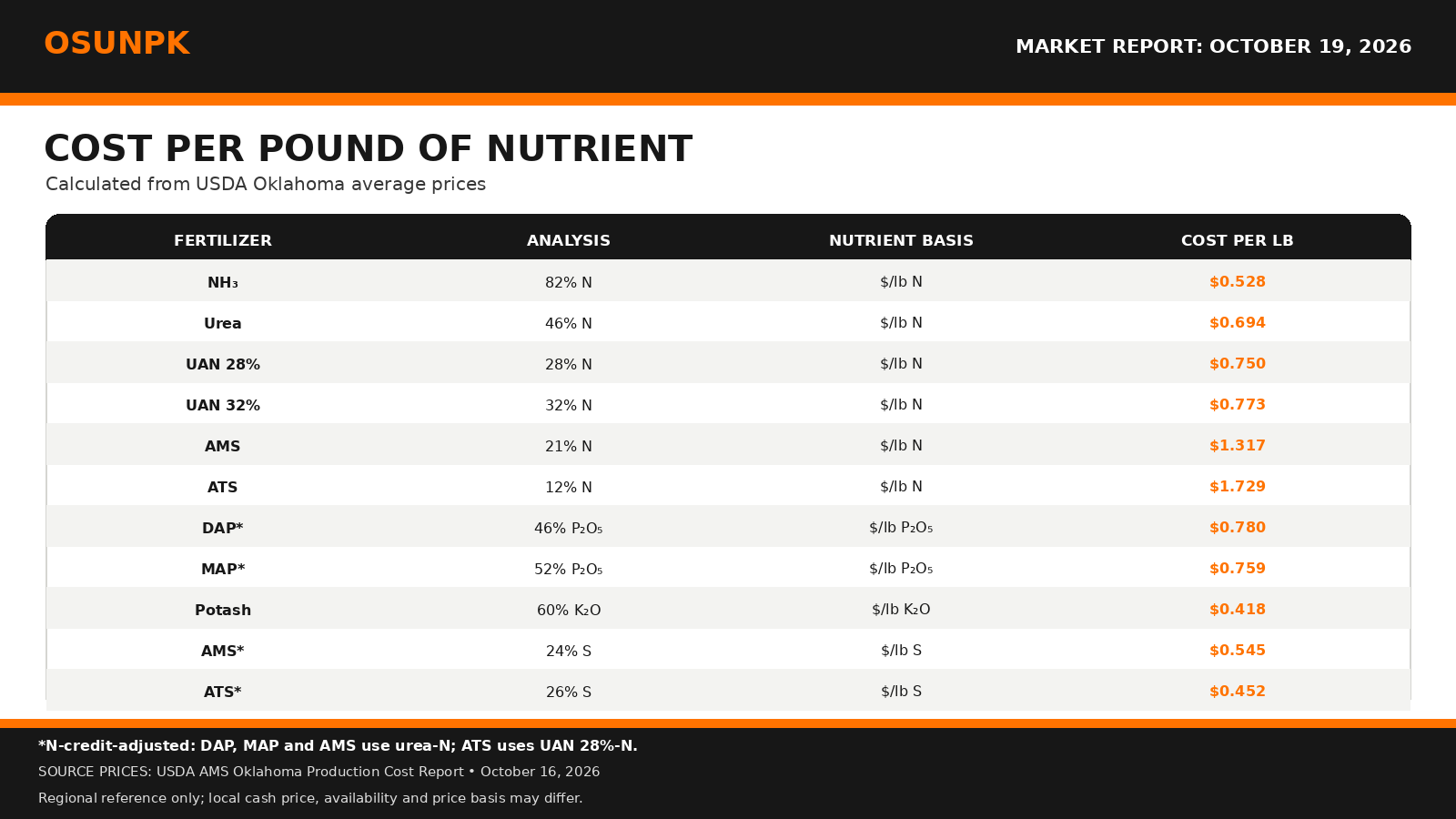
Price-source note: The graphic’s Oklahoma average, minimum, and maximum come from the USDA AMS Oklahoma Production Cost Report. USDA does not identify contributing dealers. Named public dealer cash quotes, including Two Rivers, and confidential local survey observations are tracked separately and are not blended into USDA statistics.
International nitrogen news provides some context for the softer local values. Financial Express reported October 18 that India’s September landed urea cost was about $392 per metric tonne, compared with $947 at the May peak, citing improved supply and diversified sourcing. Those figures describe Indian imports, not an Oklahoma retail offer. They nevertheless show that global nitrogen supply can improve while individual local products remain expensive. Inland freight, inventory purchased earlier, product form, and the timing of replacement loads can all delay the local response.
Phosphate faces a different set of pressures. In October 8 commentary, StoneX described disruption to ammonia and sulfur supplies as a constraint on phosphate manufacturing costs. Both materials are important production inputs, so weaker demand for finished DAP or MAP does not automatically remove the cost of making the next ton. That is consistent with the local split: nitrogen solutions declined, but Oklahoma DAP increased and MAP held steady. This is an interpretation of the combined evidence, rather than proof of what drove each reporting dealer’s price.
In an October 15 IL Corn interview, fertilizer analyst Josh Linville emphasized that international supply conditions remain central to U.S. pricing. He also cautioned that removing a trade barrier does not necessarily redirect imports when suppliers can earn more elsewhere. For Oklahoma buyers, the useful point is to distinguish a policy announcement from an actual change in available product, freight, or replacement cost. The interview is market commentary, not a forecast for a particular dealer.
AMS and ATS were unchanged in the Oklahoma reference. Their connection to sulfur markets still warrants attention, but there is no verified local price move in this release to attribute to sulfur. Likewise, the modest potash increase should be evaluated through current local quotes rather than treated as evidence that all nutrients are moving together.
Over the next two weeks, watch nitrogen import availability, the pace of fall ammonia movement, phosphate input costs, and whether current shipping constraints ease. Weather can change application demand quickly, and a short purchasing window can make availability as important as a posted price. Softer international nitrogen prices are a pressure toward lower replacement costs; manufacturing and transportation constraints can work in the opposite direction. Neither establishes a dependable local price prediction.
For Oklahoma producers and dealers, compare cash material quotes on the same pickup or FOB basis, use soil-test needs to guide nutrient purchases, and confirm availability before committing to an application plan. Fertilizer markets, local prices, and availability can change quickly and should be confirmed with local dealers.
Market Sources
- USDA Agricultural Marketing Service. Oklahoma Production Cost Report, October 16, 2026; retrieved October 19. https://www.ams.usda.gov/mnreports/ams_3621.pdf
- USDA Agricultural Marketing Service. Oklahoma Production Cost Report, September 18 and October 2, 2026. Preserved OSUNPK report observations used for changes; current-report endpoint: https://mymarketnews.ams.usda.gov/viewReport/3621
- Financial Express. “Import prices of urea down 60% since May peak,” October 18, 2026. https://www.financialexpress.com/policy/economy/import-prices-of-urea-down-60-since-may-peak/4364286/
- StoneX. “Phosphate Market Faces a Cost Floor That Demand Destruction Alone Cannot Break,” October 8, 2026. https://www.stonex.com/en/insights/phosphate-market-faces-a-cost-floor-that-demand-destruction-alone-cannot-break/
- Desmond, Tara. “What’s Really Driving Your Fertilizer Bill? StoneX’s Josh Linville Explains.” IL Corn, October 15, 2026. https://www.ilcorn.org/whats-really-driving-your-fertilizer-bill-stonexs-josh-linville-explains
- Two Rivers Cooperative. Fertilizer Index. Retrieval attempted October 19, 2026; table unavailable. https://www.tworiversks.coop/pages/custom.php?id=19995
This report is produced via Chat GPT Plus Work, with review by Brian Arnall.

