Understanding In-Season Nutrient Movement and Yield Impacts of Soybeans in the Southern Great Plains
Josh Lofton Cropping Systems Specialist.
Potassium can be a challenging nutrient to manage within a cropping system. Different rotations can highlight unique challenges that are exposed by environmental conditions such as drought or flooding. Throughout the year, the timing for adequate potassium can be very demanding.
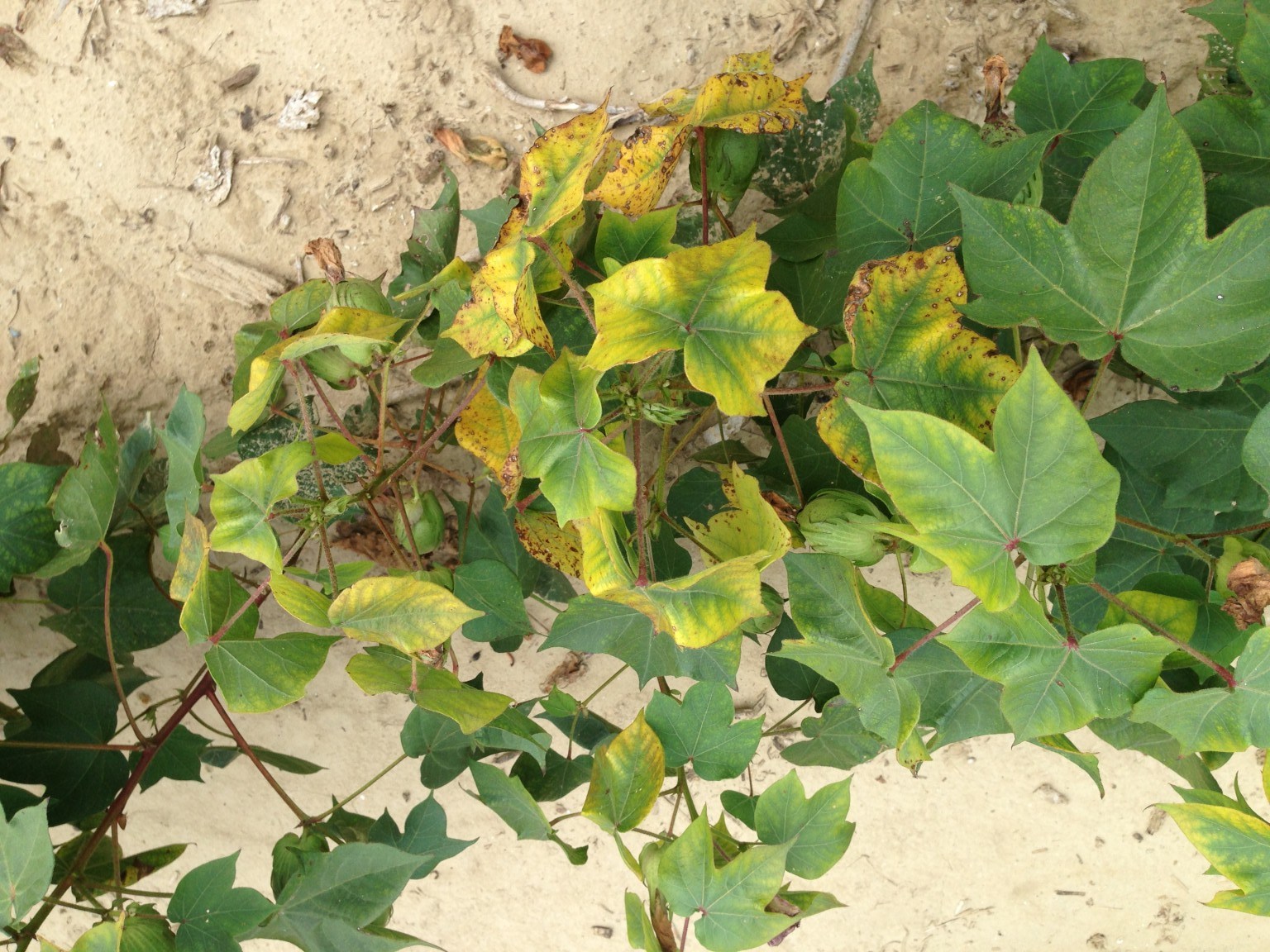
In recent years, there have been several instances of growers finding mid- to late-season potassium deficiencies that arise. These deficiencies still showed in soils that were not expected to have these issues based on soil tests. These mid-season potassium issues are typically in cotton and soybeans. However, in recent years, there have been growing number of fields of other crops as well as pastures seeing potassium issues. These issues have not typically or historically been present in these fields and pastures. This often leads to the question of, “Can foliar applications of potassium remedy issues this in-season?”
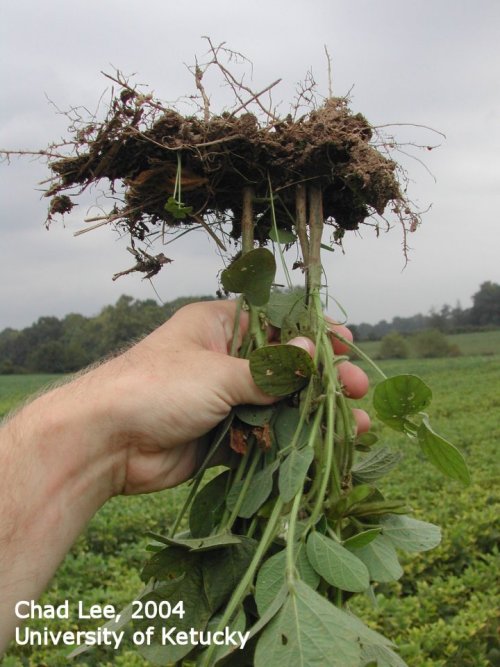
Foliar application of fertilizers is not a new concept. In fact, foliar fertilizers have been used for in-season micronutrient adjustments with some success. However, the physiological mechanisms between a macronutrient and micronutrients are quite different. I know reading this, many of you have been told by Brian Arnall himself that the difference between macronutrients (like potassium) and micronutrients (like copper and zinc, among others) is not importance, but the concentration that is needed within the plant.
This is where the issue with foliar application starts to arise. An important example is when speaking of macronutrients, we normally discuss concentration in terms of percent of total plant (grams of potassium per gram of plant material), whereas we discuss a micronutrient like zinc in ppm or parts per million (milligrams of zinc per kg of plant material). So, the scale of demand can differ widely between individual plants, and correcting a potassium deficiency may require applying several thousand-fold higher concentrations than a micronutrient.
Because of this, we wanted to track the concentration spike level of a foliar fertilization over a set time period following application to see how long the increased concentration was noted and if we could see it throughout the plant.
How the Study Was Conducted
A soybean trial was established in 2018 on a producer’s farm near Miami, Oklahoma, as well as the Mingo Valley Research Station near Bixby, Oklahoma. Data from these sites did not differ, so we combined the information into a single dataset. The study looked at a standard soil-applied fertilizer baseline (the control) compared against four different foliar potassium products applied at the R3 reproductive stage (beginning pod development):
- Soil applied only (Control)
- Soil applied + Potassium Thiosulfate
- Soil applied + Potassium Sulfate
- Soil applied + Potassium Hydroxide
- Soil applied + Potassium Thiosulfate and Potassium Acetate
For these, fertilizer was applied as a soil application of muriate of potash (0-0-60) at planting, based on soil test results. The control treatments recieved no additional applications of potassium beyond the initial soil applied. For the treatments, the different sources were then applied in addition to the fertilizer applied at planting.
To track exactly where the potassium moved after spraying, tissue samples were collected at 12, 24, 36, 48, 72, 120, and 192 hours after application. These samples were separated into leaves, petioles (leaf stems), and reproductive structures (flowers/pods/seeds). The samples were acid washed to remove any fertilizer residue on the surface of the leaves and analyzed for potassium content. Yield measurements were collected at the end of the season.
Did anything impact yields?
Of course, the first thing that needs to be addressed is yield. Results showed that there was not yield increase was seen across any treatment. This was not unexpected as most single applications of foliar fertilizers apply so few nutrients (not to mention the amount that is actually absorbed) that they often have little impact on total yield. These are often recommended to be applied multiple times over a period to provide enough nutrients to affect total concentration. It should be noted that total potassium concentration in the seeds, nor the protein or oil content was not impacted.
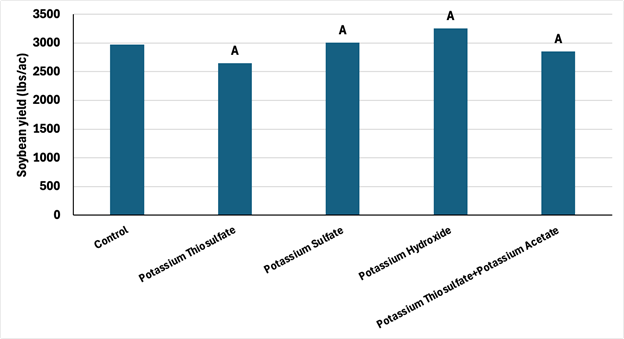
Figure 1. Impact of a single application of foliar fertilizer on soybean yields. Significances are shown by the lettering; different letters indicate significant differences between the individual treatments and the check. No comparison was made between the individual foliar treatments.
Impact of potassium concentration in the plant
All foliar fertilizers increased both leaf and petiole concentrations compared to treatments where fertilizer was only applied at planting. However, source does matter. Potassium thiosulfate alone or in with potassium acetate showed only a minor increase, reaching a 12% increase in leaf K at 36 hours and a 10% increase at 48 hours after application, respectively. From these levels, concentrations returned to levels near soil applied. The products composed of potassium hydroxide or sulfate, however, had an increase in leaf K of approximately 40% at 24 hours, which was held consistently through the 48-hour mark before returning to concentrations not different from the soil applied alone (at the 192-hour mark). This also translated to a similar increase in petiole concentration of 30% at 48-hours and held constant through the 72-hour mark before returning to concentrations not different than the soil applied alone.
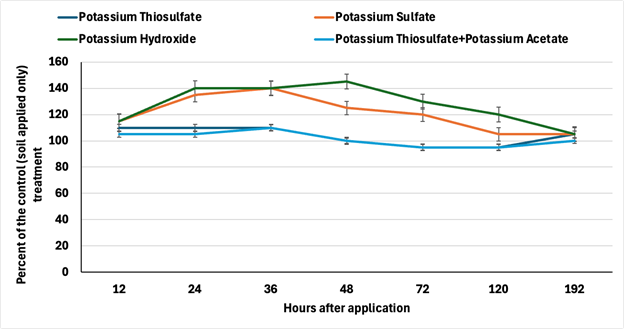
Figure 2. The impact of a single application of potassium foliar fertilizers on soybean leaf potassium concentration. The Y-axis indicates values compared to the control (soil applied only), where values under 100 indicate lower concentration and above 100 indicate an increased concentration.
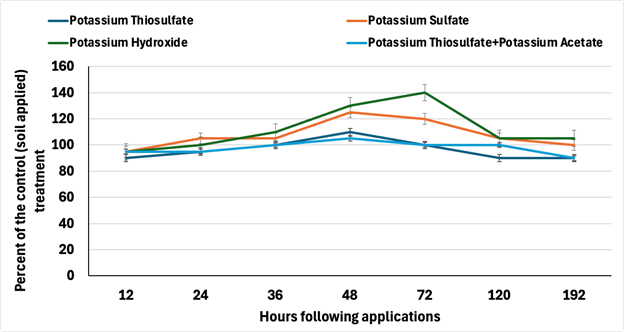
Figure 3. The impact of a single application of potassium foliar fertilizers on soybean petiole potassium concentration. The Y-axis indicates values compared to the control (soil applied only), where values under 100 indicate lower concentration and values above 100 indicate an increased concentration.
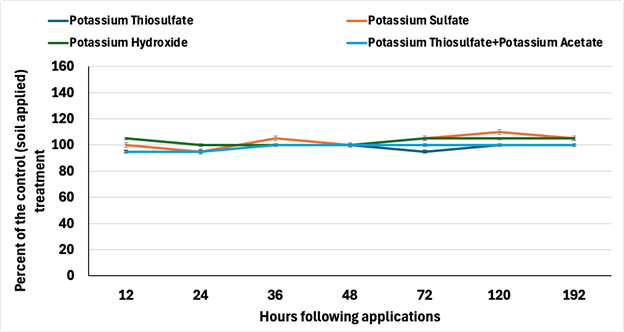
Figure 4. The impact of a single application of potassium foliar fertilizers on reproductive structures (flowers, pods, and seeds) and potassium concentration of the soybean plants. The Y-axis indicates values compared to the control (soil applied only) where values under 100 indicate lower concentration and above 100 indicate an increased concentration.
Several things impact this, but highlight that formulation, potassium source, and other components in the foliar applications matter. When looking at the concentration of the products, one is much different than the others. The potassium sulfate product has 30% potassium compared to the other that contain <20%. High concentration naturally results in a greater chance to have higher concentration inside the plant tissue (even if the percent of applied product is lower than other products). The other product that resulted in higher concentration within the plant was potassium hydroxide. This is a very soluble and small molecule that is easily taken up by the plant naturally.
Practical Takeaways for Producers and Consultants
- Temporary Fix, But Not Long-Term: Can these foliar applications make a difference in plant concentration? Yes, as shown by our data. However, this increased concentration was short-term and occurred almost entirely in the soybean leaf. Once the K moves into the petiole, the impact either decreased or was not present.
- Soil fertility basics are always better than recovery treatments: Foliar fertilizers are often considered a reactionary measure when deficiencies are found in the field. This isn’t always true, and these can be built into a fertility program; however, in many Oklahoma systems, environmental conditions are often the limiting factor compared to small concentration differences. Even if these would be yield limiting, they will often be covered/overshadowed by other factors. This leads me to the final take-home message…..
- Cost-Benefit Caution: A couple of factors came into this analysis. First and foremost, the raw data. Our data has shown no significant differences between the applied and non-applied treatments. This by itself makes seeing a consistent difference year in and year out, as well as in different systems, very unlikely. Second, as mentioned previously, several applications are often needed to make a significant difference on prolonged plant concentration.
While putting the final touches of this article, I was asked about the potential of these foliar fertilizers to improve bloom or pod retention even in the absence of major contributions to tissue concentration or yield. This one is a little tricky because there is some truth to the concept but can easily be taken out of context.
One potential deficiency of potassium deficiencies is early flower, pod, or even seed abortion. This can be due to various reasons. These can be due to reasons we normal assume, like drought. However, it can be for other more complex reasons like solute and source-sink dynamics. Since potassium plays such a critical role in loading (or pulling resources) into our reproductive structures, this can easily be seen.
Where things become a little nuanced is how impactful foliar fertilizers can be at overcoming these issues. These foliar applications do not have a hidden method for maintaining these reproductive structures but if a plant senses drought or lack of resources, it will adjust potential yield load to compensate.
An example of this is if the plant sense droughty conditions because you have low potassium and stomata regulation is not functioning as intended, yes a foliar fertilizer may address this need if it can overcome this deficiency. If we have a drought like the last couple of years, can foliar fertilizers be a way to overcome this, no. Stomata regulation is not the limiting factor, it is the lack of soil water.
This is why we cannot simply say yes/no on can this practice overcome an issues seen in-field. Because like most things in agricultural, in theory it is possible but there is nuanced to how it can happen.
Funding and support for this research were provided by the Oklahoma Soybean Board and the Oklahoma Agricultural Experiment Station.

