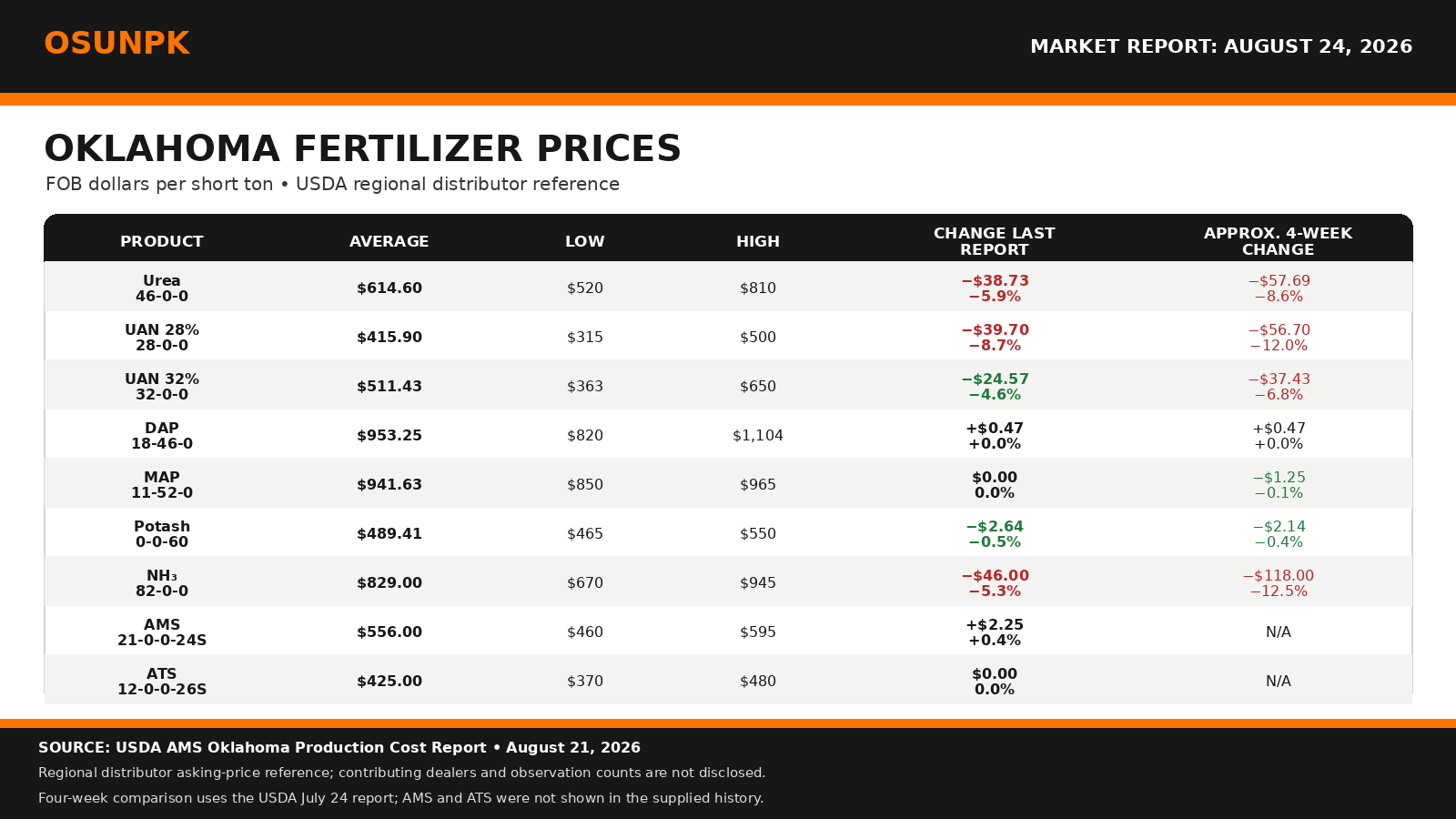
The most important movement of the past two weeks is the decline in Oklahoma nitrogen references. From August 7 to August 21, UAN 28% fell $39.70 per ton, urea fell $38.73, and anhydrous ammonia fell $46.00. USDA attributes the weakness to reduced demand as persistent heat and limited rainfall constrain field activity across the state.
Price-source note: The accompanying graphic’s Oklahoma average, minimum, and maximum come from the USDA Agricultural Marketing Service Oklahoma Production Cost Report. USDA does not identify its contributing dealers. Named public dealer cash quotes, including Two Rivers Cooperative, are monitored separately and are not blended into the USDA statistics.
The local decline does not mean that global nitrogen risk has disappeared. StoneX reported August 19 that India secured about 1.7 million metric tons in its latest urea tender with ample offers, including an expected contribution from China. That supply response eased immediate pressure, but attention now shifts toward Brazil’s September-through-December import window. Brazil needs granular urea, while much of China’s available export supply is prilled, so timing, product form, and destination still matter.
Josh Linville’s August 12 market commentary likewise described a well-supplied Indian tender and a weaker NOLA urea market, while cautioning that UAN and ammonia manufacturers held strong forward sales books. That distinction matters in Oklahoma: a softer urea benchmark can move faster than UAN or ammonia when producers have already covered substantial forward demand. Local weather can amplify the difference by weakening spot demand even while manufacturer positions remain supported.
Phosphate prices were nearly unchanged in the Oklahoma report, but their cost structure remains exposed to ammonia and sulfur. CoBank noted August 13 that Middle East disruptions and Russian supply constraints have affected ammonia production and sulfur availability, while China’s phosphate exports remain sharply restricted. Linville also highlighted sulfur as a bottleneck because a large share of globally traded sulfur normally moves through the Strait of Hormuz. Those pressures can raise the cost of producing DAP and MAP even when local posted values are temporarily steady. They also deserve attention for AMS and ATS, although Oklahoma’s reported averages changed little this period.
Potash remains the quietest major nutrient. Its production base is less directly tied to Middle East natural gas and sulfur, although ocean freight and broader logistics can still affect delivered replacement costs.
Over the next several weeks, watch Oklahoma rainfall and fall field demand, Brazil’s urea buying pace, the mix of Chinese exports, further Indian tenders, phosphate operating rates, sulfur availability, and freight. These forces point in different directions, so the current local nitrogen decline should be read as a market development rather than a definitive forecast.
For Oklahoma producers and dealers, the practical step is to compare current cash quotes on the same pickup or FOB basis and separate material price from delivery and application. Soil-test needs and product fit should remain central; price movement alone does not determine the best nutrient plan.
Fertilizer markets, local prices, and availability can change quickly. Confirm current prices and terms with local dealers before making purchasing decisions.
Market Sources
- USDA Agricultural Marketing Service. “Oklahoma Production Cost Report,” August 21, 2026. https://www.ams.usda.gov/mnreports/ams_3621.pdf
- StoneX. “Brazil’s Urea Import Window Now Decides Where Global Tonnes Land Next,” August 19, 2026. https://www.stonex.com/en/insights/brazil-s-urea-import-window-now-decides-where-global-tonnes-land-next/
- Hoosier Ag Today. “Josh Linville: Fertilizer Markets,” August 12, 2026. https://www.hoosieragtoday.com/2026/08/12/josh-linville-fertilizer-markets/
- CoBank Knowledge Exchange. “Why Higher Fertilizer Prices Are Here to Stay,” August 13, 2026. https://www.cobank.com/knowledge-exchange/why-higher-fertilizer-prices-are-here-to-stay
This report is produced via Chat GPT Plus Work, with review by Brian Arnall.

