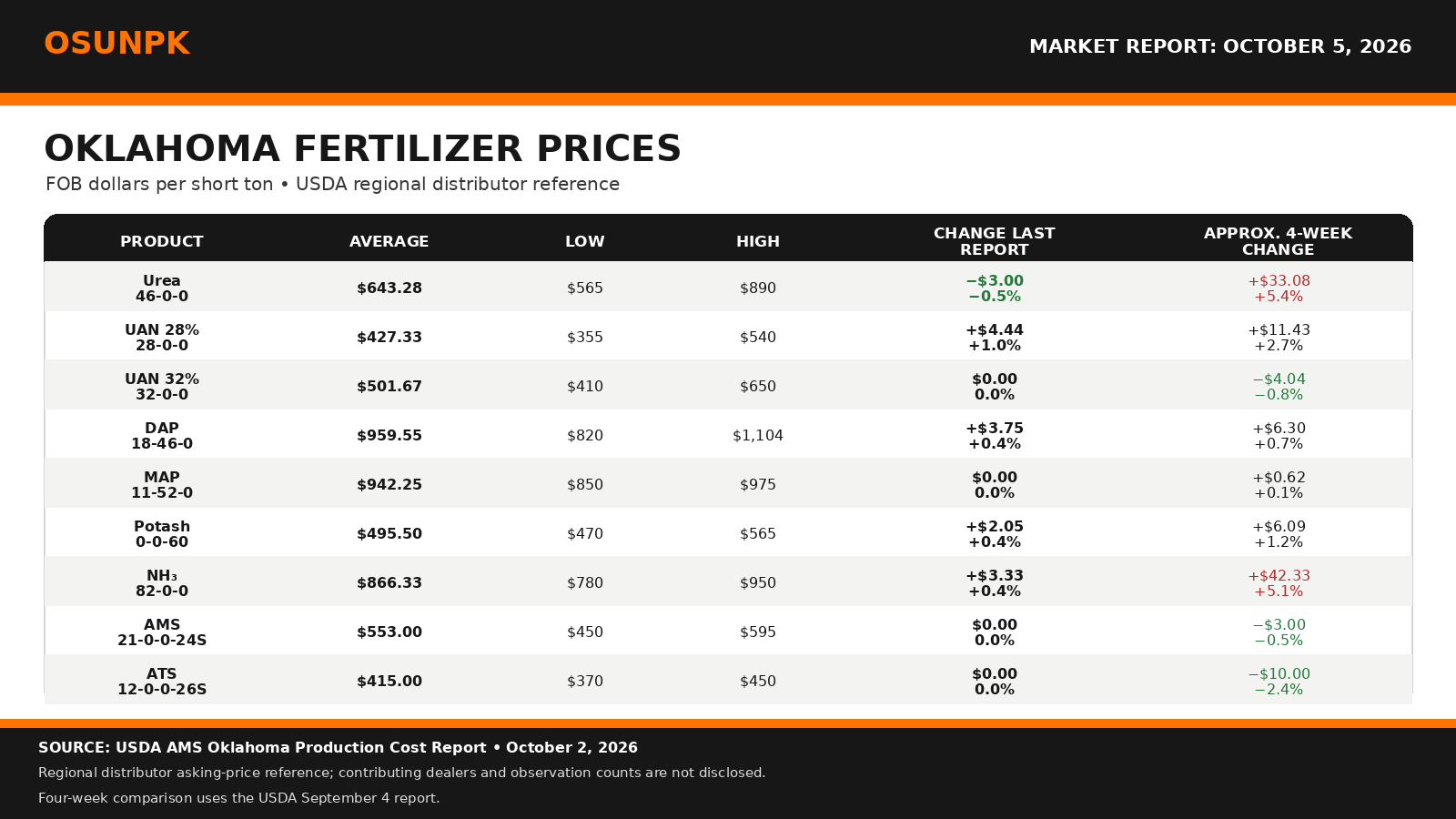
Oklahoma fertilizer prices were mostly a little higher in the October 2 USDA report, but the more important signal is what has happened over four weeks. Urea remains $33.08 per ton higher than September 4 despite easing $3.00 in the latest report, while anhydrous ammonia is up $42.33. The current report looks calm; the replacement-cost environment behind it is not.
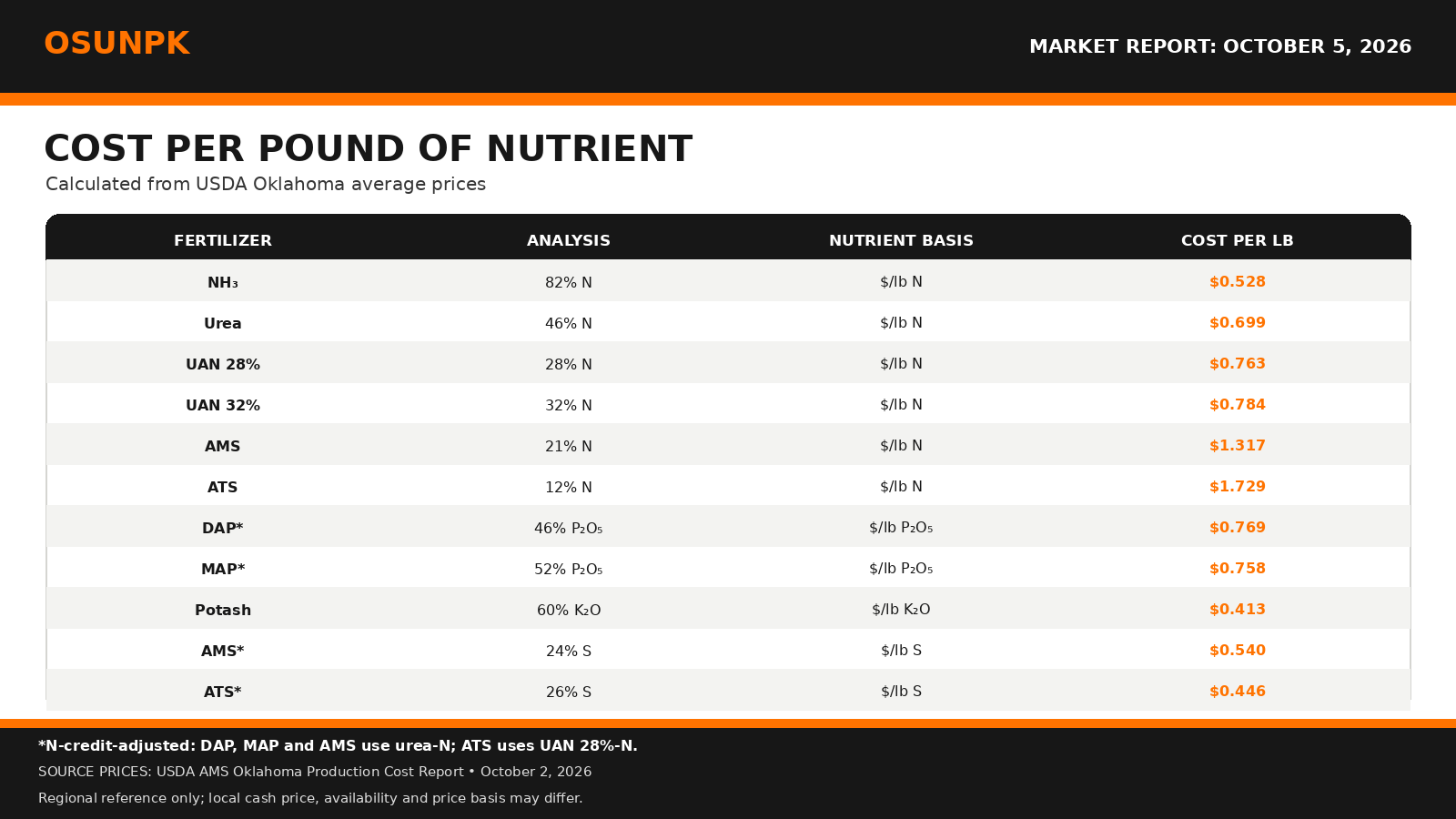
Price-source note: The accompanying graphic’s Oklahoma average, minimum, and maximum come from the USDA Agricultural Marketing Service Oklahoma Production Cost Report. USDA does not identify contributing dealers. Named public dealer cash quotes, including Two Rivers Cooperative, are tracked separately and are not blended into USDA statistics.
Nitrogen markets continue to balance improving trade flows against persistent supply exposure. India has opened another tender for as much as 1.7 million metric tonnes of granular and prilled urea, with bids due October 7. A purchase of that size can redirect export tonnes and affect where other buyers, including Brazil and the United States, find supply. At the same time, international analysis indicates that urea and ammonia have retreated from their conflict-driven peaks, although seasonal demand could renew pressure while Persian Gulf shipping remains constrained.
Josh Linville’s latest public commentary focuses on the structural side of that risk. He argues that the United States remains exposed because imported nitrogen is vulnerable to overseas production problems and logistics disruptions. That does not mean every disruption produces an immediate Oklahoma price increase, but it helps explain why local values can remain firm even when an international benchmark softens. Urea’s mixed movement in the current USDA report is consistent with dealers carrying inventory purchased at different replacement costs.
Phosphate deserves attention even though Oklahoma DAP and MAP changed very little. Sulfur shortages remain a constraint on phosphate production, and uncertainty continues around Chinese DAP and MAP exports. Linville has also noted that temporary duty relief on Moroccan phosphate has not translated quickly into lower U.S. farm prices because the global market remains tight. Higher ammonia and sulfur costs can support DAP and MAP before that pressure becomes obvious in a local price series. AMS and ATS were unchanged this period, but sulfur availability still connects those products to the broader phosphate cost structure.
Potash remains comparatively well supplied. Discussion of possible U.S. purchases from Belarus attracted attention, but Linville told Reuters that additional Belarusian supply would probably have limited effect because the United States is not currently struggling to source potash. Freight and trade policy still matter, but nitrogen and phosphate carry the larger near-term supply risks.
Over the next two weeks, watch India’s tender results, Brazilian urea demand, fall NH₃ movement, sulfur availability, phosphate operating rates, and whether Oklahoma urea contacts begin moving in the same direction. The present mix argues for monitoring rather than a confident price forecast.
For Oklahoma producers and dealers, compare cash quotes on the same pickup or FOB basis and separate material price from application and delivery. The wide local urea range makes dealer-specific confirmation especially important before committing to product.
Fertilizer markets, local prices, and availability can change quickly. Confirm current prices and terms with local dealers before purchasing.
Market Sources
- USDA Agricultural Marketing Service. Oklahoma Production Cost Report, October 2, 2026. https://www.ams.usda.gov/mnreports/ams_3621.pdf
- Indian Potash Limited. Tender Notice IPL/UREA/2026-27/02, September 23, 2026. https://indianpotash.org/tender.html
- Glauber, Joseph, and Shawn Arita. “How are fertilizer markets coping with the continued closure of the Strait of Hormuz?” IFPRI/CGIAR, September 18, 2026. https://www.cgiar.org/news-events/news/how-are-fertilizer-markets-coping-continued-closure-strait-hormuz
- Linville, Josh. “America’s Nitrogen Import Habit Leaves Farms Exposed to Supply Shocks.” StoneX, September 29, 2026. https://www.stonex.com/en/insights/america-s-nitrogen-import-habit-leaves-farms-exposed-to-supply-shocks/
- Reuters. “Trump says US is working on deal to purchase potash from Belarus,” September 21, 2026. https://www.reuters.com/world/americas/trump-says-us-is-working-deal-purchase-potash-belarus-2026-09-21/
- S&P Global Commodity Insights. “China DAP, MAP exports remain uncertain as September begins,” September 2, 2026. https://www.spglobal.com/energy/en/news-research/latest-news/agriculture/090226-china-dap-map-exports-remain-uncertain-as-september-begins
This report is produced via Chat GPT Plus Work, with review by Brian Arnall.

