Home » Posts tagged 'Fertilizer' (Page 4)
Tag Archives: Fertilizer

DAP vs MAP, Source may matter!
Historically the two primary sources of phosphorus have had different homes in Oklahoma. In general terms MAP (11-52-0) sales was focused in Panhandle and south west, while DAP (18-46-0) dominated the central plains. Now I see the availability of MAP is increasing in central Oklahoma. For many this is great, with MAP more P can be applied with less material. which can over all reduce the cost per acre. There is a significant amount of good research that documents that source of phosphorus seldom matters. However this said, there is a fairly large subset of the area that needs to watch what they buy and where they apply it.
If you are operating under optimum soil conditions the research shows time and time again source does not matter especially for a starter. In a recent study just completed by OSU multiple sources (dry, liquid, ortho, poly ect ect) of P were evaluated. Regardless of source there was no significant difference in yield. With the exception of the low pH site. The reason DAP was so predominate in central Ok, soil acidity. See an older blog on Banding P in acidic soils.
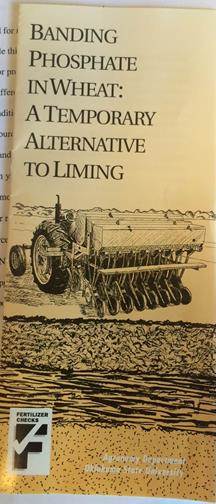
Figure 1. The cover of an extension brochure distributed in Oklahoma during the 1980s.
When DAP is applied, the soil solution pH surrounding the granule will be alkaline with a pH of 7.8-8.2. This is a two fold win on soil acidity aka aluminum (Al) toxicity. The increase in pH around the prill reduces Al content and extends the life of P, and as the pH comes back down the P ties up Al and allows the plant to keep going. However, the initial pH around the MAP granule ranges from an acid pH of 3.5-4.2. There is short term pH change in the opposite direction of DAP, however the the Al right around the prill becomes more available and in theory ties up P even faster.
Below is a table showing the yield, relative to untreated check, of in-furrow DAP and MAP treatments in winter wheat. The N401 location had a ph 6.1 while Perk (green) has a pH of 4.8. At Perkins in the low pH, both forms of P significantly increased yeild, almost 20 bushel on the average. DAP however was 5 bushel per acre better than MAP. At the N40 site the yield difference between the two sources was 1 bushel.
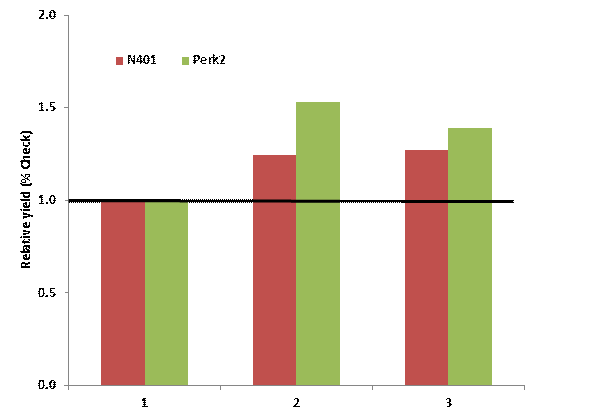
Relative yield winter wheat grain yield MAP and DAP both applied at equal rates of P (32 lbs P2O5 ac) when compared to a untreated check.
In general it can be said that in acid soils DAP will out preform MAP while in calcareous high pH soils MAP can out preform DAP. So regarding the earlier statement about the traditional sales area of MAP or DAP if you look at the soil pH of samples went into the Oklahoma State University Soil, Water, and Forage Analytical lab the distribution makes since.

Average soil pH of samples sent into OSU soil water forage analytical lab by county.
In the end game price point and accessibility drives the system. In soils with adequate soil pH levels, from about 5.7 to around 7.0, get the source which is cheapest per lbs of nutrient delivered and easiest to work with. But if you are banding phosphorus in row with your wheat crop because you have soil acidity, DAP should be your primary source.
Herbicide and UAN tank mixed for top-dress
Spring is the time that many wheat producers apply herbicide and nitrogen (N) fertilizer. For many this can be accomplished in a single pass by tank mixing the herbicide and UAN. In most cases this is an effective practice which eliminates one pass over the field. There are some scenarios in which this practice is ill advised. One such scenario is high temperatures which would lead to excessive leaf burn and crop damage. The other scenario is no-till and that will be the focus of this article. Ruling out warm temperature tank mixing herbicides and nitrogen, assuming the herbicide can be tank mixed, is a good practice. No-till on the other hand can be a different issue.
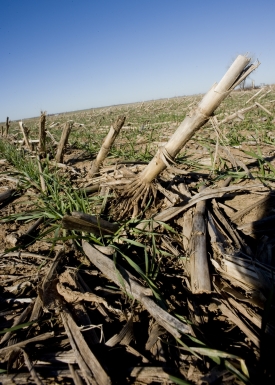
Situations with a lot of residue and smaller wheat is common during top-dress.
The problem in no-till comes from the liquid application method needed to apply herbicides, flat flan. To get a good kill with the herbicide the spray pattern needs to have good coverage, i.e a lot of small droplets to ensure maximum surface area impacted. Unfortunately there are four primary fates of UAN when applied via flat fan nozzles. The UAN could be taken directly up into the wheat plant via absorption through the leaves, the UAN could reach the soil and go into the soil solution or absorbed onto the soil itself, the UAN can be taken up by weeds, or the UAN droplet may hit dead plant tissue and be adsorbed into the residue.
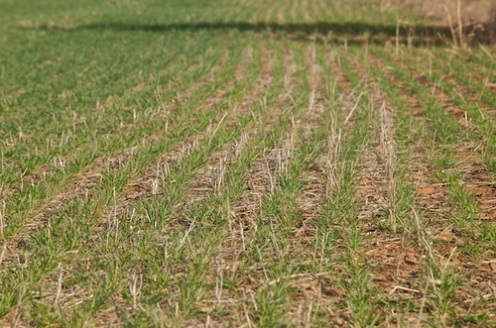
UAN applied with a flat fan will hit a growing plant, the soil, or residue.
The fourth fate of UAN presented is what can make the tank mix less efficient than a two pass system. In a no-till system any UAN that hits residue should be counted as lost, for the short term. The decision to go with a one pass or two pass system can be aided by evaluating the amount of canopy coverage. For example if the no-till field has 50% canopy coverage then one could estimate 50% of the UAN applied via a one pass system would be tied up in the residue. The cost of a second application could then be compared to the lost N. If 15 gallon of 28-0-0 was being applied then approximately 22.5 lbs of N would be tied up by the straw. At a price of $0.40 per lb on N, that is $9.00 worth of N. Conversely if the canopy coverage was 80% only 20% or 9 lbs of N would be tied up in the residue. Saving the $3.60 in nitrogen would not justify a second trip over the field. Luckily OSU recently released the Canopeo app which uses a cell phones camera to take pictures and quickly and accurately determine % canopy coverage. Canopeo is available for iOS and android http://canopeoapp.com/.


In fields with a high amount of residue or limited canopy coverage UAN should be applied with streamer nozzles. This will concentration the fertilizer into streams which will allow the UAN to have enough volume to move off the residue and into the soil.


So as the decision is being made to tank mix herbicide and UAN or make two passes take into consideration: % canopy coverage, rate of UAN (how much could be lost), cost of UAN per pound, and cost of a second trip over the field.
Below is an excerpt from the publication Best Management Practices for Nitrogen Fertilizer in Missouri; Peter C. Scharf and John A. Lory. http://plantsci.missouri.edu/nutrientmanagement/nitrogen/practices.htm
Broadcasting UAN solution (28 percent to 32 percent N) is not recommended when residue levels are high because of the potential for the N in the droplets to become tied up on the residue. Dribbling the solution in a surface band will reduce tie-up on residue, and knife or coulter injection will eliminate it. Limited research suggests that the same conclusions probably apply for grass hay or pasture. Broadcast UAN solution is also susceptible to volatile loss of N to the air in the same way as urea, but only half as much will be lost (half of the N in UAN solution is in the urea form).


Canola fertilizer rates when skip row seeding.
When drilling canola a common strategy to improve seeding rate accuracy is to only use every other row which effectively doubles the rate of seed going through each meter. There are also many producers who utilize air seeders and just prefer the wider spacing. Every season I get several questions about determining total fertilizer rates if the seed is dropped every other row but fertilizer is dropped every row. Regardless of whether or not fertilizer goes down every row it is important that the amount of salts placed with seed does not exceed the limit. The table below provide the limits in terms of lbs of salt per acre. If using 18-46-0 (DAP) or 11-52-0 (MAP) this is equivalent to pounds of N per acre. However if the fertilizer you use contains potassium (K) or sulfur (S), those have to be considered. An easy rule of thumb for determining total salt level of a fertilizer is pounds of N + K + 1/2 S.

Maximum amount of salt that can be applied in furrow with canola seed. Application rate should be at or below this value.
In a scenario in which canola is seeded in skip rows but every row will get fertilizer the total amount of fertilizer can be doubled. For example on a 15″ row spacing the max salt rate is 5 lbs per acre. If you were using DAP as your starter that maximum rate to place in furrow would be 28 lbs of DAP per acre. If using a drill set of 7.5″ spacing and putting fertilizer down every row the max rate would increase up to 56 lbs DAP per acre.

Seed, colored blue, is placed in every other row while an equal amount of fertilizer, dark grey circles, is placed in every row.
Some producers may have the capability of applying different rate in every other row. In this scenario it is important to maintain that safe rate in the seed furrow. In the opposite row, fertilizer rate can go as high as you wish or the equipment can handle.
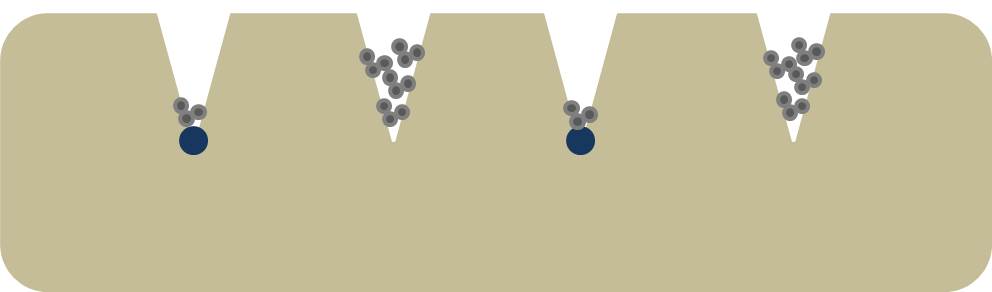
Seed, colored blue, is placed in every other row while fertilizer, dark grey circles, is placed in every row. In this scenario a high rate is placed in the row without seed.
Now the big question is, “Is between row fertilization a good idea?” While we do not have results on this style of application (trials will be going out this year) we can draw upon upon similar work in other crops. For me the best win would be the second scenario in which a higher rate could be place between the rows. In this row I would use a urea and DAP blend. Any time we can put urea below the soil surface its a win and in fields with very soil soil test phosphorus (P) it would create something similar to the deep P bands once popular in corn production. Now if the field had adequate soil test P, I would focus on urea between rows. Keep in mind it is never a good to place urea in furrow with canola seed. For the average producer who is using a box drill the first scenario is the only option. In this case the rate of the between row bands will be reduced however I still believe on fields with very low soil test P this is potentially a great way to get the rest of it on. Remember if on 15″ and using DAP max rate only gets 12.9 lbs of P2O5 down. If fertilizer is dropped down every tube that number increases to about 26 lbs P2O5, which is still not enough for fields with low soil test P, but is better. With hope we will have some good results to share from the 2015-2016 canola crop.
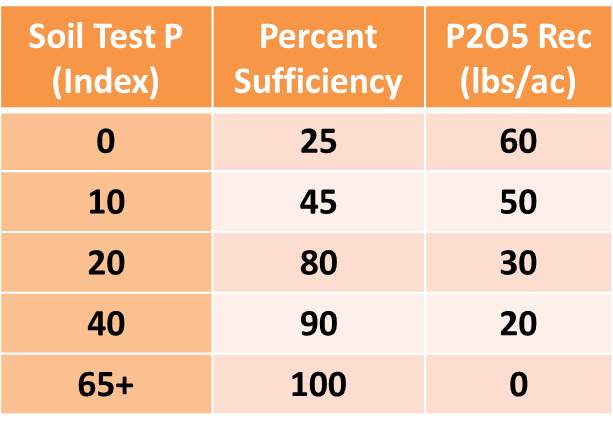
Phosphorus fertilizer recommendations based upon Mehlich 3 P test, reported as STP index (ppm * 2)
Canola Planting Considerations.
Pre- and Early-Season Weed Management-
Dr. Angela Post- Small Grains Extension Weed Scientist
Winter canola is an excellent rotational partner with wheat. Integrating canola into a wheat system allows for the cleanup of weedy fields with primarily grassy weed problems. Conventional and Roundup Ready (RR) varieties are excellent choices for managing most grassy weeds including ALS-resistant populations, because grass-only herbicide options can be used in canola without crop injury. For specific grasses that are very difficult to control, like cereal rye and jointed goatgrass, it is advisable to use canola in year one of your rotation and Clearfield wheat in the second year of your rotation before going back to conventional wheat varieties. Due to sensitivity of canola, Clearfield wheat varieties should not be used the year prior to rotating into canola.
Canola planting time is just around the corner and many are going out now with preplant burndown applications. Remember that canola is sensitive to dicamba, 2,4-D, and MCPA and these products should not be used inside of 30 days before planting. Glyphosate, glufosinate and paraquat are all potential options for removing broadleaf weeds in no-till systems prior to planting. These products have no planting restriction for canola. Tillage is the best option to remove weeds in conventionally tilled systems.
It is important to consider your previous herbicide choices when planning for canola in the fall. Many herbicides used for spring weed control in wheat can limit rotation to winter canola. These include all Group 2 herbicides all of which have long rotation restrictions to canola, meaning you cannot plant canola in these fields for 18-24 months depending on the product. See Table 1 for a list of specific restrictions. If you have used one of these products in wheat in the spring, you must plant a canola variety with the SURT trait. Examples of varieties with this trait include: DKW 45-25, DKW 46-15, DKW 47-15, HyClass 115W, HyClass 125W. All of these varieties are also RR. Kansas State also has an open-pollinated non-RR variety called Sumner with the SURT trait for growers that prefer to grow conventional canola. Note that the SURT trait is not a genetically modified trait.
No additional in-season herbicide options have been added to the toolbox for winter canola growers in the upcoming season. Both trifluralin (Treflan) and ethalfluralin (Sonolan) can still be used as preemergent weed control options in canola in conventionally tilled systems. Both need to be mechanically worked into the ground and need an activating rainfall to work properly. Quizalofop (Assure II), sethoxydim (Poast), and clethodim (Select and many generics) are the grass control herbicides available for use in canola and can be used on any canola variety including RR varieties. Roundup Ready canola growers are allowed two applications of glyphosate at 22 oz/A each over the top of the emerged crop. Clopyralid (Stinger) is the only over-the-top broadleaf control option other than glyphosate. These weed control applications should be made early in the season between 2- and 6-leaf canola, and prior to bud formation, while weeds are still very small. Applications should be spaced at least 14 days apart. Early applications will eliminate fall weed competition with canola and protect yield. For more information or questions involving weed management in canola contact Extension Weed Specialist Angela Post at 405-744-9588 and follow @OSUWeedScience.
Table 1. Rotation restrictions for planting canola following wheat. For herbicides
applied in crops other than wheat please refer to the herbicide label.

1Minimum interval between herbicide application and seeding canola. Refer to full herbicide labels for specific information as geography, pH, and rainfall may affect this interval.
2Rotation restriction can be overcome with use of a SURT canola variety.
3Rotation intervals depend on geography.
4Rotation interval depends on herbicide rate.
Pre plant fertilizer concerns with Canola
Dr. Brian Arnall- Precision Nutrient Managment Extension Specialist
When it comes to pre-plant fertility issues with canola, I typically have two soap boxes. But at this point in the canola game we are behind in terms of getting soil samples collected or applying lime and getting a boost at emergence. So assuming pH is good and you know what your soil nutrient level is we can move on to planting. One thing that over the past seven or eight years keeps coming up is the importance of starter fertilizers and the rates and sources used. Getting that little canola plant off to a good start is extremely important however with that little bitty seed a little goes a long way.
The figure below shows the impact of DAP (18-46-0) placed in row, on relative canola stands, when canola was planted in 15” rows. At 5 lbs/A of N or 28 lbs/A of DAP, the canola stand is reduced to 75%. While this seems like a great loss, the compensating nature of canola and the fairly high seeding rates used, this is a manageable level. The benefits of the additional nitrogen and phosphorus applied with the seed also help out-weigh the loss of stand. The addition of the P near the germinating seed is vital. The phosphorus aids in early root and shoot growth, helping the crop to get off to a good start. In areas where soil pH is of concern the P near the young seedling will reduce aluminum toxicity and allow the plant to tolerate the low pH. Keep in mind, while banding P will help in acidic soils, canola is still very sensitive and will not tolerate the same low pH conditions as our winter wheat’s.

Impact of DAP (18-46-0) placed in-row on canola stand in terms of lbs N ac-1.
One very important factor to keep in mind is the impact of the critical rate and row spacing. The 5 lbs of N per acre critical level set for 15” row spacing is increased to 10 lbs on 7.5’s and cut to 2.5 lbs on 30’s. The change in rate is because we use lbs per acre. So if you apply the same amount of material per acre on a 15” spacing and a 30” spacing there is actually twice as much material in the 30” row. Table 1, shows the equivalent amount of N placed in row for popular row spacing’s.

Equivalent amount of N based on 15″ row spacing.
Oklahoma State has released a smart phone app, available for both apple and android devices, to aid in determining maximum in-furrow rates. Canola Starter app provides guidelines based upon the nutrient concentrations of the fertilizers you plan to use. The final note on in-furrow fertilizer with Canola, avoid using urea. The likelihood of injury from the urea converting to ammonia greatly outweighs any potential benefits. For further information, comments, or questions please contact Dr. Brian Arnall Extension Precision Nutrient Specialist 405-744-1722 or following me on Twitter @OSU_NPK.
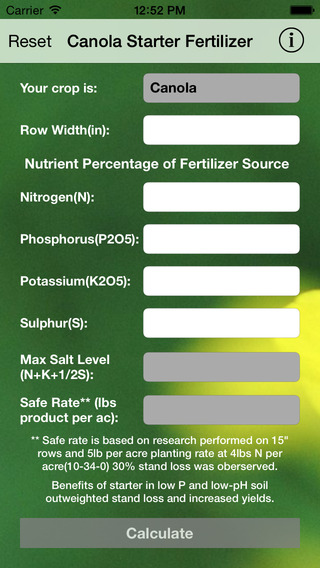
Canola Starter available on iOS and Android. For more information see http://www.dasnr.okstate.edu/apps.
Winter canola planting decisions:
Josh Lofton- Cropping Systems Specialist
Josh Bushong- Extension Associate
Stand establishment is one of the most critical practices in canola planting. This is not only because these stands are highly influential to end of the season yields but because getting the crop up with adequate growth will be critical to give the plants the best over-winter survivability possible. To accomplish this, growers need to make sure they make good field selection and follow good planting practices
Field Selection:
Soil nutrients are a critical aspect. Soil samples should be collected on a regular basis to ensure optimum productivity. Also, ensure recommendations for winter canola are followed, as nutrient recommendations for other crops may be invalid. For more information canola fertilizer management refer to the nutrient management section by Dr. Arnall.
Winter canola grows similar to winter wheat. Fields that can adequately produce wheat have the potential to produce canola. These include, well-drained soils with adequate soil nutrients. However, canola can be more sensitive than wheat. One aspect that canola can be more sensitive to is soil pH. While wheat can be grown in soils as low as 5.5 without significant yield loss, canola must be grown on soils with pHs above 5.8. In fact, canola is best grown in soils with soil pHs ranging from 6.0 to 7.0. Therefore, it is essential that if fields have lower pH, lime be applied with adequate time to neutralize the acidic soil pH before rotating into canola.
In addition to all the soil conditions, crop rotation should be considered prior to planting canola. One of the major hindrances in growing canola in rotation with other crops is herbicide carry-over. For detailed information regarding this aspect, refer to table 1 in the weed management section. To account for this, detailed field records should be kept and consulted before rotating with canola.
Planting Date:
Planting time depends on many aspects. Insured growers should plant within the constrained planting dates. For Oklahoma, the earliest planting date is September 10th with the latest date being October 10th. However, within these guidelines, seedbed and environmental conditions should be the driving factor to determine when to plant. The goal of these planting dates is to have the crop germinate, emerge, and establish 6-8 true leaves prior to the first killing freeze. As a general rule, the crop should be planted 4 to 6 weeks before this freeze. To achieve good establishment of the crop, canola should be planted into firm seedbed with adequate soil moisture. If canola is planted into dry soil (dusted in), the effective planting date will be delayed until adequate conditions for germination and emergence exist. In no-till systems, it is important to remember that canola emergence and growth will be slightly delayed. Therefore, if adequate conditions exist, no-till fields should be planted before similar conventionally tilled fields.

Uneven canola emergence. Canola on left emerged later and did not
have enough time to put on adequate growth (Photo courtesy of Josh
Bushong)
Planting depth, plant spacing, and seeding rate:
Since canola is a small seeded crop, shallow planting is required. For best germination and emergence, seeds should be planted between 0.5 and 1 inch. If adequate moisture is available deeper, planting depth can be increased. However, deeper planting has the potential to decrease germination, percent emergence, and early fall growth, so deeper planting should only be used when the planting condition advantage is present and only on certain soils. Therefore, caution should be used in planting deeper than 1 inch. Furthermore, even though moisture may be present deeper, seeds should not be planted deeper than 1.5 inches.
Oklahoma growers have options when deciding row spacing used for planting canola and depend on what equipment there is available and their production system. Since canola is typically rotated within a winter wheat production system, box drills and air seeders are typically widely available. Row-spacing for these can range from 6 to 15 inches. Row spacing within this range has little impact on final yields. As producers move from drills and air seeders to planters, row spacing typically increases from 15 up to 30 inches. All of the row-widths have the potential to produce adequate canola. Some, however, will be more beneficial than others. Narrow row spacing has the potential to result in early canopy closure, reduce potential weed competition, and may help reduce shatter prior to harvest (especially when direct harvested). Wider spacing, however, allows for some flexibility in specialized planter attachments used, especially row-cleaners, which can be greatly beneficial in no-till systems.
Seeding rates for canola in Oklahoma range from 1 to 5 lbs/A. However, row spacing plays a critical role on seeding rates. When canola is planted on less than 15 inch spacing, some flexibility exists for planting rates. Higher seeding rates can produce more uniform stands, uniform maturity, and thinner stalks that can greatly help harvest efficiency. Too high of stands can increase disease incidence, winterkill, and lodging. When row spacing is increased beyond 15 inches, care should be taken not to over seed. High seed populations can increase fall growth and potentially increase hypocotyl height, which in turn can lead to high winterkill. Optimum populations for this wider row spacing typically range from 2 to 3 lbs/A.
For further information, comments, or questions please contact Josh Lofton Extension Cropping Systems Specialist at 405-744-3389 or follow me on Twitter @OSU_oilseeds.
While producers have faced many challenges over the last couple of seasons in Oklahoma agriculture, the outlook for winter canola looks very promising for the upcoming season. Producers should focus on taking all of the right steps to ensure the 2015-2016 crop starts on the right foot and takes full advantage of the promising conditions this season. Good luck to everyone one on their upcoming production season and if anyone from Oklahoma State extension can help or assist in any way, please feel free to contact.
Results from 1st year of Soybean Starter Work
In the spring of 2014 we initiated what was to be the first year of a three year project evaluating starter fertilizers for soybean production in the southern Great Plains. The first and second year was and is being funded by the Oklahoma Soybean Board.
Year one was a bit experimental in that with so many products on the market we needed some initial work to help focus the direction for years two and three. I also added a treatment which I knew would have significant negative impact, for extension reasons. Keep in mind two locations in a single year does not make an experiment nor provide enough information to draw a definite conclusion. It is however enough to learn some lessons from and for us to plan for our 2015 trials.
The 2014 trial consisted of 12 treatments, Figure 1 and Figure 2. In these treatments I wanted to see the impact of a standard practice, see if a specific nutrient may be more so beneficial, and evaluate a few popular products. The spring of 2014 started out dry so at one of our two locations we pre-watered. This was done by hauling water to the Lake Carl Blackwell (LCB) 1000 gallons at a time and pumping through sprinklers. The other site, Perkins, we delayed planting until we had moisture.

Treatment Structure and rates for the 1st year of the Soybean Starter Study.

List of fertilizers and products used.

Image taken while planting the Soybean Starter study at Perkins. A CO2 system was used to deliver starter fertilizers with seed.
The two locations were also selected due to differences in soil fertility. The LCB site is has good soil fertility, with exception of phosphorus (P), and the Perkins site pH was an issue. I would have expected a benefit from adding P at both of these locations. Figure 4 shows the soil test results.

Soil Test results from LCB and Perkins.
At LCB as expected some of the treatments (Thio-Sul) reduced stand, some unexpectedly reduced stand (Fe) and others had less impact on stand (APP 5.0) than expected. The growth at LCB was tremendous, the 30 in rows covered over very quickly and the majority of the treatments hit me waist high by early August (I am 6’0”). Many of the treatments showed greater growth than check. But when it comes down to it, grain pays and green does not. Statistically there were no treatments that out preformed the un-treated check, however the K-Leaf and 9-18-9 did make 3 and 2 bpa more than the check respectively. What I am hypothesizing at this site is that the added nutrients, especially those with high P levels, significantly increased vegetative grown and these big plants were delayed into going reproductive and they started setting pods later in much hotter weather. While riding in the combine I could see that the plots with compact plants with clearly defined rows out yielded those were the vines had crossed over and we harvested through more of a solid mat of mature plants. A hot August is not uncommon and I am curious on whether this trend repeats itself. If it does this may direct us into research evaluating ways to force/promote the reproductive stage to start in these big plants. Even if we can force flowering to start earlier, it’s unknown whether yields will increase or not.
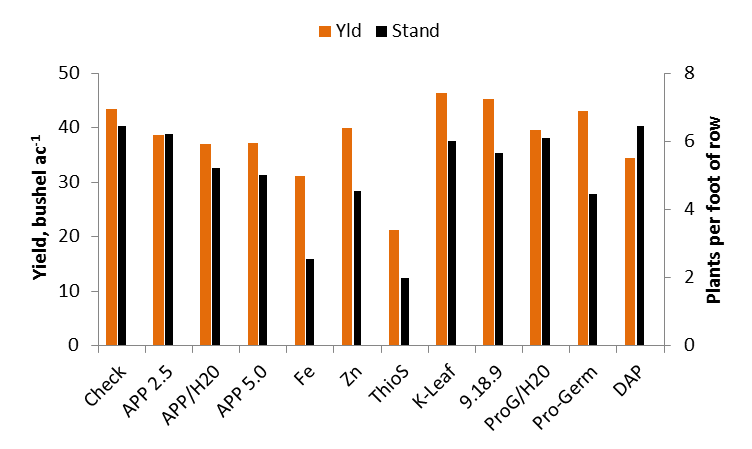
Yield and Stand counts from the 2014 LCB Soybean Starter Study.

The Check plot at LCB were plants noticeably a bit smaller and more yellow than the neighbors with phosphorus.

Soybeans at LCB on August 4th.
The same trends in treatments reducing stand can be seen at Perkins, however the impact was less extreme. Perkins being planted later due to waiting on moisture forced a later flowering date and I believe reduced overall yields. But the addition of P at this low pH site definitely made a difference. While again no treatments were statistically greater than the un-treated check the 2.5 gpa APP, DAP broadcast, APP/H2O, and Pro-Germ/H20 treatments increased yield by 5.6, 4.2, 3.8 and 1.7 bpa respectively.

Yield and Stand Counts from the Perkins 2014 Soybean Starter Study.
Take home from year one was that at LCB the addition of a starter fertilizer had little benefit and if done wrong could cost you yield while at the low pH site of Perkins an addition 2.5 gallons of APP did get a 5 bpa bump, but do to variability in the trial the increase was not statistically significant. This year we will drop some of the treatments and incorporate a few new treatments. Based on the current weather we look to potentially being able to start with better soil moisture at planting. Again do not take this work and significantly adjust any plans you have for your 2015 soybean crop. This is however some interesting findings that I wanted to share and make everyone aware of. Finally thank you to the Oklahoma Soybean Board for providing funding for this work. www.oksoy.org/
Sensing the N-Rich Strip and Using the SBNRC
Original Post:
With the significant swing in temperature over the last few weeks many are chomping at the bit to get outside. The wheat is starting to respond to the good weather and N-Rich Strips are showing up around the state. Over the past week I have had several calls concerning the impact of the cold weather on the N-Rich Strips. Many of the fields either are still small due to limited days of warm weather and growth or may have a good deal of damage to the foliage. If the field of concern has only a little or no damage and the strip is visible, the time to go is NOW, but if you cannot see the strip and your field has tissue damage or is small, similar to the first two images, then you will need to wait a week or two for sensor based recommendations. Another situation fits with the third image, the field has freeze damage but the N-Rich Strip is also visible. In this case the predicted yield level would be reduced do to the dead tissue making the N rate recommendation a little off. I still however recommend using the sensor and online SBNRC (http://www.soiltesting.okstate.edu/SBNRC/SBNRC.php) to make or base top-dress N rate. Even if the recommendation is a little off it will still be much more accurate than just guessing. However you must look at the SBNRC and ensure that it makes agronomic sense, if it does not consult your county educator or myself. This is discussed in more detail in my earlier blog about freeze damage. Keep in mind no matter what, if you can see the N-Rich Strip, everything outside of the strip is suffering from nitrogen deficiency. Decisions and fertilizer applications need to be made soon, to maximize yield.
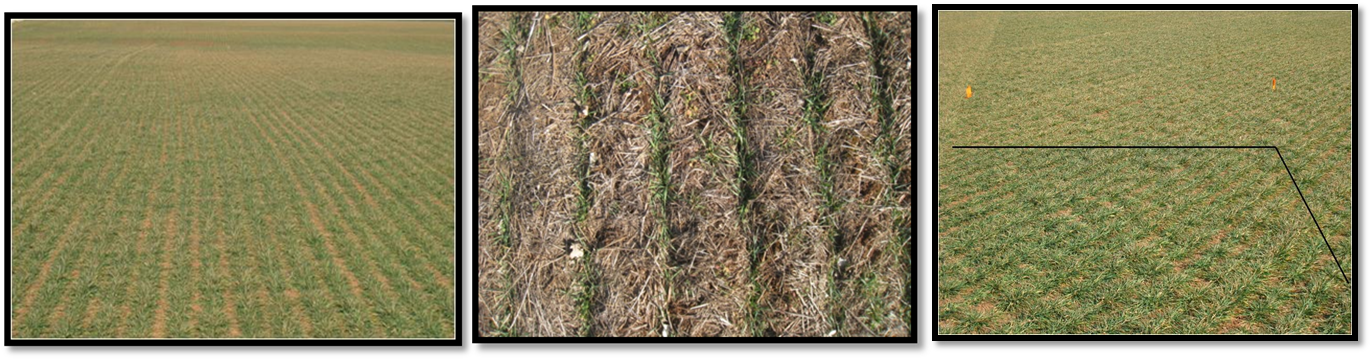
Winter Wheat and Nitrogen Rich Strips.
Regardless of whether or not the strip is visible you should be planning to sense with the GreenSeeker Handheld very soon. Remember the sensor has the ability to detect differences before your eyes can. To sense the N-Rich Strip and Farmer Practice the user should carry the sensor approximately 30 to 40 inches above the crop canopy while holding the sensor level over the crop. While you are walking the two area the trigger should be held the entire time. I recommend walking at minimum 100 paces for each. The average NDVI value seen on the screen will only stay on the screen for a few seconds. Therefore it is critical you have a method of recording the number for later use. The sensor has limited memory so it will time out is the trigger is held for an extended period of time. If you wish to collect more NDVI readings just do it in multiple trigger pulls recording each. Once you have the average NDVI for the N-Rich Strip and Farmer Practice you can go to the SBNRC site mentioned above to retrieve the N rate recommendation. Once in the calculator, for those in Oklahoma, choose the “within Oklahoma” option in the bottom left hand corner of the screen. This will allow the calculator to access the Oklahoma Mesonet to determine growing degree days. After the location is picked from the options you will need to enter Planting Date and Date Prior to Sensing. Additional information requested is the expected grain and fertilizer prices. While these inputs will provide some economic evaluations they will not impact recommended N rate.
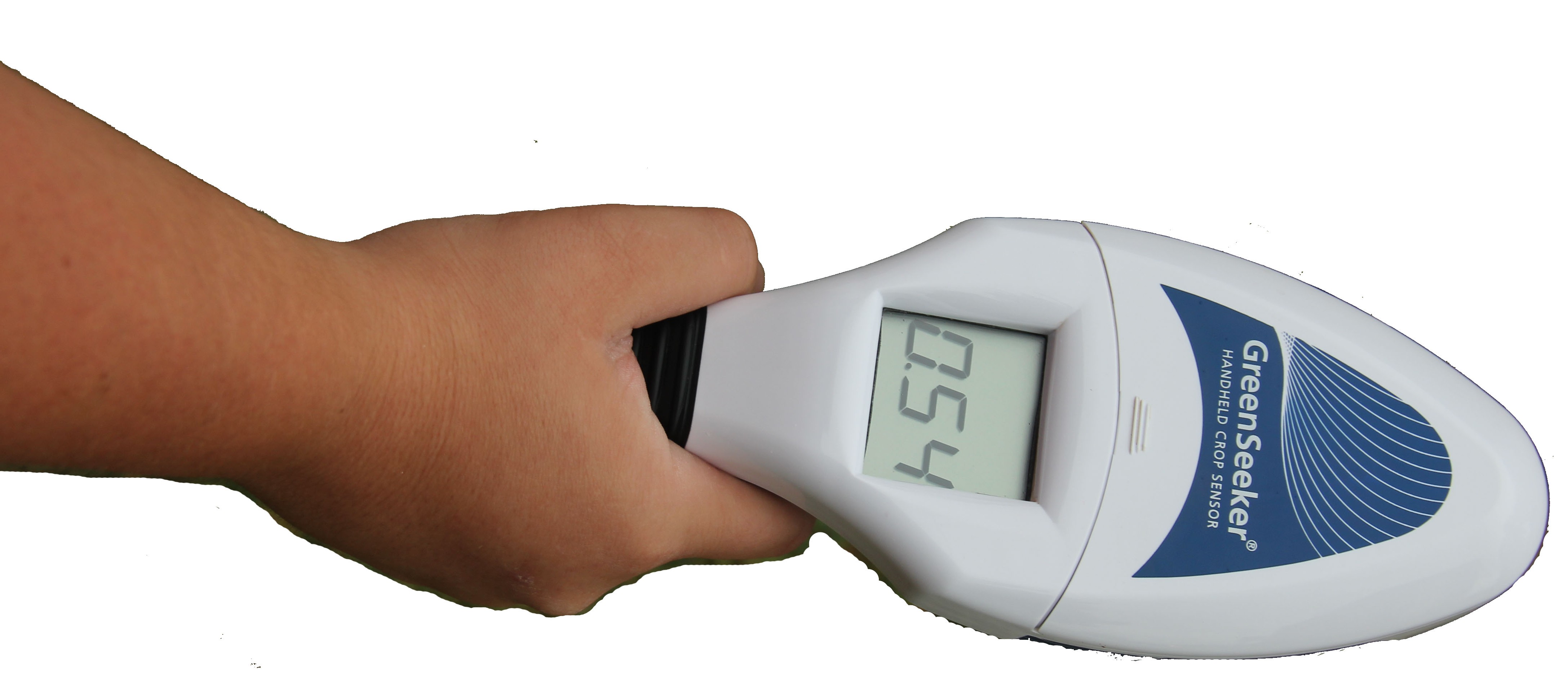
GreenSeeker HandHeld NDVI Sensor
Below is a YouTube video in which I describe how to use the GreenSeeker to collect NDVI readings, describe the data needed to complete the online calculator, and how to interrupt the calculators output.
Nitrogen Rich Strips
The Nitrogen Rich Strip, or N-Rich Strip, is a technique/tool/process that I spend a great deal of time working with and talking about. It is one of the most simplistic forms of precision agriculture a producer can adopt. The concept of the N-Rich strip is to have an area in the field that has more nitrogen (N) than the rest. Due to our fertilizer applicators this is typically a strip. The approach maybe somewhat new but at one point most producers have had N-Rich Strips in their fields, albeit accidentally. Before the days of auto-steer it was not uncommon, and honestly still is not, to see a area in the field that the fertilizer applicator either doubled up on or skipped. In our pastures and dual purpose/graze out wheat every spring we can see the tell-tale signs of livestock deposits. When over laps or “Cow Pox” become visible we can assume the rest of the field is behind in nitrogen. I like to tell producers that the goal of the N-Rich strip is to make a really big cow pie.

- Cow Pox, Image courtesy Kaitlyn Nelson
What I like most about the N-Rich Strip approach is its Simplicity. The N-Rich Strip is applied and; Scenario 1. The N-Rich Strip becomes visible (Greener) you APPLY NITROGEN, Scenario 2. The strip is not visible you Option A. DON’T APPLY NITROGEN Option B. Apply Nitrogen Anyways. The conclusion to apply N or not is based on the reasoning that the only difference between the N-Rich Strip and the area 10 ft from it is nitrogen, so if the strip is greener the rest of the field needs nitrogen. If there is no difference N is not limiting and our research shows N does not have to be applied. However producers who decide to be risk adverse (in terms of yield) can apply N but it would be advised to do so at a reduce the rate. Now is a good time to note that the N-Rich Strip alone provides a Yes or No, not rate recommendation. At OSU we use the GreenSeeker optical sensor and Sensor Based Nitrogen Rate Calculator (SBNRC) to determine the rate, but that discussion will come later. I equate the change from using yield goal N rate recs to the N-Rich Strip as to going from foam markers to light bars on a sprayer. Not 100% accurate but a great improvement.

N-Rich Strip in no-till wheat near Hobart OK.
Now that we have covered the WHY, lets get down to the nuts and bolts HOW, WHEN, WHERE.
How the strip is applied has more to do with convenience and availability than anything else but there are a few criteria I suggest be met. The strip should be at least 10 ft wide and 300 ft long. The rate should be no less than 50 lbs N (above the rest of the field) for grain only wheat and canola, 80 lbs N for dual purpose wheat. The normal recommendation is that when applying pre-plant either have a second, higher rate programmed into the applicator or make a second pass over an area already fertilized. Many will choose to rent a pull type spreader with urea for a day, hitting each field.
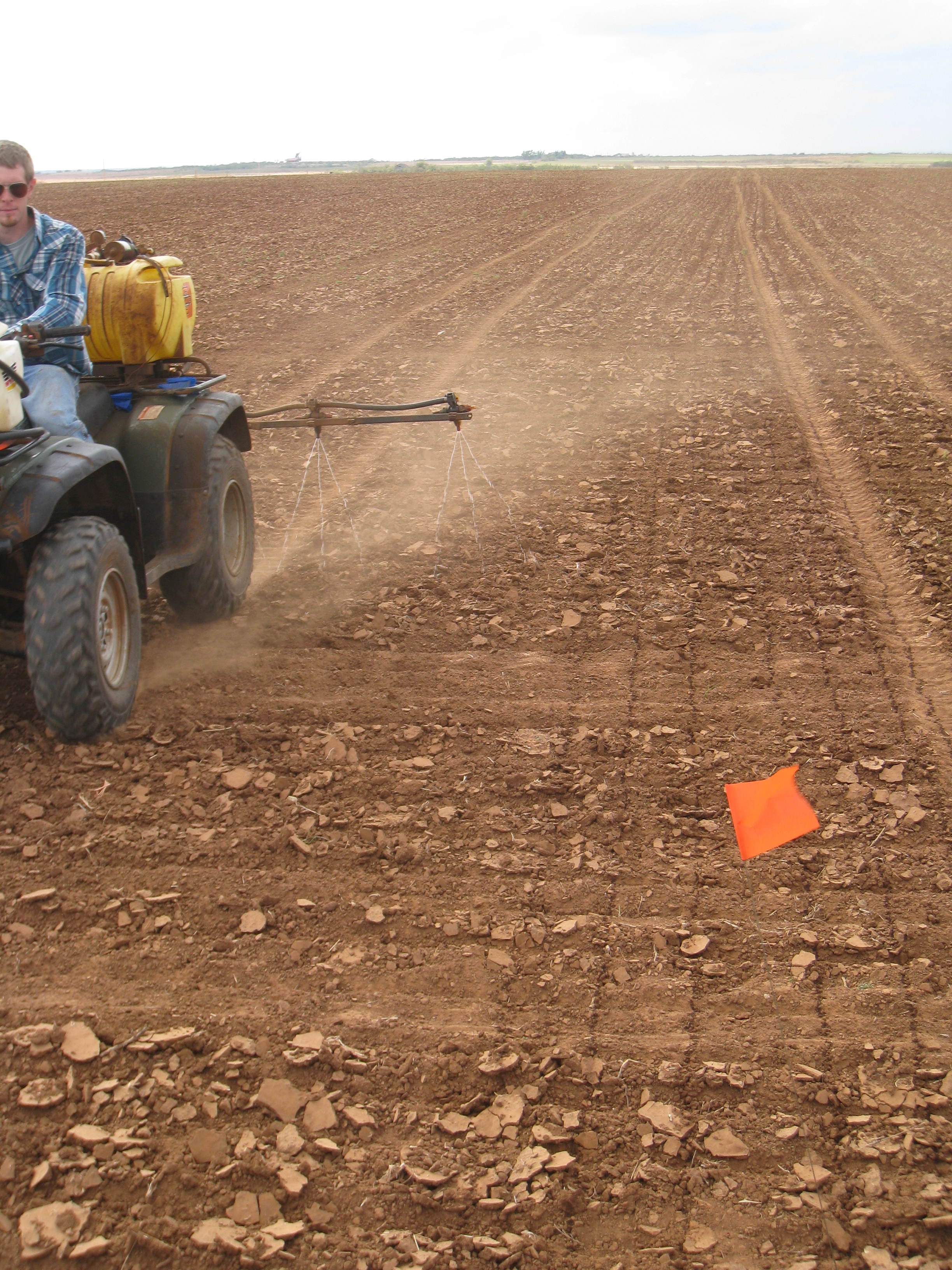
Becoming more popular are applicators made or adapted for use. ATV sprayers are the most common as they can be multi-purpose. In most cases a 20-25 gallon tank with a 1 gpm pump is placed on the ATV with an 8-10ft breakover boom. The third applicator is a ride away sprayer with a boom running along the rear of the trailer. In all cases when liquid is the source I recommend some form of streamer nozzle. In most cases there is not a great deal of thought put into what source. I recommend whichever source is the easiest, cheapest, and most convenient to apply.

Vincent N-Rich Strip Applicator, Ponca City OK
Oklahoma State Univ. N-Rich Strip Applicator
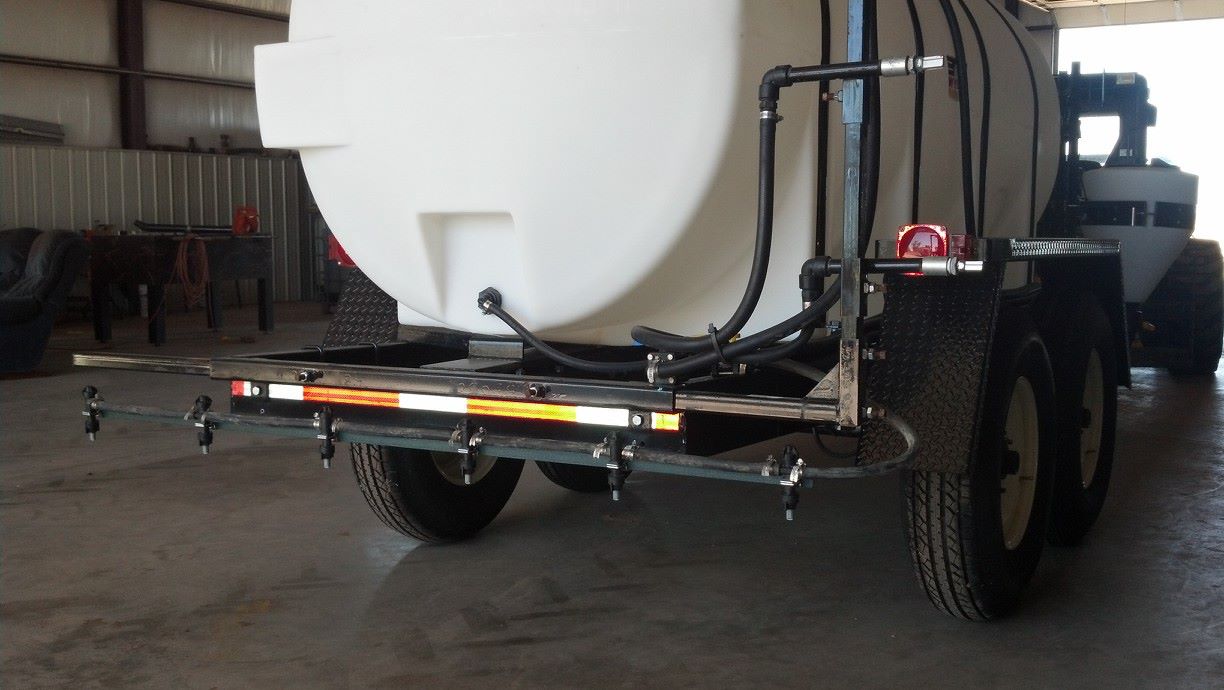
Gard N-Rich Strip Applicator, Fairview Ok
When the strip is applied in winter crops proper timing is regionally dependent. For the Central Great Plains, ideally the fertilizer should be applied pre-plant or soon after. However, in most cases as long as the fertilizer is down by the first of November everything works. This does not say a strip applied after this time doesn’t work but it leaves more room for error. There is a chance the crop could already be stressed or the nitrogen tied up and not release in time. However when the N-Rich Strip approach is used on the Eastern Shore in Virginia and Maryland the strips have to be applied at green up. The soils in that region are very deep sands and nitrogen applied in the fall may not make it to the spring. Also most wheat producers in the area make three or more applications of nitrogen unlike the two (pre and top) of the Great Plains. It is always important to make the tools fit your specific regional needs and practices and not the other way around.
Where is actually the biggest unknown. The basic answer is to place the N-Rich Strip in the area that best represents the field. Many people question this as it doesn’t account for spacial variability in the field, and they are correct. But my response is that in this case spatial variability is not the goal, temporal variability is. Keeping in mind the goal is to take a field which has been receiving a flat yield goal recommendation for the last 30+ years and make a better flat rate recommendation. My typically request is that on a field with significant variability either apply a strip long enough to cross the zones or apply smaller strips in each significant area. This allows for in-season decisions. I have seen some make the choice to ignore the variability in the field, made evident by the strip, and apply one rate and others choose the address the variability by applying two or more rates. One key to the placement of N-Rich Strips is record keeping. Either via notes or GPS, record the location of every strip. This allows for the strips to be easily located at non-response sites. It is also recommended to move the strip each year to avoid overloading the area with N.
I hear a great deal of talk about how it would take to much time to put out the N-Rich Strip. However the majority of producers that do it once on one field, end up doing it every year on every field. There is very likely someone in your area who is using the N-Rich Strips. As top-dress grows closer keep an eye out for a blog “Using the GreenSeeker Sensor and Sensor Based Nitrogen Rate Calculator”.
For more information on N-Rich Strips check out the YouTube video below, visit http://www.npk.okstate.edu or contact me directly at b.arnall@okstate.edu. I have lots of material I am happy to share and distribute.
See the YouTube Video http://www.youtube.com/watch?v=kJ3DSwWYgE8
Response to NPKS strips across Oklahoma
From the fall of 2011 to about a week ago one of my grad students, Lance Shepherd, has spent A LOT of time burning up the highways and back roads of Oklahoma. Lance’s project was titled “NPKS Strips in Oklahoma winter wheat”, basically an extension of the N-Rich Strip concept. We wanted to see if we could or would find a response to added nitrogen (N), phosphorus (P), potassium (K), or sulfur (S) fertilizer on top of the farmer’s fertilizer applications. Over the two crop years lance applied NPKS strip on more than 80 fields from the Kansas border to the Red River. Of those 80+ Lance was able to collect, by hand, grain samples from 59 sites. Over the next few weeks I will be sharing some of the juicy tidbits we are gleaming from this fantastic data set.

NPKS applicator. Gandy boxes hold each fertilizer and a pto driven fan blew the fertilizer down the boom.
For the project at every site Lance collected soil samples to 18”, documented soil type and collected producer fertilizer, variety, and field history information. Over the 59 locations there were essentially 236 trials. The yield of each strip (N,P,K, and S) was compared back to a sample collected from the field, referred to as Farmer Practice. Of the 236 comparisons there were a total of 17 positive responses. Of these 17 responses seven were to N, seven to P, three to K, with no responses to S.

N-Rich strip very evident in field west of Alva. N-Rich 70 bu/ac Farmer Practice 38 bu/ac.
We are learning a great deal from these 17 locations. The biggest take home was that in most instances soil test results identified the yield limiting factors. For example of the seven responsive P locations six had either a low soil pH or low soil P index, some both. At only one site was there a response not predicted by soil test. Of all 59 harvested fields more than just six had low P or pH levels however most producers had applied enough fertilizer to reach maximum yield. For nitrogen two items proved to be the most likely reason for loss of yield, under estimated yield goal or environment conducive to N loss. As for the K responses we look at both K and chloride (Cl) as KCl, 0-0-62 potash, was applied in the K strip. Just looking at the soils data K was not low at any of the three sites. However, two sites are in sandy loam soils, which is conducive to Cl deficiencies. The lack of response to S was not surprising as soil tests indicated S was sufficient at all 80 locations were strips were applied. So again what did we learn from these plots, soil testing is key in maximizing yield and profitability and in most of the N responsive sites the N-Rich strip indicated a need for added fertilizer in February.
 Down and Dirty with NPK