Home » Posts tagged 'Corn' (Page 2)
Tag Archives: Corn

Nutrient Products: Stabilizers, Enhancers, Safeners, Biologicals and so on.
In this blog I am not going to tell you what to use or what not to use. In fact I will not mention a single product name. What I will do is hopefully provide some food for thought, new knowledge and direction.
First I want to approach a topic I have been called out on several times. I believe there is a stigma that University researchers and extension specialists do not want products to work. It may seem that way at times but it is far from the truth. The reality is that all of us are scientists and know someone may be inventing the product that changes nutrient management as we speak. The issue is that most of us have been jaded. While I may be younger I have over 11 years experience, testing “products” in the field, and that includes dozens of products. I have sprayed, spread, tossed, drilled, mixed and applied everything under the sun, with hopes that I will see that one thing I am always looking for, MORE GRAIN…
The truth is Everything works Sometimes yet Nothing works ALL the time. I and others in my profession do not expect anything to work 100% of the time, I am personally looking for something that will provide a checkmark in the win column 50% of the time. A win is the result of one of two things, more money in the producers pocket or less nutrients in the water or air. Products can increase vigor, nutrient uptake, chlorophyll concentration, greenness but not yield. What Co-op or elevator pays for any of those attributes? Grain makes green.


So many safeners, stabilizers, enhancers, biologicals, and on and on are available, so what should a producer do? Here are few things to think about. Ask yourself “ what part of my nutrient management plan can I get the most bang from improving”?
If the answer is Nitrogen (N) there are three basic categories: Urease inhibition, Nitrification inhibitor, and slow release. All are methods of preventing loss; the last two are preventing loss from water movement.
Urease inhibitors prevent the conversion of Urea to NH3 (ammonia). This conversion is typically a good thing, unless it happens out in the open. Ideally any urea containing product is incorporated with tillage or rain. However, in No-till when urea is broadcast and no significant rainfall events (>0.5”) occur, N loss is likely. The urea prill starts dissolving in the presence of moisture, this can be a light rain or dew, and urease starts converting urea into NH3. As the system dries and the day warms, if there was not enough moisture to move the NH3 into the soil the wind will drive NH3 into the atmosphere. Nitrogen loss via this pathway can range from 5% to 40% of the total N applied.
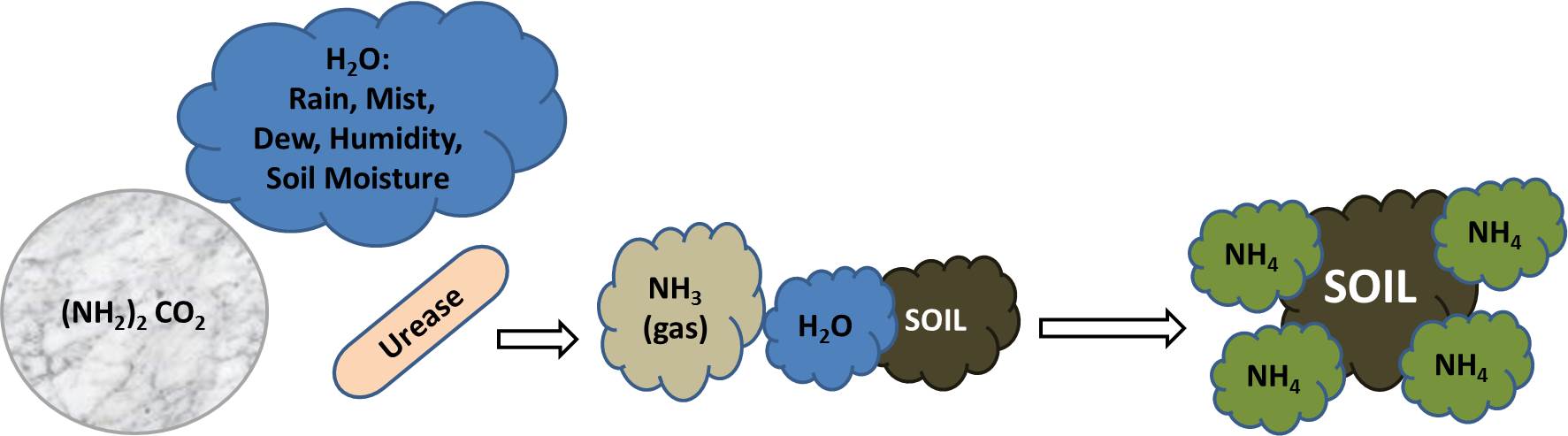
Graphic of Urea’s conversion to plant available ammonium.

Urea placed on a wet soil under two different temperatures. Number in white is hours after application.
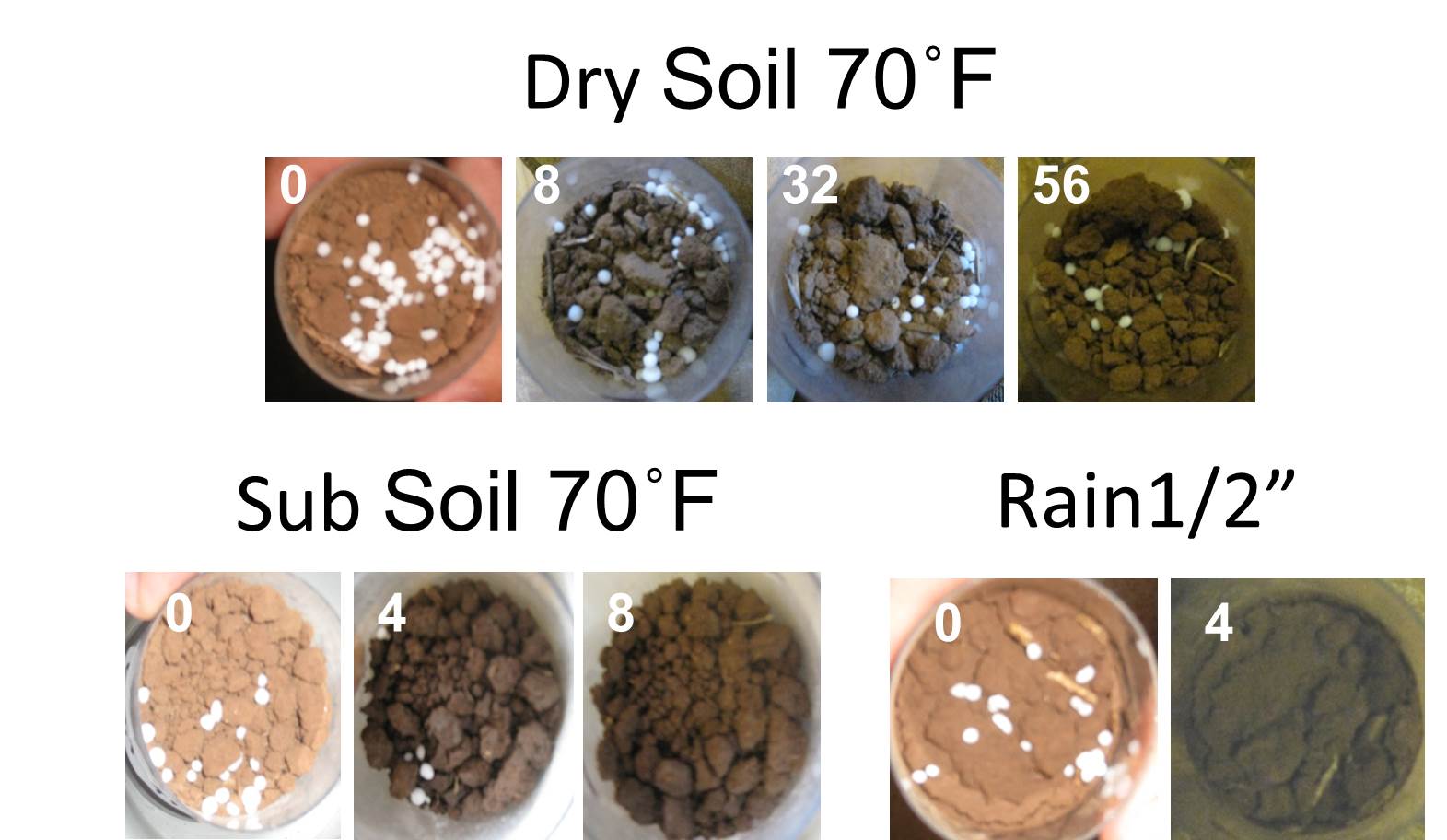
Urea placed on a dry soil, on top no water added, bottom left is moisture from the subsurface, and bottom right is simulated rain fall of 1/2″. Number in white is hours after application.
Nitrification inhibitors prevent the conversion of NH4 into NO3. Both are plant available N sources but NH4 is a positively charged compound that will form a bound with the negatively charged soil particles. Nitrate (NO3) is negatively charged and will flow with the water, in corn country that tends to be right down the tile drainage. Nitrate will also be converted to gasses under wet water logged soil conditions. Nitrate is lost in the presence of water, this means I do not typically recommend nitrification inhibitors for western OK, KS, TX dryland wheat producers.
Slow release N (SRN) comes in a range of forms: coated, long chain polymer, organic and many versions in each category. Again, water is the reason for the use of SRN sources. Slow release N whether coated or other have specific release patterns which are controlled by moisture, temperature and sometimes microbes. The release patterns of SRNS are not the same and may not work across crops and landscapes. For instance in Oklahoma the uptake pattern of nutrients for dryland corn in the North East is not that same as irrigated corn in the West. The little nuances in the growth pattern of a crop can make or break your SRN.
While N products have been on the market for decade’s phosphorus enhancers and stabilizers are relatively new, resulting in many of my peers holding back on providing recommendations until field trials could be conducted. At this point many of us do have a better understanding of what’s available and are able to provide our regional recommendations. Phosphorus products are not sold to prevent loss like their N counterparts; they are sold to make the applied P more available. On a scale of 1 to 10, P reactivity with other elements in the soil is a 9.9. If there is available Ca, Mg, Fe, or Al, phosphorus is reacting with it. In the southern Great Plains it is not uncommon for a soil to have 3,000-5,000 lbs of available Ca, a soil with a pH of 4, yes we have many of those, will have approximately 64,000 lbs of Al in the soil solution. That’s a lot of competition for your fertilizer P and for any substance that is trying to protect it.
I have been testing “biologicals” of all shapes and forms since 2003. While I have not hit any homeruns I have learned quite a bit. Many of these products originate from up north where the weather is kind and organic matter (OM) is high. Where I work the average OM is 0.75% and soil temp is brutal and unforgiving. Our soil does not have many reserves to release nor is it hospitable to foreign bodies.

Soil temperature for Stillwater OK under sod and bare soil conditions. Graph from http://www.Mesonet.org.
I hope you are still hanging on as this next topic is a bit of a soap box for me. Rate, Rate, Rate this aspect is missed both by producers and academia and it drives me crazy. If your crop is sufficient in any growth factor adding more will not increase yield. It goes back to Von Liebig’s LAW of the Minimum. I see too many research studies in which products are tested at optimum fertilization levels. This is just not a fair comparison. On the other hand, time and again I see producers sold on a product because they applied 30% less N or P and cut the same yield. If you let me hand pick 100 farms in Oklahoma I could reduce the N rate by 30% of the average and not lose a bushel on 75 of the farms. Why? Because the rate being used was above optimum in the first place, there is no magic just good agronomy. The list of products that increase the availability of nutrients is a mile long. Increasing nutrient availability is all well and good if you have a deficiency of one of those nutrients. If you don’t, well you have increased the availability of something you did not need in the first place.
University researchers and extension professionals seem to live and die by the statistics, and are told so regularly. We do rely upon the significant differences, LSD’s, and etc to help us understand the likely hood of a treatment causing an effect. However if I see a trend develop, or not develop, over time and landscape regardless of stats I will have no problem making recommendations. The stats help me when I do not have enough information (replications).
Too wrap up, have a goal. Do not just buy a product because of advertised promises or because a friend sells it. There is a right time and place for most of the things out there, but you need to know what that is and if it suits your needs. I also recommend turning to your local Extension office. We do our best to provide unbiased information in hopes of making your operation as sustainable as possible. If you are looking at making sizable investments do some reading, more than just Google. Testimonies are great but should but should not be enough to cut a check. Google Scholar www.google.com/scholar is a good resource for scientific pubs. I have done my best to put together a list of peer reviewed publications and their outcomes. To make the review work I had to be very general about outcome of the research. Either the product increased yield or decreased environmental losses or it had no impact. This was not easy as many of the papers summarize multiple studies. I did my best to make an unbiased recommendation but some could be argued. http://npk.okstate.edu/Trials/products/Product_Peer_Review.8-21-2014.pdf
Ag Apps Updated
Since my Ag App post in July I have presented on the topic an additional five times and have two more on the books for 2014. A good thing about doing talks is that you have to update the information to remain current. Which in all honesty, when it comes to technology of any kind this is quite challenging and even more so for Smart Phone Apps. In July when I first blogged on the subject I had 76 apps on my iPad. Today (1.3.14) I have 111 apps on my iPad, for both the iPhone and iPad, that I deem to be Ag related. Since the summer I have found new favorites, changed some, and added categories but for the most part I still maintain my 2 minute rule stated in the first blog. I have allowed a bit more leniency in that I now say “If I cannot figure it out in 3 minutes it’s GONE. An app should be intuitive, easy to use and have a purpose. They only exception to the 3 minute rule is the Scouting and Mapping Apps. Because of their complexity I allow them 5 minutes, and then I am done. Any app with GIS in its name gets much more time” I guess I am just getting soft.
Again I must make the obligatory statement; I am not a developer, designer, or expert. I am just a user who has had a chance to look at a few apps. Almost all of the apps I have are free and I am sure I have missed a few. Please share those with me. I am also not discussing Mobi’s, this is another large group of quality decision aid tools. I am also not discussing none apples apps. This is not because they are not relevant or important, it is because I do not have that technology.
I now have nine Ag folders on my iPad:
Ag News/Weather/Markets, Scouting/Mapping, Record Keeping, ID Tools, Crop Tools, Calculators, Sprayer/Chemicals, Fertilizer, Seed Select.
Apps are nice because the majority are stand alone and do not need internet or cell connection. This means they can be used when you are in the middle of nowhere, which is a great deal of Oklahoma, and have no service. This will exclude many of the Ag News/Weather/Markets, Scouting/Mapping, and Record Keeping apps that need positioning or location information.
Now let’s discuss some of the new and old apps.
Ag News/Weather/Markets


Not much change in this group however I have added one or two.
Scouting/Mapping


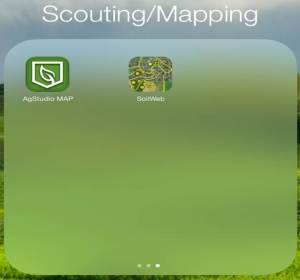
This category has changed the most. Record keeping apps have been removed and several new apps added. The only free apps which can create boundaries are still Scout and Sirrus. To date Scout remains to be my favorite app for in field scouting notes. Pictures tagged with Lat Long and a note is very useful. My knock on is app is its boundary creation. It is a challenge every time as it is hard to remember the steps and not make a mistake. That is where Sirrus comes to play, by far the best boundary creation app. Sirrus has easy to use tools for both point and pivot boundaries. I like the edit vertex zoom in tool that resembles a rifle scope. I was able to add 12 fields in a matter of 20 minutes. Being able to create grid soil sampling scheme and record samples is also a very nice tool. My favorite part of the app, the UNDO button, and all apps should include this. The drawback to Sirrus is that it has no ability to take notes such as Scout. An additional nice scouting tool is South Dakota States NPIPM (North Plains IPM) app. This app provides not only a pest id tool with morphological drop down, I will discuss this in the ID Tools cat, but also management recommendation for the identified insect.
Record Keeping,
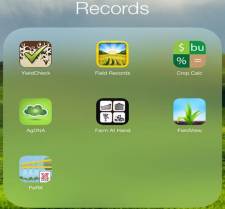
The majority of the apps in this category are “Pay to Play”, which makes since as they deal with data management and storage. Many would also fit the Scouting/Mapping category. As I do not pay for many apps I do not have experience with any of these. However this is the category that I would recommend any group to look at as they should be the all-inclusive app. However, PeRK by the University of Nebraska is a free app designed for field records of pesticide applicators.
ID Tools,

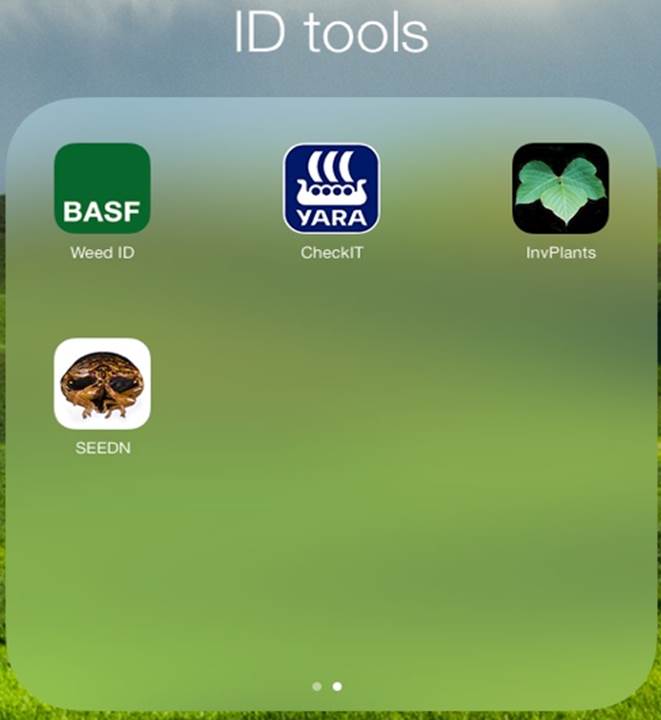
I have added a few apps to this category but my favorites have not changed. I regularly use Plant Images, ID Weeds, and the Pestbook as references. I will add more discuss to app ID tools. The importance of being able to ID weeds and Pest via morphological drop down menus (ID Weeds and NPIPM) is extremely important. Many of the ID tools just have pictures and names. Well is I am using an ID Tool I likely do not know what I am looking at or what it is called.
Crop Tools,
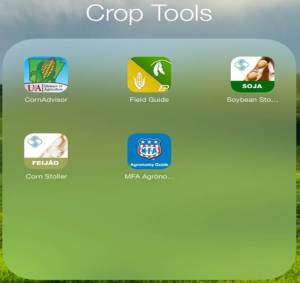
Crop Tools includes my second “Paid in Full” app. And this one hurt a bit more. Not because it cost money but because I have multiple versions of the hard copy. However Field Guide by Purdue is one of my most recommended apps. Field Guide is the electronic version of the Purdue Corn and Soybean Field Guide, which the majority of consultants in the Corn Belt likely have this sitting in their truck. The Stoller apps also have nice very nice image bank of plant developmental phases. FieldGuide and CornAdvisor, another good app, are great examples of what I expect to be coming out of the majority of the Land Grant Universities very soon. Cooperative Extension has hundreds if not thousands of quality hard copy publications just waiting to be turned in to handy dandy apps. To be honest I am working on turning my Nutrient Management Field Guide into an app right now.
Calculators,
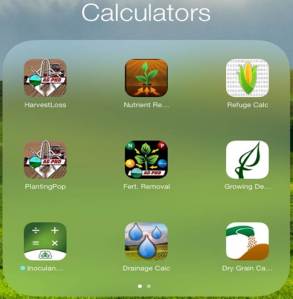

Only two apps has been added to this category. I am still using Fert.Removal, HarvestLoss and Growing Degrees on a regular basis.
Sprayer/Chemicals,

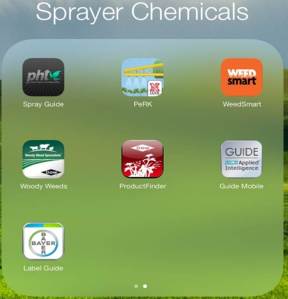
Many apps have been added to this group but none of them have been good enough to kick TankMixCalc and SpraySelect of my favorites list.
Fertilizer,


Similar to the Sprayer/Chemicals category several apps have been added to this group, including several from Ok State. For me the Fert Cost Calc is still very useful. I do not get to use the Manure Calc I am very impressed by its layout and user friendliness. This app allows for applicator calibration, nutrient recs and manure value estimator.
Seed Select,

It is no surprise the apps in this category are company created. I will say for the central Great Plains Pioneer’s Canola Calc is very useful tool for selecting canola planting rate providing input for row spacing live plants, seed weight, Germ percent, and survival percent.
To wrap up this blog I want to share with you may new Favorite none ag app. Bump is a huge time saver for anyone who takes pics with your iPhone or iPad. Bump allows easy transfer between mobile devices but more importantly between your mobile device and desktop by a simple tap of the space bar. This file share will go both directions. This means no more emailing pictures from your phone so that you can have them on your desktop. Bump is a iPhone app that can work on the iPad.
When searching with an IPad, remember to switch the search to include IPhone apps, there are some good ones out there that are IPhone only. Check out www.npk.osktate.edu/presentations to see screen shots from many of my favorite apps.

