Brian Arnall: Precision Nutrient Management Extension Specialist, Oklahoma State University
In 2020, we published a summary of four OSU trial series comparing pre-plant nitrogen (N) to in-season N in grain-only winter wheat. https://osunpk.com/2020/09/10/value-of-in-season-application-for-grain-only-wheat-production/ Since then, three of those trial series have made it through peer review, and additional analyses have added considerably more data to the story. From both historic data from Dr. Raun’s program and new work. All together, these studies now represent more than 90 Oklahoma site-years across a wide range of environments, N rates, and application timings. So, after several more years of research, has the conclusion changed?
Does waiting to apply nitrogen cost wheat yield?
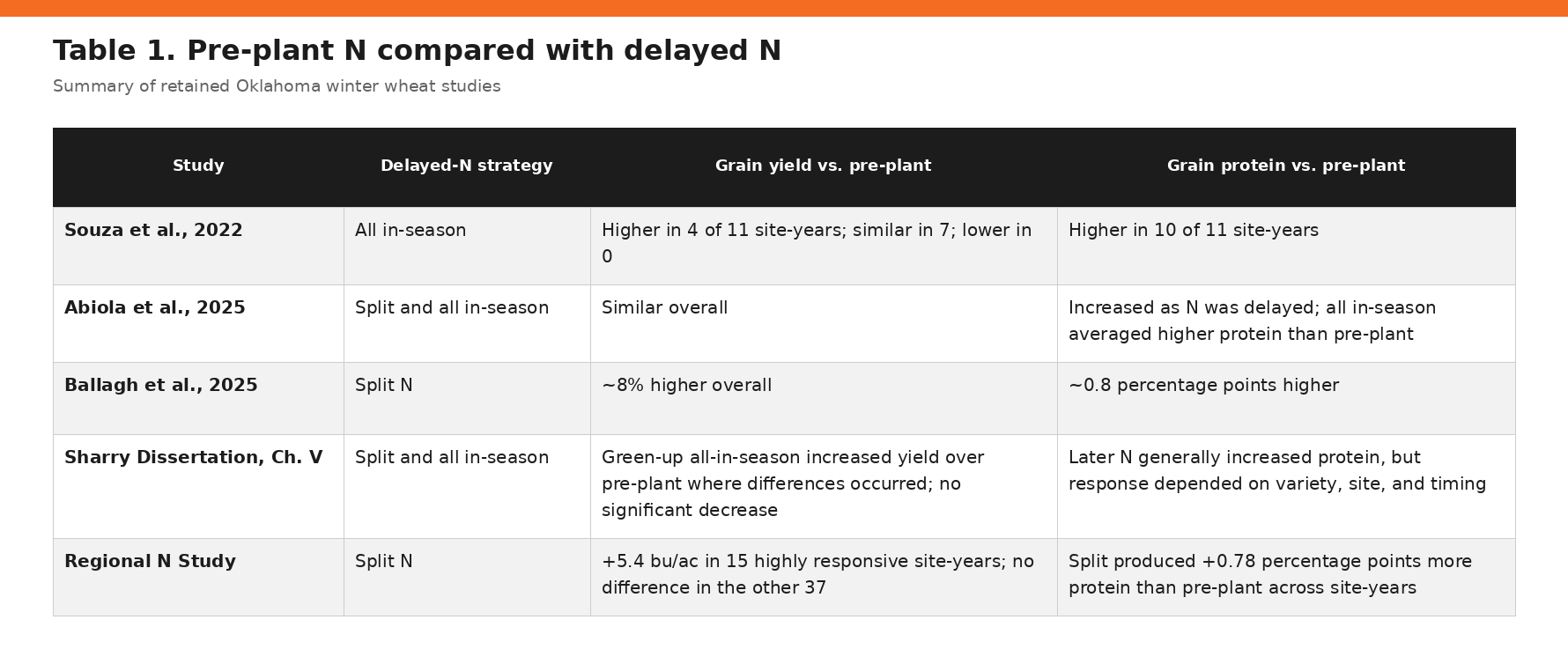
Across these studies, moving N from pre-plant to a properly timed in-season application generally maintained or increased grain yield. How often in-season N increased yield varied among datasets. Souza et al. found that winter wheat could recover from early N stress without sacrificing yield over a surprisingly wide application window. In other studies, in-season N was statistically similar to pre-plant N. The important point is that delaying N did not automatically mean giving up yield.
The Regional N study started by Dr. Raun 2in 2009, adds an important environmental piece to the story. Split N out yielded pre-plant N in approximately 29% of the 52 site-years, specifically those classified as highly responsive to N. These years tend to be wetter environments with greater yield potential. In the remaining 71%, split and pre-plant N produced statistically similar yields. Across all 52 site-years, splitting N never resulted in a significant yield loss compared with pre-plant N.
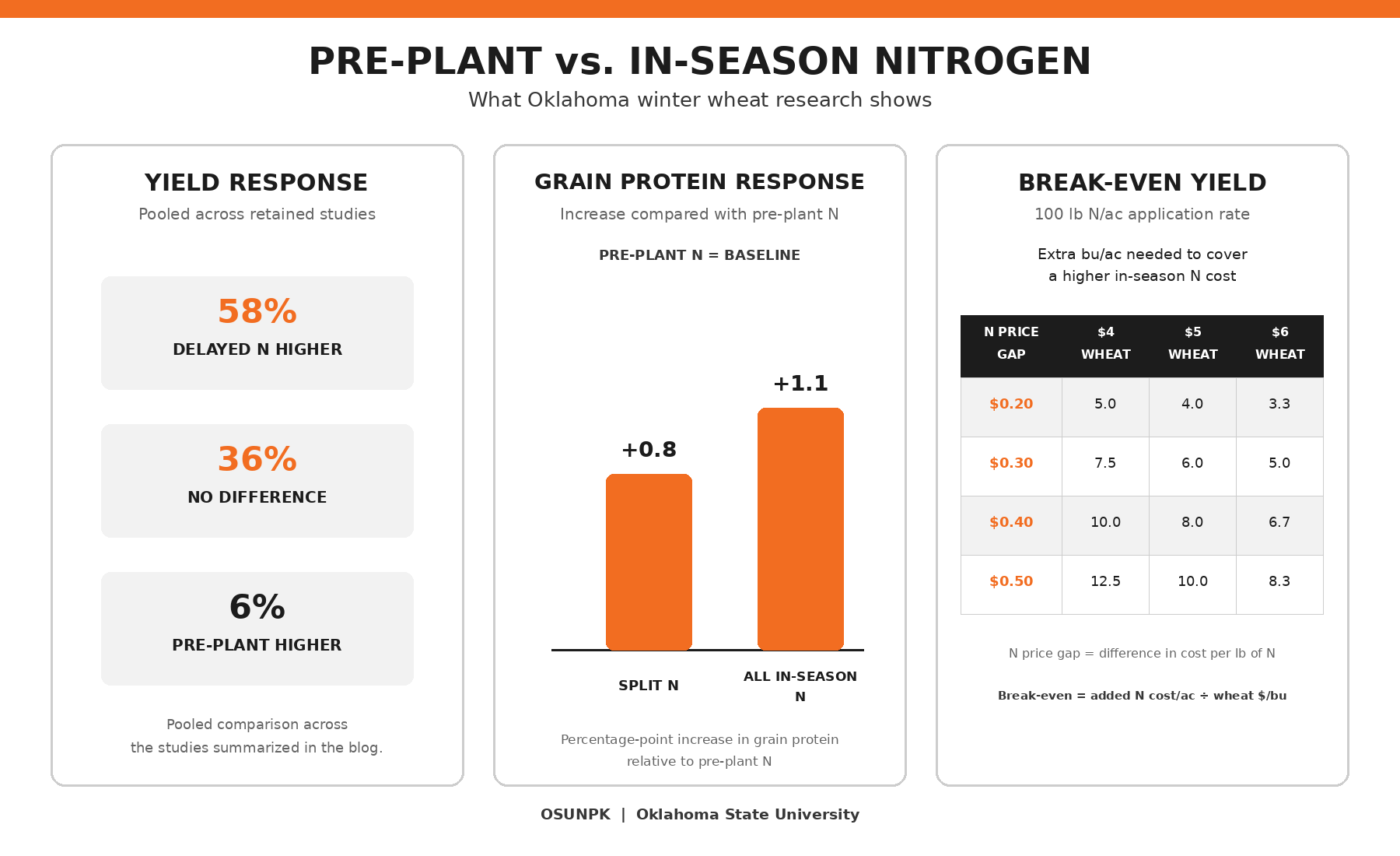
When a yield advantage with in-season N occurred, it could be meaningful. One study found a single in-season application produced approximately 8% greater yield than a full-rate pre-plant application. Sharry’s Gallagher/Green Hammer study found a single Feekes 4 (spring green up) application averaging approximately 11% greater yield than a single pre-plant application across two varieties and four site-years. The Regional N analysis found an approximately 5.4 bu/ac, or 14%, advantage for split N over pre-plant N in highly N-responsive environments, while there was no difference in the remaining environments. The message isn’t that in-season N always produces more wheat. It doesn’t. Properly timed in-season N generally maintained yield, and about 58% of the time increased it.
Protein Tells an Even More Consistent Story
Protein responded more consistently to N timing than yield. Later N increased grain protein across nearly every dataset. In the Regional N study, split N increased protein by 0.8 percentage points above the pre-plant compared with a 1.1-point increase from all N applied in-season. That advantage occurred across every environmental response category. In the end yield response to delayed N depends heavily on environment. The protein response is considerably more consistent.
If In-Season N Works, Is There a Reason to Split It?
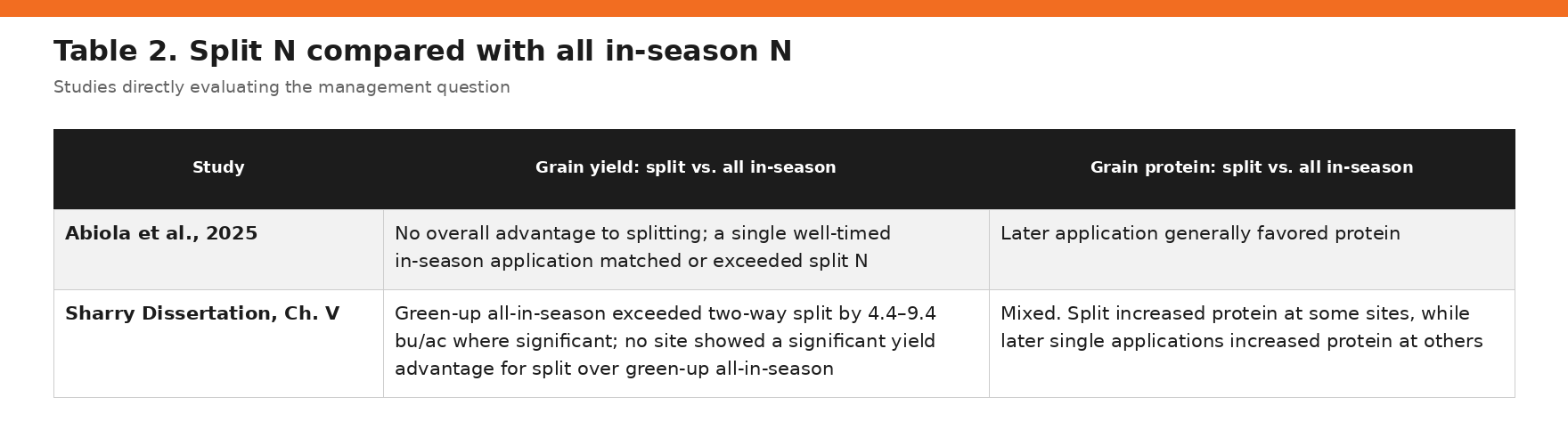
Once the decision is made to move N away from a full pre-plant application, another question follows: should some N still go out pre-plant and the remainder in-season, or can the entire rate wait until the growing season? Two datasets tested that question directly, and neither found a consistent yield advantage to splitting N over a single, well-timed in-season application.
Sharry’s study found that a single green up application out-yielded both two-way and three-way splits by approximately 4.4 to 9.4 bu/ac at the site-years where treatments differed. At no site-year did a split application out-yield the single in-season timing. Abiola (2025) reached essentially the same conclusion. A single in-season application matched or exceeded a 50/50 pre-plant/in-season split across the timings evaluated. There was, however, an important exception. As the single in-season application was pushed into late March and April, having some N already applied reduced the potential downside.
Splitting N appears to be more about risk management than yield management.
Putting some N out early provides insurance against weather, field conditions, equipment problems, or other factors that prevent the planned in-season application from being made on time. If a single in-season application can be made at the proper time, however, these data provide little evidence that splitting N improves yield. So, in the end you reduce the “risk” but double application cost.
Timing Still Matters
None of this should be interpreted as saying N can be applied whenever it is convenient. The window for applying N to grain-only winter wheat is wider than many growers assume, but it isn’t unlimited. As application moves later, the opportunity for unfavorable weather to interfere with N availability becomes increasingly important.
The Regional N study provides a good example. For post top-dress applied N rainfall alone explained 27% of the site-to-site variation in how much the crop responded to N. The environments where split N increased yield over pre-plant N were generally the wetter, higher-yielding environments.
Waiting on N is a management strategy. Waiting too long is not.
Moving N in-season allows the rate decision to be made when considerably more is known about stand, growing conditions, and yield potential. But that flexibility only has value if the application is made while the crop can still effectively use the N. The data shows that the most risk adverse timing falls in the January to mid-March time frame.
What About Fertilizer Price?
Agronomy is only part of the decision. Anhydrous ammonia can provide a substantial cost-per-pound-of-N advantage over fertilizer sources typically used for in-season applications. When that price gap becomes large, the in-season strategy needs to create enough additional value through yield, protein, improved N-rate decisions, or reduced N loss to pay for the more expensive source.
The break-even calculation is straightforward: Additional N cost per acre ÷ wheat price = additional bushels needed to break even. At a 100 lb N/ac rate, every $0.10/lb difference in N price represents $10/ac in fertilizer cost.
For example, if the in-season N source costs $0.30/lb N more, that is a $30/ac disadvantage before the crop is planted. At $4.00 wheat, in-season N needs to produce 7.5 additional bu/ac to cover that difference. At $5.00 wheat, it needs 6 bu/ac, and at $6.00 wheat, it needs 5 bu/ac.
The range becomes fairly large as the difference in N price changes. At a 100 lb N/ac rate and wheat prices between $4 and $6/bu, a $0.20/lb N-price difference requires roughly 3 to 5 additional bu/ac, while a $0.50/lb difference requires roughly 8 to 13 additional bu/ac.
That doesn’t make either strategy automatically more profitable. In environments where yield is the same, the cheaper N source has the economic advantage. Where in-season N increases yield or protein, the economics can move in the other direction. There is also another economic benefit to waiting that is harder to put into a simple table: by waiting, the producer can adjust the N rate to the yield potential that is there rather than the yield potential hoped for before planting.
So fertilizer price adds another question to the N-timing decision: How much is the flexibility of waiting worth this year?
After more than 90 Oklahoma site-years, there is little evidence that grain-only winter wheat inherently benefits from having the entire N requirement available before planting. A properly timed in-season application generally maintains yield and can increase yield under responsive conditions. The opportunity to increase grain protein is even more consistent. Waiting also allows the final N decision to be made when the producer knows considerably more about the crop, weather, and realistic yield potential.
Splitting N does not appear to provide an additional yield benefit over a single, properly timed in-season application. Its primary value is insurance against missing that application window. But fertilizer price matters. When anhydrous or another pre-plant source provides N substantially cheaper than the available in-season source, those savings have real value and should be weighed against the potential benefits of waiting. There isn’t one N-timing strategy that wins every year. The goal isn’t simply to maximize yield or minimize fertilizer cost. It is to choose the N source, rate, and timing combination that provides the best economic return for the conditions in front of you.
These conclusions apply to grain-only winter wheat. Dual-purpose wheat requires sufficient fall growth for forage production and has a different early-season N requirement.
If you have any questions or comments, please feel free to reach out.
Brian Arnall
b.arnall@okstate.edu
Sources
Souza, J.L.B., Antonangelo, J.A., Silva, A.O., Reed, V., and Arnall, B. 2022. Recovery of Grain Yield and Protein with Fertilizer Application Post Nitrogen Stress in Winter Wheat (Triticum aestivum L.). Agronomy 12:2024.
Abiola, S.O., Souza, J.L.B., Sharry, R., Derrick, J.R., Maatougui, M., and Arnall, D.B. 2025. Split nitrogen applications provide no benefit over a single well timed application in rainfed winter wheat. Frontiers in Plant Science 16:1698494.
Ballagh, B., Ballagh, A., Bushong, J., and Arnall, D.B. The Effect of Nitrogen Fertilizer Placement and Timing on Winter Wheat Grain Yield and Protein Concentration.
Sharry, R. 2025. Response to nitrogen timing of varying winter wheat genotypes Dissertation, https://hdl.handle.net/20.500.14446/344867
Regional N study. 52 Oklahoma site-years, 2009–2023, Okstate Soil Fertility data unpublished.


LIKE!
Kinder Farms
More Information