Home » Posts tagged 'Soil'
Tag Archives: Soil

Management of soybean inoculum
Josh Lofton, Cropping Systems Specialist
Brian Arnall, Precision Nutrient Management Specialist
Soybean, a legume, can form a symbiotic relationship with Bradyrhizobium japonicum (Kirchner, Buchanan) and create their N to supplement crop demands. However, this relationship depends upon these beneficial microorganisms’ presence and persistence in the soil. This specific strain of microorganisms is not native to Oklahoma and thus must be supplemented using inoculum as a seed treatment. However, the use of inoculums alone does not guarantee a successful relationship. Handling, storage, soil conditions, and other factors can impact the ability of these microorganisms to do their job.
Soybean nitrogen demand is high, with most reports indicating that soybeans need 4.5 to 5.0 pounds of nitrogen per bushel of grain yield. This means that a 30-bushel crop requires between 135 and 150 pounds of nitrogen per acre (in comparison, corn and wheat need only 0.8 or1.6 pounds, respectively). This relationship has been shown to supply an equivalent of 89 lbs of N to the soil. In the previous example, these bacteria could fulfill 50-90% of nitrogen demand, reducing input costs significantly.
However, the bacteria associated with soybean inoculum are living organisms. Therefore, the conditions they experience before being applied to the seed and after treatment (including both before and following planting) can significantly impact their relationship with the soybean plant and, thus, their ability to provide N to the plant. By introducing a high concentration of bacteria near the seed and emerging root, this symbiotic relationship is more likely to be established quickly.
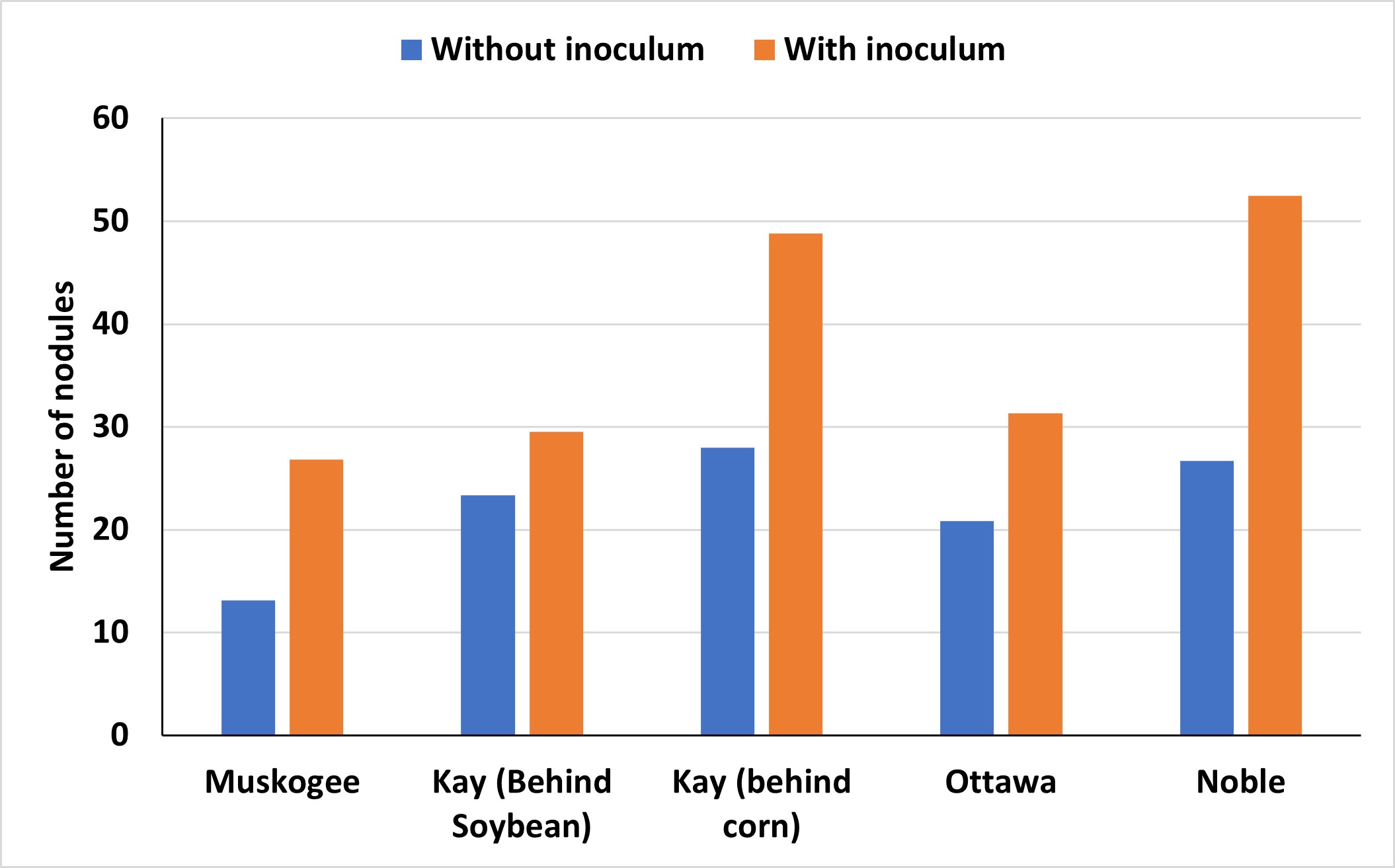
The importance of using inoculum is often debated in Oklahoma, particularly given the fluctuating prices of commodities and inputs. A recent assessment of various soybean-producing areas throughout the state revealed that most fields experienced advantages from incorporating soybean inoculation (Figure 1).
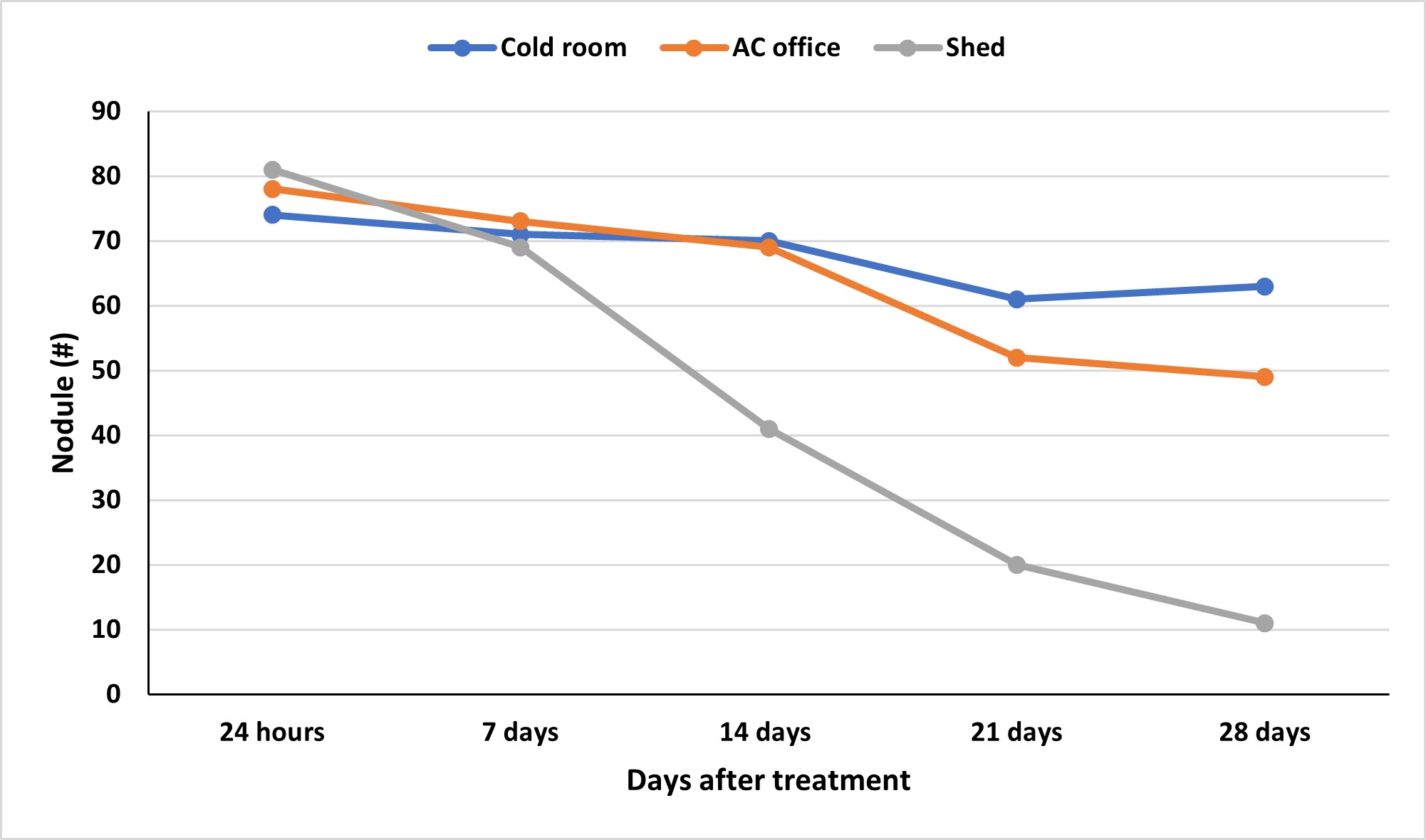
These benefits can be seen when the inoculum maintains viability until it is planted. It is always recommended that the bacteria be stored in a cool, dark environment before application on the seed. These conditions help preserve the survival of these bacteria outside of the host relationship. An evaluation of soybean inoculant after being stored short-term in different conditions found that in as little as 14 days, viability can decrease when kept in non-climate-controlled conditions (Figure 2). Additionally, viability was further reduced at 21 days when stored at room temperature compared to a refrigerated system
However, conditions colder than this, such as the use of a freezer, can compromise survival as well. Storing inoculum in the freezer forms ice crystals within the living cells and damages the cell membranes, making the microorganisms less likely to be alive upon rethawing. Additional chemicals can be added to increase the viability of long-term storage and sub-freezing temperatures. From an application standpoint, a new product should be purchased if additional storage is needed beyond short-term storage.
An additional question frequently arises: “How often should I inoculate my soybean?” As mentioned, these bacteria are not native to Oklahoma. As a result, they are not well adapted to survive in our environment and must outcompete native populations in the soil. Additionally, periods of hot and dry conditions appear to reduce the bacteria’s ability to survive without a host, the soybean roots. These are conditions we often observe in Oklahoma systems. Therefore, inoculation should be applied with every soybean planting to ensure a sufficient population of these bacteria. These bacteria promote root nodulation and nitrogen fixation in the soil.
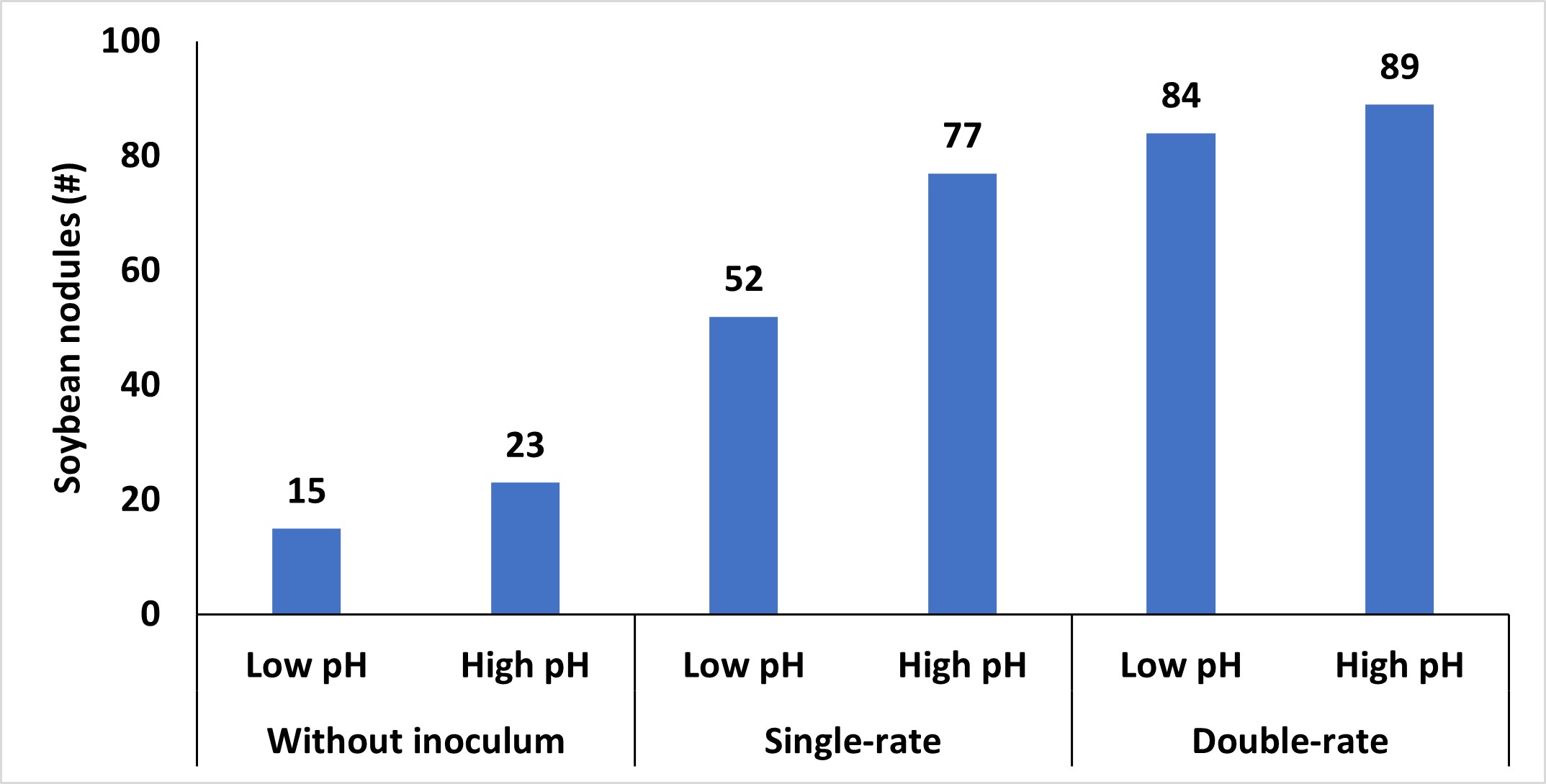
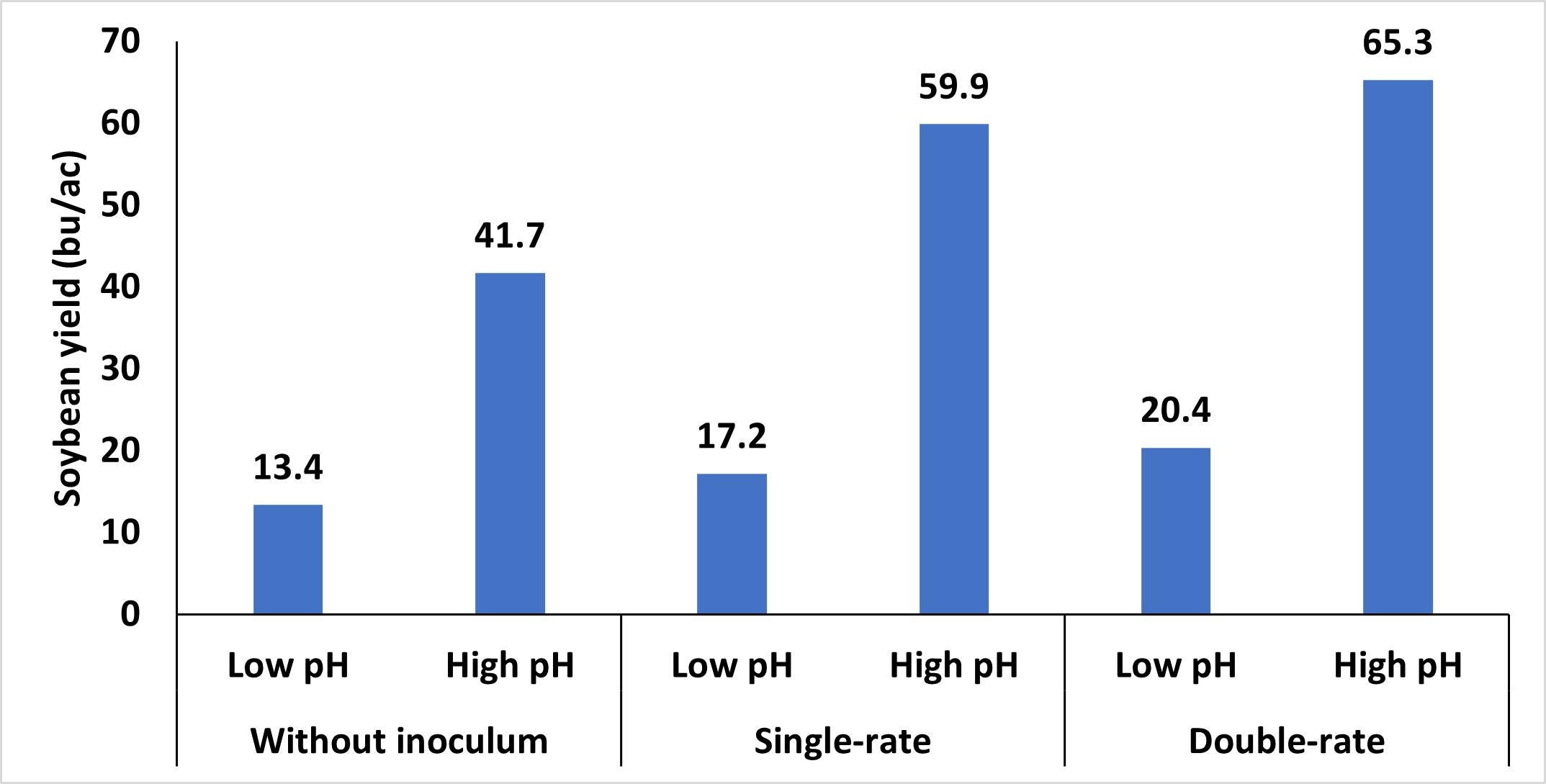
Other soil conditions, such as excessively dry or wet soils, high or low pH, and residual nutrients, can also impact the persistence of these microorganisms. Of these, soil pH has the biggest impact on the survival of these bacteria. High pH is less of a concern to Oklahoma production systems; however, soil with lower pH should be remediated. Like many bacterial systems, these bacteria optimally function at a pH range that closely resembles the ideal pH range for most crops. Lowering the soil pH below a critical threshold reduces the viability of the bacteria, hampers N-fixation processes, and diminishes the capacity of both the bacteria and soybean plants to form and maintain this relationship. While applying inoculum to soybean seeds in these adverse soil conditions can provide some advantages (Figure 3), but it often doesn’t increase yields. Therefore, inoculation with corresponding adjustments to soil pH represents the best approach.
While using inoculum is not a new concept, it is important to highlight the benefits it can provide when utilized correctly. The potential to reduce N input costs is attractive, but the effectiveness depends on proper handling, storage, and soil conditions until it can intercept the host. To maximize benefits, inoculum should be stored in a cool, dark environment and utilized in a timely manner. If there is doubt that there are not enough bacteria, an inoculum should be added. Oklahoma’s climate, particularly hot and dry conditions, can limit bacteria survival, reinforcing the need to treat the inoculum until it is in the ground carefully. Additionally, considering the soil environment is important to sustain the population of bacteria until it can inoculate its host. Emphasis on these small details can have a large impact on the plant’s ability to fix nitrogen and optimize productivity throughout the growing season.
TAKE HOMES
* Soybean requires more lbs of N per bushel than most grain crops.
* Soybeans symbiotic relationship with rhizobia can provide the majority of this nitrogen.
* Soybean rhizobia is not native to Oklahoma soils so should be added to first year soybean fields.
* Inoculum should be treated with care to insure proper nodulation.
* Due to Oklahoma’s climate and existing soil conditions rhizobia may not persist from year to year.
Any questions or comments feel free to contact Dr. Lofton or myself
josh.lofton@okstate.edu
b.arnall@okstate.edu
Appreciation of the Oklahoma Soybean Board for their support of this project.
Saline and Sodic Seep Renovation A potential Positive Impact of Drought
This article is written by Dr. Jason Warren, OSU Soil and Water Conservation State Extension Specialist.
The drought has caused numerous negative impacts on Agriculture in Oklahoma. However its impact on our ability to renovate some types of Saline and/or Sodic soils has been a positive. Saline and sodic seeps are referred to by many names, including: salt spots, alkaline spots or slick spots. They are all similar in that they contain excessive amounts of salt or sodium that prevent plant growth. However there are various differences that influence how we renovate these sites.
These areas are classified by the amount and type of salt present. Saline soils are those that contain an EC greater than 4000 μmhos/cm and less than 15% Exchangeable sodium. A Saline/sodic soil contains an EC greater than 4000 μmhos/cm and greater than 15% exchangeable sodium. Lastly, the Sodic soils contain less than 4000 μmhos/cm and greater than 15% exchangeable sodium. Given these differences it is important to have soils from these barren areas tested before a renovation plan is developed. The soil tests will provide recommendations for renovation and more detail on these strategies can be found in factsheet PSS-2226.
Beyond the classifications briefly mentioned above there are different ways in which these saline and sodic soils form. Some of these soils are formed from parent material that contained excessive salt or sodium. Others are formed when ground water moves to the surface through evaporation and deposits salt as the water is lost to the atmosphere. The drought conditions we are current experiencing can impact our ability to renovate the latter.


Figure 1: The upper picture was taken in Feb. 2011 and the bottom picture was taken in April 2013.
Hydraulic seeps, those formed from the movement of groundwater to the surface, are often found in low lying areas of the landscape where the groundwater is close enough to the soil surface that water can be conducted through capillary force to the soil surface. These forces are similar to those that allow use to suck water up through a straw but in the case of a saline seep evaporation from the soil surface provides the hydraulic gradient that pulls water from the water table. The drought has caused the water table in many areas to subside and become too deep for these force to pull water to the surface and deposit salts.
Figure 1 shows a saline/sodic soil in 2011 and again in 2013. This site had been treated with Gypsum as described factsheet PSS -2226 in 2007. However, because of a shallow water table that persisted until the onset of drought in 2011 the renovation effort was not successful because there was insufficient movement of water through the profile to leach the salts down out of the soil surface. These soils are in proximity to Stillwater Creek and Lake Carl Blackwell. The water table has declined which allows limited rainfall experienced at this site in 2012-13 to move the salts down out of the soil surface. This in turn has allowed crop establishment further improves water infiltration by protecting the soil from crusting.
The drop in most water tables across Oklahoma, particularly western Oklahoma where these salt spots are most common, provides for a unique opportunity to renovate hydraulic salt spots. Again the first course of action is to collect a soil sample to determine what types of salts are present. You can also make an effort to determine how the salt spot was formed. This information can be found on the soil survey at http://websoilsurvey.sc.egov.usda.gov/App/HomePage.htm. Your county extension educator or local NRCS can help to interpret this information.
We have observed that our success in renovating a hydraulic seep near Stillwater was greatly improved during this period of drought. However, given the fact that our sub soils are generally dry throughout Oklahoma, which improves our ability to leach salts, the drought should improve our ability to renovate those formed from parent material as well.
 Down and Dirty with NPK