Home » Posts tagged 'news'
Tag Archives: news

OSUNPK Fertilizer Market Outlook — July 27, 2026
Produced by Chat GPT Work, reviewed by Brian Arnall, OSU Precision Nutrient Management.
Oklahoma fertilizer markets moved in two different directions during the latest reporting period. Nitrogen prices generally declined, while phosphate and potash remained nearly steady. That local stability does not mean the broader market is free of risk. International production costs, sulfur availability, trade flows and large import programs continue to influence the prices Oklahoma producers may encounter later in the season.
The USDA’s July 24 Oklahoma report placed urea at an average of $672.29 per ton, down $14.42 from the previous report. UAN 28 declined $16 to $472.60, UAN 32 fell $5 to $548.86, and anhydrous ammonia declined $29 to $947. One reported urea quote fell by approximately $300 per ton, while an NH₃ quote moved below $900 and a UAN 28 quote dropped below $400. Those individual movements contributed to unusually wide ranges and should not be treated as representative statewide prices without verification.
The USDA attributed part of the softer market to reduced fertilizer demand during triple-digit heat. Seasonal demand also appears less urgent following major spring and early-summer applications. However, the spread between low and high quotes remains substantial: $365 per ton for urea, $232 for UAN 28 and $225 for NH₃. Those differences make product basis, location and service charges particularly important when comparing offers. (USDA Oklahoma Production Cost Report)
International nitrogen conditions remain uncertain. Fertilizer-market analyst Josh Linville recently identified the resumption of vessel traffic through the Strait of Hormuz and the possibility of renewed Chinese urea exports as potentially bearish influences. Either development could improve global availability. However, fertilizer remains expensive relative to grain prices, and freight, energy or geopolitical disruptions could quickly change the cost calculation. (Josh Linville market commentary)
Oklahoma phosphate prices showed little immediate movement. DAP averaged $952.78, an increase of $2.22, while MAP held at $942.88. The local numbers appear quiet, but upstream phosphate conditions deserve attention. Linville has noted renewed strength in international phosphate values as limited sulfur availability and high production costs constrain output.
Sulfur matters because it is used to produce sulfuric acid, a critical input in manufacturing phosphoric acid and finished phosphate fertilizers such as DAP and MAP. Ammonia is another important production input. Consequently, higher sulfur or ammonia costs can support phosphate prices even when Oklahoma retail quotations have not yet responded. This is an upstream warning signal rather than a prediction that local prices must rise. (Josh Linville on phosphate and sulfur, World Bank fertilizer-market analysis)
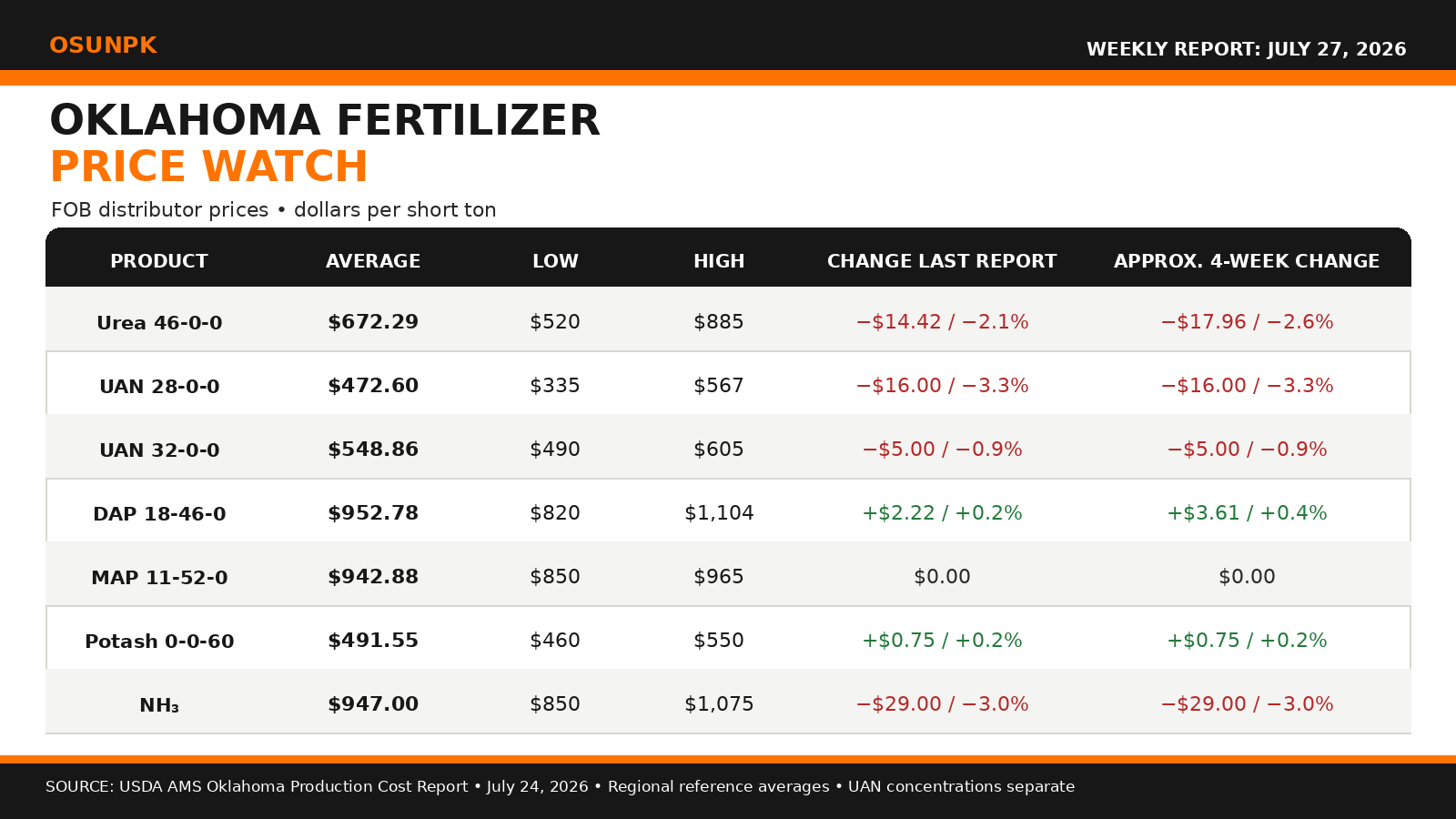
Potash remained the quietest major nutrient in Oklahoma. The reported average increased only 75 cents to $491.55, with a range of $460 to $550. Global potash supply is geographically broader than the supply chain for several nitrogen and phosphate inputs. Expanded or recovering shipments from major producing regions may help moderate market pressure, although trade restrictions, transportation constraints and regional demand can still affect delivered costs.
International buying also remains important. India reported importing more than 3.2 million metric tons of urea and DAP during its first fiscal quarter and is pursuing longer-term overseas supply agreements. Large import programs can affect competition for available urea and phosphate cargoes, especially when export availability is already uncertain. (Times of India fertilizer-import report)
For Oklahoma producers, the current report offers a somewhat more favorable nitrogen signal, but not a uniform one. Wide quote ranges mean that comparison shopping may be as important as the regional average. Phosphate prices are locally stable, while sulfur availability and production costs remain meaningful external risks. Potash is comparatively steady.
Before acting on any quotation, confirm the nutrient analysis, cash-price basis, pickup or delivery terms, quote expiration and whether application or blending charges have been separated. UAN quotations should always be identified as either 28% or 32% before comparison.

