Home » Grain Sorghum (Page 2)
Category Archives: Grain Sorghum

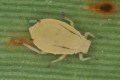
Sugarcane Aphids Numbers are Building in Oklahoma.
Guest Blog:
Jessica Pavlu, Graduate Research Assistant,
Tom A. Royer, Oklahoa State University Extension Entomologist
Co-Editors: Eric Rebek and Justin Talley; Oklahoma Cooperative Extension Service
On July 12, 2016, we found sugarcane aphids in a sorghum field in Caddo county that had exceeded treatment thresholds. Jerry Goodson, Extension Assistant in Altus, reported finding a sparse colony of sugarcane aphids in Tillman county last week. Most of the sugarcane aphid infestations that we have observed so far are located south of Interstate 40. We will continue to provide weekly reports of sugarcane activity throughout the rest of the summer growing season.
Oklahoma’s “Sugarcane Aphid Team” (which also includes Dr. Ali Zarrabi, Mr. Kelly Seuhs, Dr. Kristopher Giles from the Department of Entomology and Plant Pathology, USDA researchers Dr. Norm Elliott and Dr. Scott Armstrong, and Dr. Josh Loftin and Dr. Tracy Beedy from the Department of Plant and Soil Sciences), is conducting research to identify effective insecticides, resistant sorghum varieties, best cultural practices to avoid sugarcane aphid, and develop improved sampling and decision-making rules for treatment thresholds.
When scouting, make sure you are finding sugarcane aphid, as it can be confused with yellow sugarcane aphid. The sugarcane aphid (Fig.1) is light yellow, with dark, paired “tailpipes” called cornicles and dark “feet” called tarsi. The yellow sugarcane aphid (Fig. 2) is bright yellow with many hairs on its body and no extended cornicles.

Figure 1. Sugarcane aphid

Figure 2. Yellow sugarcane aphid
Currently the suggested treatment threshold for sugarcane aphid is to treat when 20-30 percent of the plants are infested with one or more established colonies of sugarcane aphids. An established colony is an adult (winged or wingless) accompanied by one or more nymphs (Fig 3).

Figure 3. Sugarcane aphid colony
Two insecticides, Sivanto 200 SL, and Transform WD, provide superior control of sugarcane aphid. Sivanto can be applied at 4-7 fluid ounces per acre. Transform WG can be applied at 0.75-1.5 oz. per acre. It is important to achieve complete coverage of the crop in order to obtain the most effective control. Consult CR-7170, Management of Insect and Mite Pests in Sorghum http://pods.dasnr.okstate.edu/docushare/dsweb/HomePage for additional information on sorghum insect pest management.
Sorghum “Whorlworm” and “Headworm” Decisions
Tom A. Royer, Extension Entomologist
This week, I received several reports of “worms” feeding in the whorls of sorghum (Fig 4) which I identified as fall armyworms. I rarely recommend that a producer treat for fall armyworms infesting whorl stage sorghum. Why? because available research suggests that under rain-fed production, whorl feeding rarely caused enough yield loss to warrant treatment costs, AND more importantly, most insecticide applications provide poor control. The poor control is a result of difficult delivery of the insecticide into the whorl allowing the caterpillars to avoid contact. However, recent unpublished research shows that some new insecticides may provide effective control of fall armyworm in the whorl, so it is time to revisit my recommendations.

Figure 4. “Whorlworm” damage
Recent unpublished research results conducted in irrigated sorghum out of Lubbock suggest that Prevathon®, Besiege®, and Belt® can provide acceptable control of the caterpillars in the whorl (even large caterpillars). Therefore, the second of the two reasons I listed above may no longer be true; they can be controlled. However, 1: these products were tested on irrigated sorghum 2: they are quite expensive 3: some products may flare sugarcane aphids and spidermites and 4: WE STILL DON’T KNOW HOW THEY IMPACT YIELD, thus, we are still “guessing” with regard to return on investment for control.
How has this information changed my recommendations? Keep in mind that the research in Texas was conducted in irrigated sorghum with a very high yield potential. Since Oklahoma growers typically grow rain-fed sorghum which has lower yield potential, my suggestion is to examine 30 plants (5 consecutive plants in 6 different locations) and split a few stalks to see where the panicle is located. If the panicles are close to emerging (boot stage), my “best guess” is to consider treating if 70% or more of the whorls are infested and there are an average of 1-2 live caterpillars present. Under this scenario, you would be protecting physical damage to the emerging head.
On choosing an insecticide I offer some things to consider. 1: the effective products may or may not be available. 2: some have the potential to flare sugarcane aphids and spidermites. 3: they are all expensive. Belt is still available for use, but EPA recently requested that Bayer voluntarily remove it from the market. Bayer refused, and asked for an administrative hearing. On June 1, an administrative law judge upheld EPA’s decision to cancel registration of Belt. Bayer is appealing and is scheduled to receive another review from the Environmental Appeals Board before July 6. If EPA prevails in the appeal process, Belt will no longer be available. However, Bayer says that Belt can still be sold, purchased and used during the appeals process.
I have little information on how Belt affects sugarcane aphids or spidermites. Besiege is a mixture of the active ingredient in Prevathon with an added pyrethroid. Research in Lubbock suggests that spidermites may flare with Besiege. We also know that any pyrethroid will flare sugarcane aphid. Prevathon has not shown the propensity to flare either spidermites or sugarcane aphids.
We are attempting to obtain data on the effectiveness of, and yield returns obtained from Prevathon to control fall armyworm in the whorl. Until I have more data, I can only say that a producer should carefully consider a decision to control “whorlworms”. The jury is still out as to whether controlling them is economically justified.
With regard to headworms, we have well-designed decision making capability coupled with solid treatment thresholds. USDA and University scientists developed a computer-based program that can calculate an economic threshold for headworms (Fig.5) and provide a simple sampling plan that tells the producer if threshold is reached (Fig.6).

Figure 5. Sorghum headworm
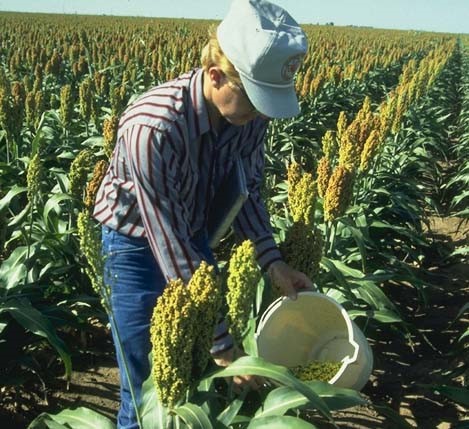
Figure 6. Bucket sampling for headworm
Called the Headworm Sequential Sampling and Decision Support System (http://entoplp.okstate.edu/shwweb/index.htm), it uses input on the plant population, the crop’s worth and the control costs to calculate a treatment threshold.
Now, prepare for the tricky part! If we only had to consider one pest, I would advise selecting the insecticide that works best on that pest. However, we now have to consider sugarcane aphid in all of our sorghum pest management decisions. In my opinion, if sugarcane aphid is already starting, a producer must consider using either Transform or Sivanto. That narrows the choice options for combining another product to control headworms because pyrethroids could flare the aphids.
I have reviewed data from multiple years of insecticide trials throughout the SE US. The data suggests that products containing chlorpyrifos provide spotty control of headworms. Data that I have reviewed from other insecticide trials suggests that Prevathon and Blackhawk provide excellent control of headworms and Diamond® was also effective on headworms. For information on spray mix compatibility, talk to the local sales representatives for the products you have chosen.
Consult CR-7170, Management of Insect and Mite Pests in Sorghum http://pods.dasnr.okstate.edu/docushare/dsweb/HomePage for more information.
Recent Weather Causing Corn (and Sorghum) Injury From Pre-emerge Herbicides
While this is not about fertility in the southern Great Plains I feel it is a very important topic. I will not be surprised if we don’t start seeing this in some of the corn and sorghum that was just planted before the rains. I would also add the over the years I often see bleaching in sorghum, that looks similar to zinc and/or iron deficiency, caused by atrazine injury. This typically occurs when atrazine is applied prior to a heavy rain. The atrazine is washed down slope and into the rows, the injury is almost always seen in low lying areas. The crop usually grows out of it.

Atrazine injury in sorghum. Heavy rains followed application. Pic via Rick Kochenower.
Brian A.
This article is written by Mr. Cody Daft, Field Agronomist Western Business Unit, Pioneer Hi-Bred
Have you noticed any corn leafing out underground prior to emergence? Have you seen tightly rolled leaves or plants that can’t seem to unfurl leaves and look buggy whipped? Almost all of the fields I have looked at recently have shown these symptoms in at least a portion of the field, and some fields this has been very widespread. The common denominator in all the fields I have viewed has been the herbicides applied were a metolachlor (Dual/Cinch type products) and the weather (cooler than normal, wetter than normal). Similar issues can be noted in grain sorghum to some extent.
The recent wet weather and water-logged soils have increased the possibility of corn injury from many popular soil applied herbicides. Corn growing in wet soils is not able to metabolize (degrade) herbicides as rapidly as corn growing in drier conditions. Plant absorption of herbicides occurs by diffusion. What this means is that the herbicide diffuses from locations of high concentration (application site on the soil) to low concentration (plant roots). The diffusion process continues regardless of how rapidly the corn is growing. In corn that is not growing rapidly (cool, wet conditions) corn plants can take up doses of herbicide high enough to show damage and a few differences in symptomology.
The unfortunate aspect of wet soil conditions is that additional stress is put on the plant not only to metabolize herbicide residues, but also to ward off diseases and insects. These additional stresses can impact a corn plant’s ability to metabolize herbicide.
The most common type of herbicide injury observed under these conditions is associated with chloroacetamide herbicides. These herbicides are used for control of grass and small seeded broadleaf weeds, and are seedling root and shoot inhibitors.
These products include the soil-applied grass herbicides such as:
- Dual/Cinch/Medal II
- Degree/Harness
- Microtech/Lasso
- Frontier/Outlook
- Define/Axiom
- And other atrazine premixes like Lumax (a premix of mesotrione (Callisto), s-metolachlor (Dual II Magnum), atrazine and a safener benoxacor).
What About The Injury Symptoms?
Before corn emergence:
- Stunting of shoots that result in abnormal seedlings that do not emerge from soil.
- Corkscrewing symptoms similar to cold/chilling injury.
- Corn plants and grassy weeds may leaf out underground and leaves may not properly unfurl.
After corn emergence:
- Buggy whipping – leaves may not unfurl properly.

Figure . Buggy-whipping symptom from carryover of PPO herbicides to corn.via https://www.pioneer.com/home/site/us/agronomy/library/herbicide-carryover/
What About Safeners?
Products like DUAL II Magnum herbicide contain the safener benoxacor which has been shown to enhance S- Metolachlor metabolism in corn. This enhanced metabolism can reduce the potential of S- Metolachlor injury to corn seedlings when grown under unfavorable weather conditions such as cool temperature or water stress. However, a safener is not the silver bullet, and slow plant growth may still have trouble metabolizing the herbicide even with a safener…but it does help the severity of damage/symptoms.
Will The Plants Recover?
Plants that have leafed out underground or show corkscrewed mesocotyl symptoms are likely to not recover or even emerge from below the soil. Larger plants that are already emerged that show tightly rolled leaves and are buggy whipped will most likely recover once the field sees drier conditions and we have warm weather and sun light to assist in better plant growth.
More Information Discussing Corn Injury From Pre-emerge Herbicides Here:
Cody Daft
Pioneer Hi-Bred
cody.daft@pioneer.com
Sampling for pH and liming in continuous no-till fields
This article is written by Dr. David Mengel, Kansas State University Soil Fertility Specialist.
One question that commonly comes up with continuous no-till operations is: “How deep should I sample soils for pH?” The next common question is: “How should the lime be applied if the soil is acidic and the field needs lime?”
Sampling depth in continuous no-till
First, sampling depth. Should two sets of samples be taken, at different depths?
Our standard recommendation for pH is to take one set of samples to a 6 inch depth. On continuous no-till fields where most or all of the nitrogen (N) is surface applied, we recommend taking a second sample to a 3-inch depth. We make the same recommendation for long-term pasture or grass hayfields, such as a bromegrass field that has been fertilized with urea annually for several years.
Nitrogen fertilizer is the primary driving force in lowering soil pH levels, so N application rates and methods must be considered when determining how deep to sample for pH. In no-till, the effects of N fertilizer on lowering pH are most pronounced in the area where the fertilizer is actually applied. In a tilled system, the applied N or acid produced through nitrification is mixed in through the action of tillage and distributed throughout the tilled area.
Where N sources such as urea or liquid UAN solutions are broadcast on the surface in no-till system, the pH effects of the acid formed by nitrification of the ammonium will be confined to the surface few inches of soil. Initially this may be just the top 1 to 2 inches but over time, and as N rates increase, the effect of acidity become more pronounced, and the pH drops at deeper depths. How deep and how quickly the acidity develops over time is primarily a function of N rate and soil CEC, or buffering capacity.
Where anhydrous ammonia is applied, or liquid UAN is knifed or coulter banded below the surface, an acid zone will develop deeper in the soil, usually 2-3 inches above the release point where the fertilizer is placed in the soil. So if the ammonia is injected 8 inches deep, there will be acid bands 5 to 8 inches below the soil surface. As with long-term surface applications, these bands will expand over time as more and more N fertilizer is placed in the same general area. The graphic below illustrates the effect of a high rate of ammonia placed in the same general area in the row middle on a high CEC soil for more than 20 years.
The actual depth of the acid zone in fields fertilized with ammonia gets tricky as application depth can vary depending on the tool used to apply the ammonia. Traditional shank applicators generally run 6 to 8 inches deep, so a sample for pH measurement could be taken at 3-6 inches or 5-8 inches deep, depending on how deep the shanks were run. The new low-disturbance applicators apply the ammonia 4-5 inches deep. A sweep plow or V-blade applies ammonia only 3-4 inches deep. So sampling depth for pH should really depend on where the acid-forming N fertilizer is put in the soil.

Mengel and West, Purdue Univ.
Liming application methods in continuous no-till
Now, where do you place the lime in continuous no-till? If you surface apply N, then surface apply the lime. That’s a simple but effective rule. But remember that surface-applied lime will likely only neutralize the acidity in the top 2-3 inches of soil. So if a producer hasn’t limed for 20 years of continuous no-till and has applied 100 to 150 pounds of N per year, there will probably be a 4-5 inch thick acid zone, and the bottom half of that zone may not be neutralized from surface-applied lime. So, if a producer is only able to neutralize the top 3 inches of a 5-inch deep surface zone of acid soil, would that suggest he needs to incorporate lime? Not really. Research has shown as long as the surface is in an appropriate range and the remainder of the acid soil is above pH 5, crops will do fine.
Liming benefits crop production in large part by reducing toxic aluminum, supplying calcium and magnesium, and enhancing the activity of some herbicides. Aluminum toxicity doesn’t occur until the soil pH is normally below 4.8. At that pH the Al in soil solution begins to increase dramatically as pH declines further. Aluminum is toxic to plant roots, and at worse the roots would not grow well in the remaining acid zone.
This implies that the acid zones from ammonia are probably not a major problem. We have monitored ammonia bands in the row middles of long-term no-till for many years and while the pH got very low, below 4.5, we never saw any adverse impacts on the crop that would justify liming and using tillage to incorporate the lime. In fact, some nutrients such as zinc, manganese, and iron can become more available at low pH, which can be an advantage at times.
Yield enhancement is not the only concern with low-pH soils, however. Herbicide effectiveness must also be considered. The most commonly used soil-applied herbicide impacted by pH is atrazine. As pH goes down, activity and hence performance goes down. So in acid soils weed control may be impacted. We do see that in corn and sorghum production.
Liming products for no-till
When choosing a liming product, is there any value to using dolomitic lime (which contains a large percentage of magnesium in addition to calcium) over a purely calcium-based lime product? On most of our soils in Kansas we are blessed with high magnesium content. So as long as we maintain a reasonable soil pH, there normally is enough magnesium present to supply the needs of a crop. Calcium content is normally significantly higher than magnesium, so calcium deficiency is very, very rare in Kansas. The soil pH would need to be below 4.5 before calcium deficiency would become an issue. Before calcium deficiency would occur, aluminum toxicity or manganese toxicity would be severely impacting crop growth. So producers really don’t have to worry about a deficiency of calcium or magnesium on most Kansas soils.
What about the use of pelletized lime as a pH management tool on no-till fields? The idea has been around for a while to use pel-lime in low doses to neutralize the acidity created from nitrogen and prevent acid zones from developing. There is no reason it won’t work, if you apply enough product each year. Pel-lime is a very high-quality product, normally having 1800 to 2000 pounds of effective calcium carbonate (ECC) per ton, and can be blended with fertilizers such as MAP or DAP or potash easily.
But it is costly. As an example, at a cost of $160 per ton and 1,800 lbs effective calcium carbonate (ECC) per ton, 100 pounds of ECC pel-lime costs $8.80. If it costs $25 per ton to buy, haul, and apply a 50% ECC limestone, that equates to $2.50 per 100 pounds ECC.
If you were applying 100 pounds of urea-based nitrogen, it would take approximately 180 pounds of ECC to neutralize the acidity produced by the N. This would require 200 pounds of 1,800 pound ECC pel-lime or 360 pounds of 50% ECC ag lime. The cost would be around $16 per acre with pel-lime or $4.50 per acre with ag lime. So technically, the pel-lime option is fine. But it would cost more than 3 times as much, at least in this example. You can use your own figures regarding costs and ECC of different lime products available to you to do a similar calculation. Deciding which product to use is a simple economic choice.
Summary
Applying N fertilizer to soil will cause the soil to become acidic over time. Placement of the applied N and the level of soil mixing done through tillage determine where the acid zones will develop. Make sure your soil testing program is focused on the area in the soil becoming acidic, and apply the lime accordingly.
Dave Mengel
Kansas State University
Professor Soil Fertility Specialist
dmengel@ksu.edu
4 Keys to Reaching Grain Sorghums Yield Potential
When I started writing this blog (3.13.2105) Ok grain elevator cash bids for grain sorghum aka milo was 6.61-7.70 cwt (3.7-4.31 per bushel) and corn was at 3.64-4.06 per bushel. Meaning there is currently a premium on sorghum grain. This difference among other things has increased the interest in planting sorghum. Of late I have been quite successful, at least on a small-scale, at producing sorghum yield in the 120-150 bpa range, thanks to the advice of Rick Kochenower former OSU sorghum specialist. Both of us believe that every year many producers are leaving significant bushels on the table due to one or two miss steps. I wanted to take this opportunity to share what is in my opinion the keys in producing a bumper sorghum crop. I should note that the primary key is out of our control, rain.
Key 1. Planting date, the optimum planting date for grain sorghum is generally when soil temperatures reach 60° F and increase after planting. For much of the region that I believe is best suited for sorghum this falls between April 1 and April 15 for south of I40 and April 15 and May 1 north of I40. graph below shows the long-term average daily 4″ soil temp (bare soil) for Apache, Blackwell, Cherokee, and Vinita. It is easy to see how your location within the state can impact soil temps.
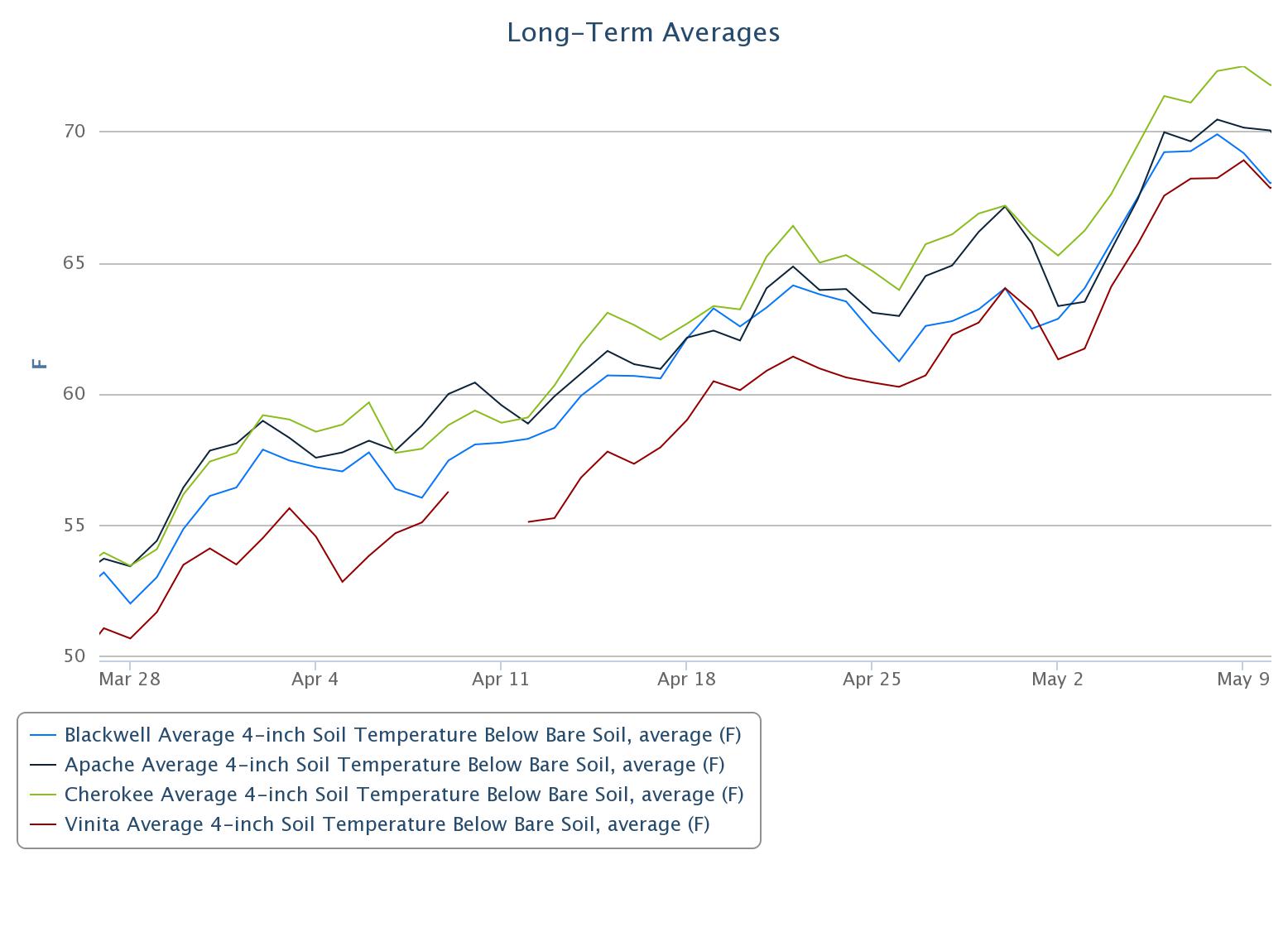
Long term average 4 inch soil temps from Blackwell, Apache, Cherokee, and Vinita for bare soil. Data from the Mesonet.org.
You should not forget however that tillage practices will also impact soil temps. The two graphs below show the long-term average daily 4″ soil temp for Cherokee and Blackwell for both bare soil and under sod. Note that when the soil is covered by residue it warms slower. The two figures also show that residue will have more impact in some areas more so than others.
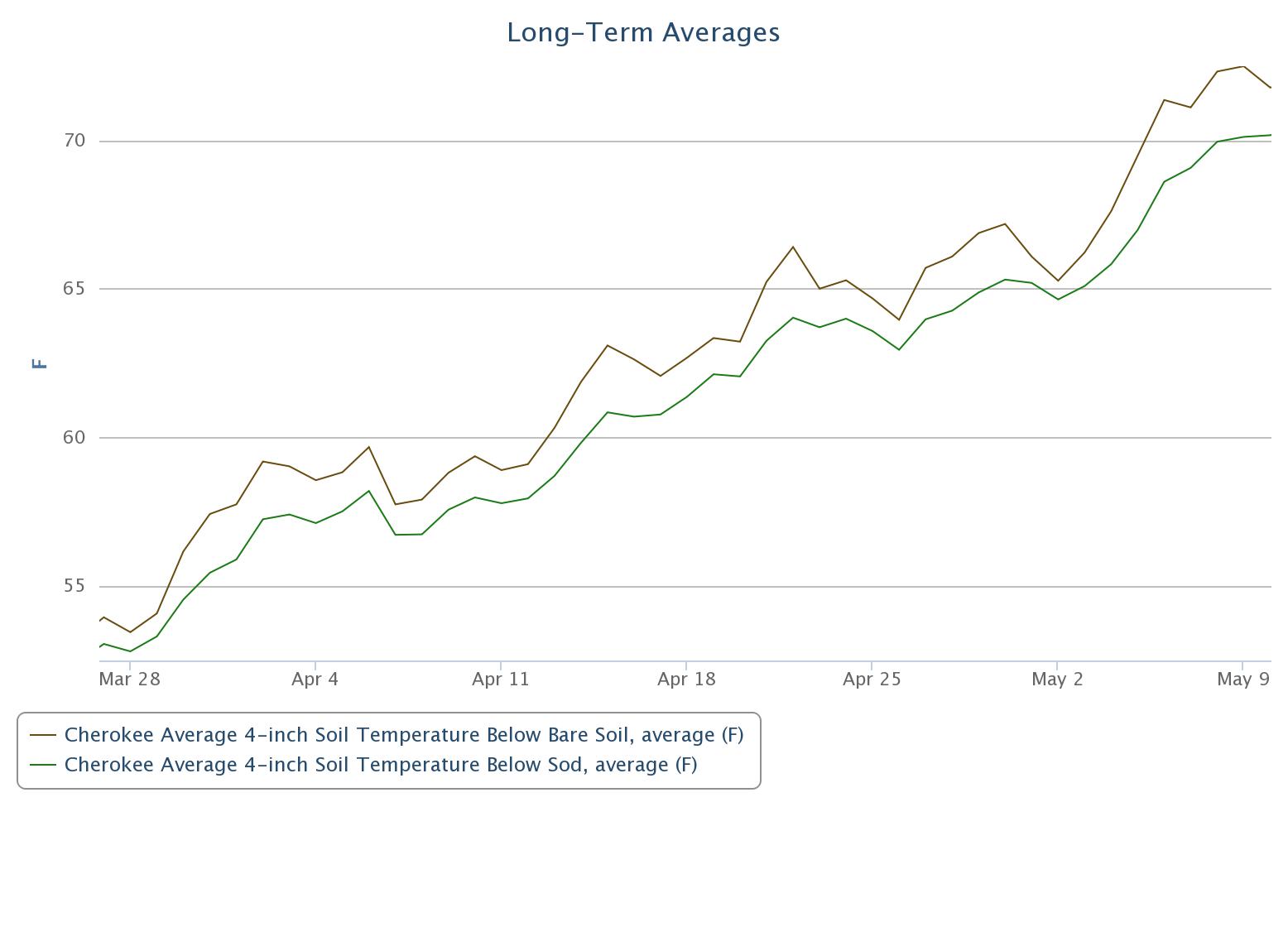
Long term average 4 inch soil temps at Cherokee for bare soil and under sod. Data from the Mesonet.org.
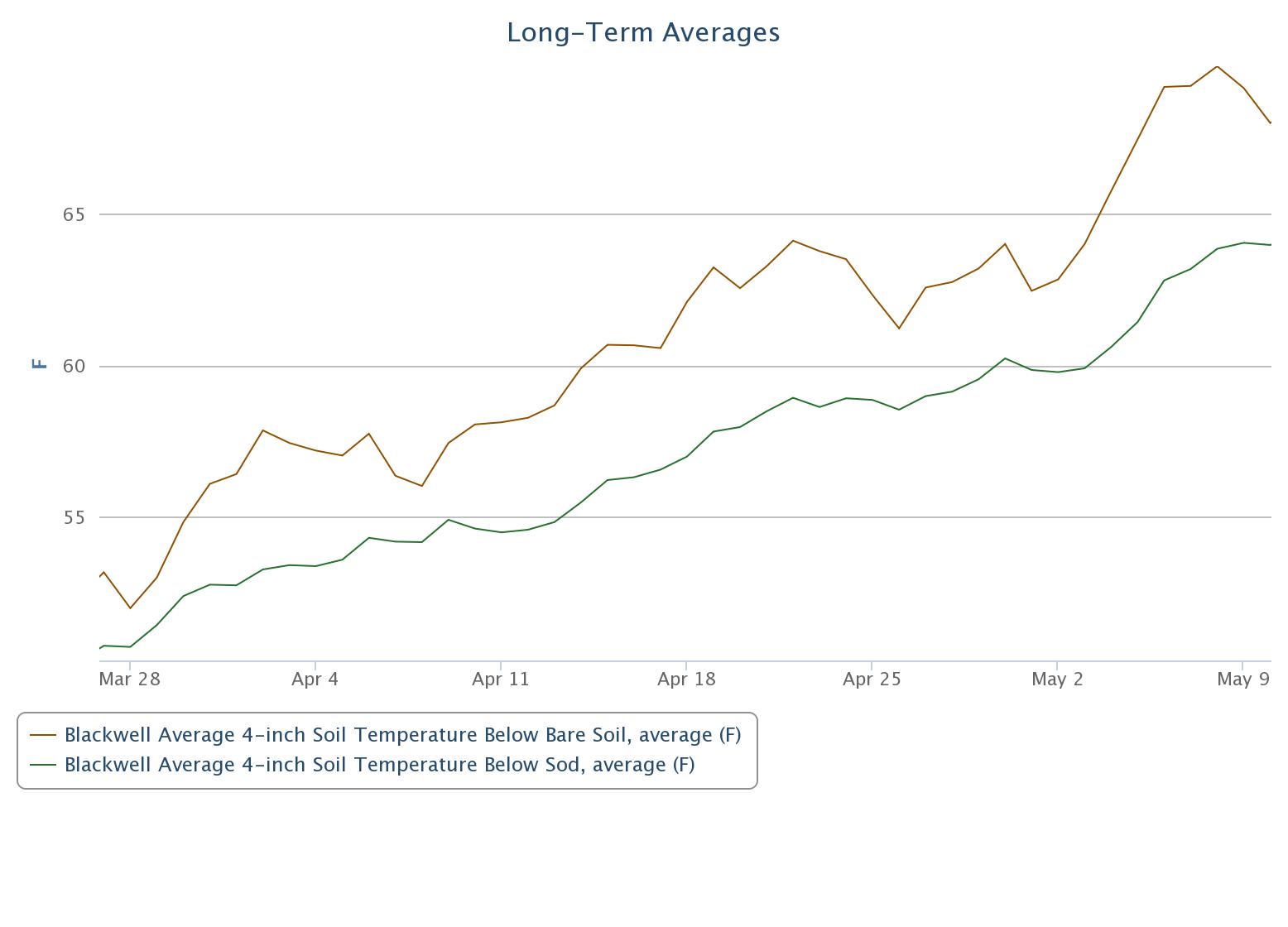
Long term average 4 inch soil temps at Blackwell for bare soil and under sod. Data from the Mesonet.org.
My best word of advise is to keep a watchful eye on the Mesonet. While the long-term average is nice to know here in Oklahoma the difference in weather from one year to the next can be huge. The figure below shows the average daily 4″ soil temp (below sod) from Blackwell for the past five years. Link to Mesonet Soil Temp page Click here.
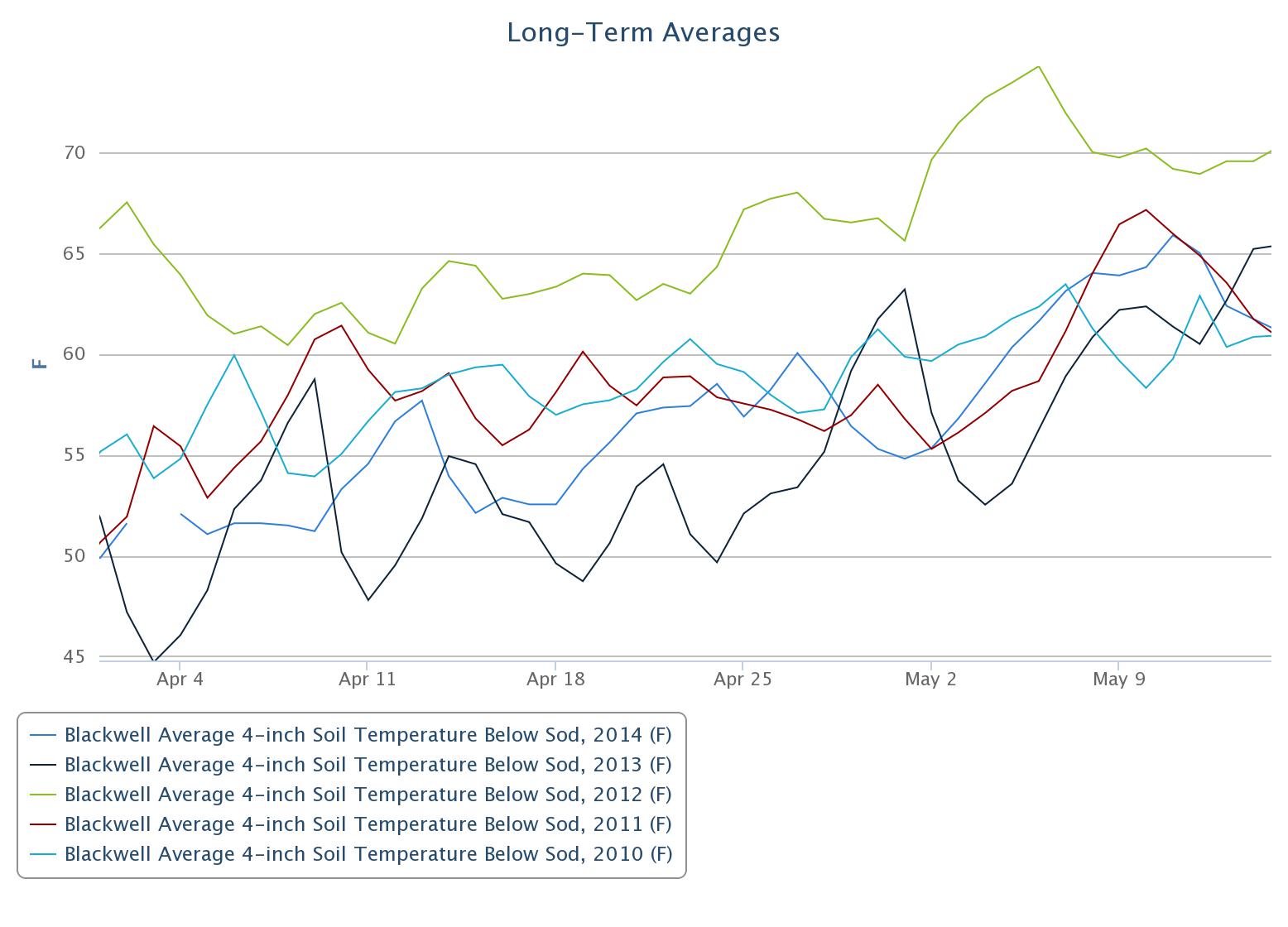
Average 4 inch soil temps at Blackwell for 2010, 2011, 2012, 2013, and 2014 for under sod. Data from the Mesonet.org.
Another great resource is a report on planting date written by Rick Kochenower presented to RMA. Link to report.
Key 2. Hybrid selection, primarily maturity group selection. Rick has created a great graphic that helps put a planting date window with maturity group. It is always important to visit with your local seed dealer to find out what has been performing best in your region and consider the importance of stay-green, standablilty and disease packages. But for me the number one key is the selection of maturity group. This should be based upon planting date and harvest strategies. Below is a great graphic created by Rick, while this may not be scientific it is a great guide created via years of experience. I also recommend that if you are planting a significant amount of acres you should diversify your maturity groups. Not only does this spread out he harvest window but it also you to spread the risk of high temps coming early or late. An additional resource is the Sorghum Performance trial summary located on the Ok Panhandle Research and Extension Center website. Click here.
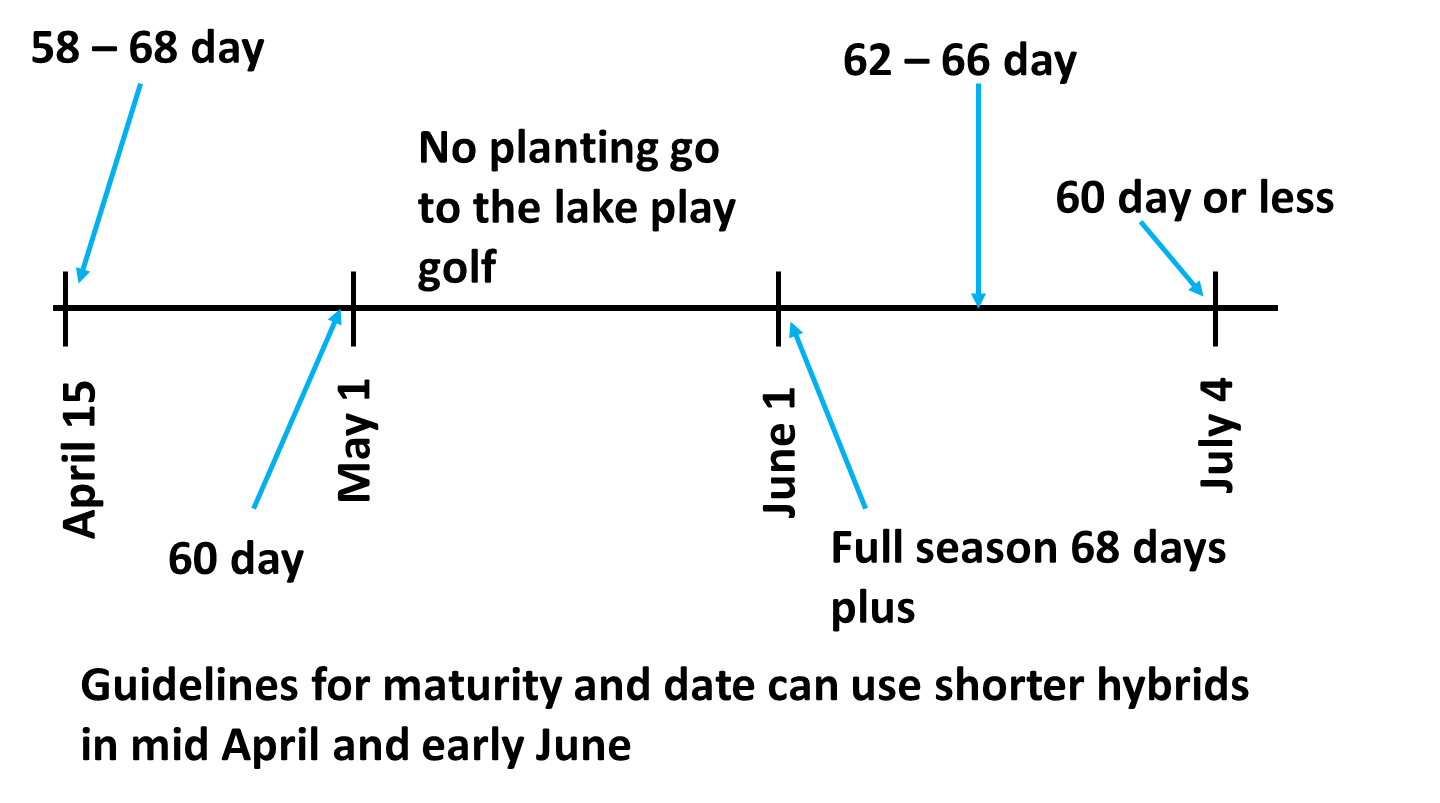
Timeline for optimum planting date (N of I-40) and proper maturity groups. Developed by Rick Kochenower (Chromatin seed)
Key 3. Soil Fertility, while soil pH plays a big role on sorghum productivity but it is too late in the game to do much about it this year. So the most important things to keep in mind on fertilizing sorghum are your macro-nutrients nitrogen (N), phosphorous (P) and potassium (K). It is my opinion that historically producers have underestimated the yield potential of sorghum and therefore lost yield due to under application on N. You should expect more than 60 to 80 bushel out of your crop if you put the right seed in the ground, at the right time and in the right way.
Ask around look at Rick’s yield data, producers in N. Central Ok on a good soil should be going for 125+ bpa easy. Unfortunately you are unlikely to hit these yield levels if you fertilize for a 75 bpa crop. An easy rule of thumb on N fertilization is 1.2 lbs of N per bushel, for a more exact number take a look at the image below. This comes from the corn and sorghum PeteSheet and is the same table that comes from the Soil Fertility Handbook. (If you would like some Pete Sheets just send me an email requesting them at b.arnall@okstate.edu, Link to PeteSheets page).

Nitrogen, Phosphorus and Potassium Recommendations for corn and sorghum production. Adapted from the Field guide and PeteSheet available at http://www.npk.okstate.edu
Key 4. Weed Control With sorghum utilizing a pre-plant herbicide with residual is extremely important due to the lack of over the top options. Most times proper weed control will be accomplished by utilizing concept treated seed and use of labeled rates of a pre-emergent grass control herbicide combined with atrazine.
While I primarily focus of the four keys above there are a few other important items to consider.
Population: Prefer to think in terms of seeds per acre instead of lbs per acre. This comes into to play with the use of a planter. Rick Kochenower says “for seeding rate(on 30 inch rows), it isn’t as critical as most people think it is. Because most guys in Oklahoma tend to under plant not over plant. I always suggested 45,000 but as you look at the last slide it really don’t matter much. The way I always liked putting it is to make you sure have enough out there to not have to replant, because being late hurts more than having to few too many or too few plants.”
Row spacing: I like 30, but many may not have a planter so I suggest at least plugging every other hole in the drill to be at a 12″-20″ spacing. Make sure your population is correct for your row spacing. For this consult with your local seed dealer to match cultivar with row spacing and proper population.
Insects: Scouting for aphids and head midge is very important, these little critters are yield robbers and can gum up the works at harvest.
Harvest prep: I almost put this as the fifth key. By chemically maturing/terminating your crop you are both able to increase harvest efficiency and preserve moisture for a following winter crop of wheat or canola.
While this is a good start I suggest a visit with your local OSU Extension educator, consultant or seed dealer for information about your specific situation. Just know the crop has great potential to yield big if treated right. I like to say don’t treat your sorghum crop like the stray you adopted, treat it like your hunting dog that you traveled halfway across the country to pick up. Good luck in 2015 and I hope the rains fall when and were needed.
 Down and Dirty with NPK