Home » General (Page 3)
Category Archives: General

Learning from Strip Trials.
This article is written by Dr. George Rehm, University Minnesota, Soil Fertility Specialist (retired).
See more of Dr. Rehm’s blogs at agwaterexchange.com.
Use of strip trials as a learning as a way to learn is becoming more popular across the Corn Belt. This is to be expected. Crop producers have a thirst for information. With GPS technology and yield monitors, and the use of common sense, it’s not difficult to establish strip trials for the purpose of evaluating a concept or compare one or more products or rates of a product. There are, however, some important considerations for the conduct of a strip trial. These begin with planning before planting and continue with appropriate interpretation of the data following harvest. These considerations are summarized in the paragraphs that follow.
IN THE PLANNING PROCESS, SIMPLICITY RULES — Speaking from years of experience, when planning, it’s very easy to bite off more than you can chew. What looks easy or simple on paper can be a logistical problem when you go to the field. So, make comparisons simple. If comparing rates of nitrogen fertilizer for corn, for example use no more than three rates. It’s nice to have a control (the variable of interest is not used). The treatments to be compared must be repeated in the field at, least three times. If comparing rates of nitrogen fertilizer for corn, for example, use no more than three rates. It’s nice to have a control (the variable of interest is not used). The treatments to be compared must be repeated at least three times. The replication must be in the same field. It is almost a waste of time if fields are used as replications. If a control is used, it should also be replicated three times.
SITE UNIFORMITY — The day of selection of the site for a strip trial is probably the most day for the entire project. Soil uniformity is a must. There is no easy and simple procedure that can be used to correct for lack of soil uniformity at the site. There are several tools that can be used to select for soil uniformity. The Soil Survey should not be ignored. Soil test information based on either grid or zone sampling can also be very valuable. Time spent in selecting a uniform site is time well spent.
PRODUCTION PRACTICES — Once a specific comparison has been selected it’s very important to keep other production practices constant. For example, information from a strip trial designed to compare nitrogen rates has little value if varieties are changed in the trial area. Except for the factor of interest, keep all other production practices constant across the strip trial area. Two production practices that change across the strip trial cannot be changed at the same time. Careful planning for this type of project takes time and thought.
DATA COLLECTION — Unless there are special reasons to do otherwise, samples collected from treatments at any strip trial site should be collected at the same time. This practice reduces variability in the data. Considering yields, use of combine yield monitors or weigh wagons is certainly appropriate. Although this may be obvious to most, it is essential to record yields from each strip separately.
STATISTICAL ANALYSIS — There’s a reason for repeating (replicating) each treatment at least three times. The project is not complete until the data collected have been analyzed with a mathematical procedure called “statistical analysis”. I think that we all realize that there is variability across any field. With all factors being equal, we could combine four strips across any field and the yields would not be the same. So, when we see differences in yield, the obvious question is: “Is the difference in the yield the result of a real difference caused by the factor being considered or variability across the field?” Statistical analysis is the tool needed to answer this question. There is no other way to answer this question.
Let’s look at an example illustrating the importance of statistical analysis. Using strip trials in different counties, two rates of nitrogen were compared. There were three strips of each rate. For a field in Kandiyohi County with corn following a soybean crop, yields from the lower nitrogen rate (149 lb. soil + fertilizer N/acre) were 123, 157, and 170 bu./acre for the three strip receiving this rate. These three yields average to 150 bu./acre. For the higher nitrogen rate (199 lb. soil + fertilizer nitrogen), the three yields were 157, 176, and 166 bu./acre. This averages 171 bu./acre. Using these arithmetic averages, the initial conclusion is that the higher nitrogen rate was better than the lower nitrogen rate It would certainly appear that 171 bu./acre is better than 150 bu./acre. If statistical analysis is used, however, the difference in yield is not statistically significant. Why? This conclusion is the consequence of substantial variability among three replications. In other words, the arithmetic difference is due to variability in yield across the field rather than the factor being compared.
For the same project, a strip trial was used on a field in Carver County. The corn/soybean rotation was used. The low nitrogen rate was 102 lb./acre and the higher nitrogen rate was 151 lb./acre. Yields from the three strips with the low nitrogen were 181, 196, and 195 bu./acre with an average of 191 bu./acre. For the high nitrogen rate, yields from the three strips were 208, 210, and 207 bu./acre with an average of 208 bu./acre. Statistical analysis of this yield data showed that the difference between 191 bu./acre and 208 bu./acre was not due to variability in the field. It was, in fact, the result of the rate of nitrogen applied. Notice that variability among the three replications for each nitrogen rate was small. Thus, we can say with confidence that there was a REAL difference in yield caused by the rate of applied nitrogen.
Nearly everyone involved with strip trials wants to present an economic analysis of the yield data. This is logical. HOWEVWE, an economic interpretation is only valid if differences between or among treatments is STATISTICALLY SIGNIFICANT. Otherwise, we make a serious MISTAKE that could have serious economic consequences. For the Kandiyohi County field, the difference in yield could have been caused by treatment applied or natural variation in the field. We have no way of knowing the real cause. For the trial in Carver County, we are sure that the difference in yield was due to the rate of nitrogen applied. Use of statistical analysis allows us to reach this conclusion. Now economic interpretation can be applied to the results.
SUMMING UP — Use of strip trials is a good way to make comparisons between or among factors that affect crop production. In addition, these comparisons can be conducted in growers’ fields. However, it’s not an easy task to do an accurate job. Good planning is needed at the beginning and STATISTICAL ANALYSIS is essential at the end. There are too many comparisons where statistical analysis is ignored and only arithmetic averages are used. Without statistical analysis, there can be any number of interpretations of the data. Statistical analysis eliminates the potential for confusion.
Dr. George Rehm,
University of Minnesota
Nutrient Management Specialist (retired)
rehmx001@umn.edu
Check Canola for Aphids
Tom A. Royer, Extension Entomologist
I have received scattered reports of cabbage aphids infesting canola racemes and low levels of green peach aphids feeding on canola leaves. Cabbage aphids are small, 2.0-2.5 mm (1/12 inches) blue-gray aphids with short cornicles. They are usually covered with a powdery wax coating. They are often found clustering on the developing panicle (Figure 1). They can cause plant stunting, distortion of growth, and flower abortion.

Cabbage Aphids
Green peach aphids are pale green to yellow (and sometimes pink) with long cornicles and antennae and measure 1/8 inch. They are found in winter and spring on leaves (Figure 2). Their feeding can cause stunting and defoliation. They can also transmit plant disease-causing viruses such as cauliflower mosaic and turnip mosaic viruses.
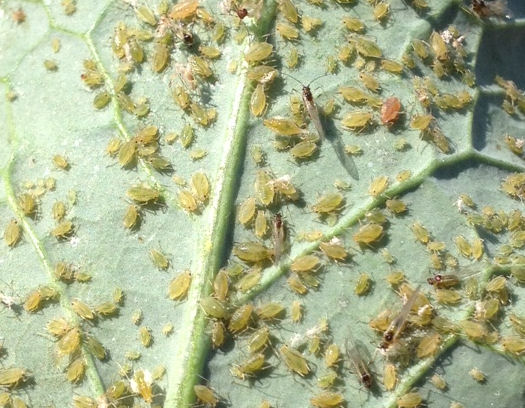
Green Peach Aphids
Scout for aphids by looking on the underside of the leaves, and racemes. For cabbage aphids, research conducted in Australia suggests that an insecticide application is justified if 20% of the racemes are infested with cabbage aphids.


For green peach aphids, research conducted by Dr. Kris Giles at OSU found that and average of one green peach aphid per plant can reduce seed yield by about 0.5 lb per acre. Thus, if the cost of an application is $10 per acre, and canola is bringing $0.2 per pound (quote from ADM Farmer Services 04/08/2016 www.adm.com), an infestation of 100 aphids per plant would cause yield loss of $10.00 (50 lb, x $0.2/pound) which is equal to the cost of the application. This is known as the ECONOMIC INJURY LEVEL (EIL). We typically set the ECONOMIC THRESHOLD (ET) below the EIL, in this case at 80% of the EIL (80 aphids per plant) to give time to schedule an application before the EIL is reached. Below is a set of suggested ECONOMIC THRESHOLDS, based on the cost of the application.
Application Cost Economic Injury Level Economic Threshold (Application cost/
0.5 lb/aphid x $0.2/lb (0.8 x EIL)
$8.00/acre 80 aphids/plant 64 aphids/plant\
$10.00/acre 100 aphids/plant 80 aphids/plant
$12.00/acre 120 aphids/plant 98 aphids/plant
$14.00/acre 140 aphids/plant 112 aphids/plant
Current recommendations for control of aphids in canola are listed in CR-7667, Management of Insect and Mite Pests in Canola which can be obtained online at http://pods.dasnr.okstate.edu/docushare/dsweb/Get/Document-3045/CR-7667web2009.pdf.
Transform® insecticide is no longer registered for use in canola as of November 11, 2015. Only existing stocks that have already been purchased and delivered to the grower before the cancellation can be applied according to the label.
Remember, green peach aphids have a history of developing resistance to pyrethroids, which are the primary registered insecticides for use in canola. Thorough coverage of an insecticide application is necessary to obtain optimal control.
If you notice natural enemy activity, especially lady beetles, and want to preserve their activity, keep several things in mind. Our research shows that Beleaf® insecticide is particularly benign to natural enemies because of its slow acting efficacy on aphids, which allows aphid-feeding beneficials to continue to eat them with little to no consequence on their biology. That being said, cabbage aphid may contain toxins that they acquire through their feeding which make them less palatable to some predators, and reduces their effectiveness as natural controls.
With all pesticides, review label restrictions for applications during bloom, as honeybees can be killed if exposed to several of the registered products. One registered product, Beleaf® (FMC Corporation) does not have any restrictions for application during bloom.
Wrong Then Wrong Now
This article is written by Dr. George Rehm, University Minnesota, Soil Fertility Specialist (retired).
See more of Dr. Rehm’s blogs at www.agwaterexchange.com
Various products and/or concepts that pertain to crop production seem to cycle with time. I’m never surprised. There are foo-foo juice products that have disappeared only to appear sometime later under a different name. Likewise, there are concepts that have been proven by research to be bogus. Yet, they don’t die. There appear again. It seems that there are always some who attempt to make money from farmers by selling revived foo-foo juice products or bogus concepts. To paraphrase a line from a once-popular song: “everything old is new again”.
Recently, there has been a revived promotion of CATION EXCHANGE CAPACITY (CEC) and CATION RATIOS. The CATION RATIO concept has sometimes been referred to as “BALANCED SOIL FERTILITY”. So, some review of what we know about CEC and balanced cations is probably appropriate at this time.
The concept of CEC and it’s relationship to crop production was first researched in New Jersey in the mid-1940’s. At that time, researchers measured the CEC of soils as well as the exchangeable cations (Ca++, Mg++, K+). The CEC is a nearly constant property of soils that is directly related to soil texture. Sandy soils have relatively low CEC values. BY contrast, fine textured soils have high CEC values. The exchangeable cation values (Ca++, Mg++, K+) vary with other soil properties — mainly soil pH.
In the New Jersey soils, the researchers measured the exchangeable cations in a “productive soil” and a “non-productive” soil. They calculated the ratios of one cation to another. For example, the ratio of Ca++ to Mg++ was 6.5 to 1. Alfalfa was the test crop. So, it was thought that a “productive” soil should have a Ca to Mg ratio of this value. These researchers neglected one important piece of information. This was that lime had been used on the “productive” soil but not on the “non-productive” soil and the sandy soil had an acid pH. The lime supplied Ca++. Do you suspect that productivity of the alfalfa crop was a consequence of the use of lime rather the magic ratios? In the years that followed, numerous research projects were conducted through the Midwest for the purpose of investigating the effect of cation ratios on crop production.
There were the comparisons of fertilizer recommendations provided by various Soil Testing Laboratories. Some followed the cation ratio concept. Others Used the sufficiency approach based on the response of crops to measured levels of available nutrients by standardized, routine analytical procedures. Although costs of fertilizer recommended by these approaches varied considerably each year for extended periods of time (14 years in Nebraska), crop yield was not affected. Fertilizer recommendations based on the cation ratio concept were much higher than those that were based on the sufficiency approach.
The results of the Midwest research led to the conclusion that the ratio of one cation to another in soils had no effect on crop production. Crop response to fertilizer was the result of the nutrient supply in the soil — not ratios. Nutrient supply is measured by the standard analytical procedures. The crop has no interest in ratios. Given the uniformity of the conclusions of these research projects, it appeared that the “ideal ratio” or “balanced nutrient” concept was dead and had disappeared from our knowledge base that pertained to soil fertility and fertilizer use.
Land Grant universities in the northern and western Corn Belt have published reports that document the bogus nature of the ideal cation ratio concept. Staff at Agvise Laboratories have worked hard and listed the links to these reports on the Laboratory web site. The web address is: agvise.com if anyone is interested in the detailed reports.
The concept of IDEAL CATION RATIOS has been thoroughly research for several crops. There is consistency in the results of this research. This concept is not in any way related to effective and economical fertilizer recommendations. In fact, use of this concept has a high probability of producing less than optimum recommendations for use of potash fertilizers on sandy soils.
The concept of IDEAL CATION RATIOS as a basis for fertilizer recommendations is truly bogus and has no place in agriculture. Please use this ratio concept if you want to waste money on fertilizer purchases in 2015. Those who advocate the use of this concept are not up to date in their understanding of modern principles of soil fertility. They’re still working in the 1940’s. It was WRONG THEN and it’s WRONG NOW.
Dr. George Rehm,
University of Minnesota
Nutrient Management Specialist (retired)
rehmx001@umn.edu
Recent Weather Causing Corn (and Sorghum) Injury From Pre-emerge Herbicides
While this is not about fertility in the southern Great Plains I feel it is a very important topic. I will not be surprised if we don’t start seeing this in some of the corn and sorghum that was just planted before the rains. I would also add the over the years I often see bleaching in sorghum, that looks similar to zinc and/or iron deficiency, caused by atrazine injury. This typically occurs when atrazine is applied prior to a heavy rain. The atrazine is washed down slope and into the rows, the injury is almost always seen in low lying areas. The crop usually grows out of it.

Atrazine injury in sorghum. Heavy rains followed application. Pic via Rick Kochenower.
Brian A.
This article is written by Mr. Cody Daft, Field Agronomist Western Business Unit, Pioneer Hi-Bred
Have you noticed any corn leafing out underground prior to emergence? Have you seen tightly rolled leaves or plants that can’t seem to unfurl leaves and look buggy whipped? Almost all of the fields I have looked at recently have shown these symptoms in at least a portion of the field, and some fields this has been very widespread. The common denominator in all the fields I have viewed has been the herbicides applied were a metolachlor (Dual/Cinch type products) and the weather (cooler than normal, wetter than normal). Similar issues can be noted in grain sorghum to some extent.
The recent wet weather and water-logged soils have increased the possibility of corn injury from many popular soil applied herbicides. Corn growing in wet soils is not able to metabolize (degrade) herbicides as rapidly as corn growing in drier conditions. Plant absorption of herbicides occurs by diffusion. What this means is that the herbicide diffuses from locations of high concentration (application site on the soil) to low concentration (plant roots). The diffusion process continues regardless of how rapidly the corn is growing. In corn that is not growing rapidly (cool, wet conditions) corn plants can take up doses of herbicide high enough to show damage and a few differences in symptomology.
The unfortunate aspect of wet soil conditions is that additional stress is put on the plant not only to metabolize herbicide residues, but also to ward off diseases and insects. These additional stresses can impact a corn plant’s ability to metabolize herbicide.
The most common type of herbicide injury observed under these conditions is associated with chloroacetamide herbicides. These herbicides are used for control of grass and small seeded broadleaf weeds, and are seedling root and shoot inhibitors.
These products include the soil-applied grass herbicides such as:
- Dual/Cinch/Medal II
- Degree/Harness
- Microtech/Lasso
- Frontier/Outlook
- Define/Axiom
- And other atrazine premixes like Lumax (a premix of mesotrione (Callisto), s-metolachlor (Dual II Magnum), atrazine and a safener benoxacor).
What About The Injury Symptoms?
Before corn emergence:
- Stunting of shoots that result in abnormal seedlings that do not emerge from soil.
- Corkscrewing symptoms similar to cold/chilling injury.
- Corn plants and grassy weeds may leaf out underground and leaves may not properly unfurl.
After corn emergence:
- Buggy whipping – leaves may not unfurl properly.

Figure . Buggy-whipping symptom from carryover of PPO herbicides to corn.via https://www.pioneer.com/home/site/us/agronomy/library/herbicide-carryover/
What About Safeners?
Products like DUAL II Magnum herbicide contain the safener benoxacor which has been shown to enhance S- Metolachlor metabolism in corn. This enhanced metabolism can reduce the potential of S- Metolachlor injury to corn seedlings when grown under unfavorable weather conditions such as cool temperature or water stress. However, a safener is not the silver bullet, and slow plant growth may still have trouble metabolizing the herbicide even with a safener…but it does help the severity of damage/symptoms.
Will The Plants Recover?
Plants that have leafed out underground or show corkscrewed mesocotyl symptoms are likely to not recover or even emerge from below the soil. Larger plants that are already emerged that show tightly rolled leaves and are buggy whipped will most likely recover once the field sees drier conditions and we have warm weather and sun light to assist in better plant growth.
More Information Discussing Corn Injury From Pre-emerge Herbicides Here:
Cody Daft
Pioneer Hi-Bred
cody.daft@pioneer.com
I am in Extension and I am just borrowing your idea
This blog is a bit of a self-serving advertisement while at the same time telling an important story about a successful extension program. I am still a newbie in terms of service years as I just finished my sixth year as a state specialist. Over this time I have learned an important fact, an idea or concept does not have to be your own to be applicable. Case in point, ever since grad school I’ve had a tent card, 4”x 3.5” card folded in half to equal the size of a business card, from Potash and Phosphate Institute (PPI), now the International Plant Nutrition Institute (IPNI) pinned to my wall. The Plant Food Uptake card has the nutrient concentrations of the primary grain crops grown in the Great Plains. During my research, it was a handy piece of information. Today, it still hangs on my board today with a series of out-dated photos and thank you cards from former students.
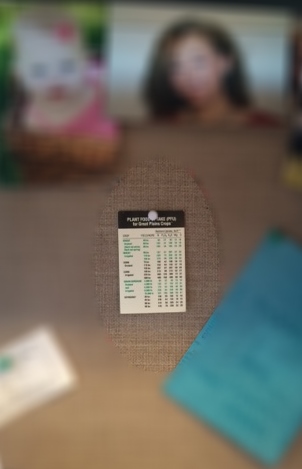
Plant Food Uptake (PPI)
It is from the Plant Food Uptake card that I developed the concept of the first Pete’s Sheets Do’s and Don’ts of using N-Rich Strips and N-Ramps in 2008. I personally thought this was a great idea but did not know if it would be well received by my audience. The results have been more than I could have ever imaged. Since 2009, I have developed 10 additional Pete’s Sheets with the latest out for print. I keep close tabs on how many I have ordered, and the latest order brings to total 38500 Pete’s Sheets. I currently have 8000 Pete’s Sheets on hand, which means there is approximately 30,000 cards in circulation. I doubt any fact sheet I have ever written has that level of distribution.
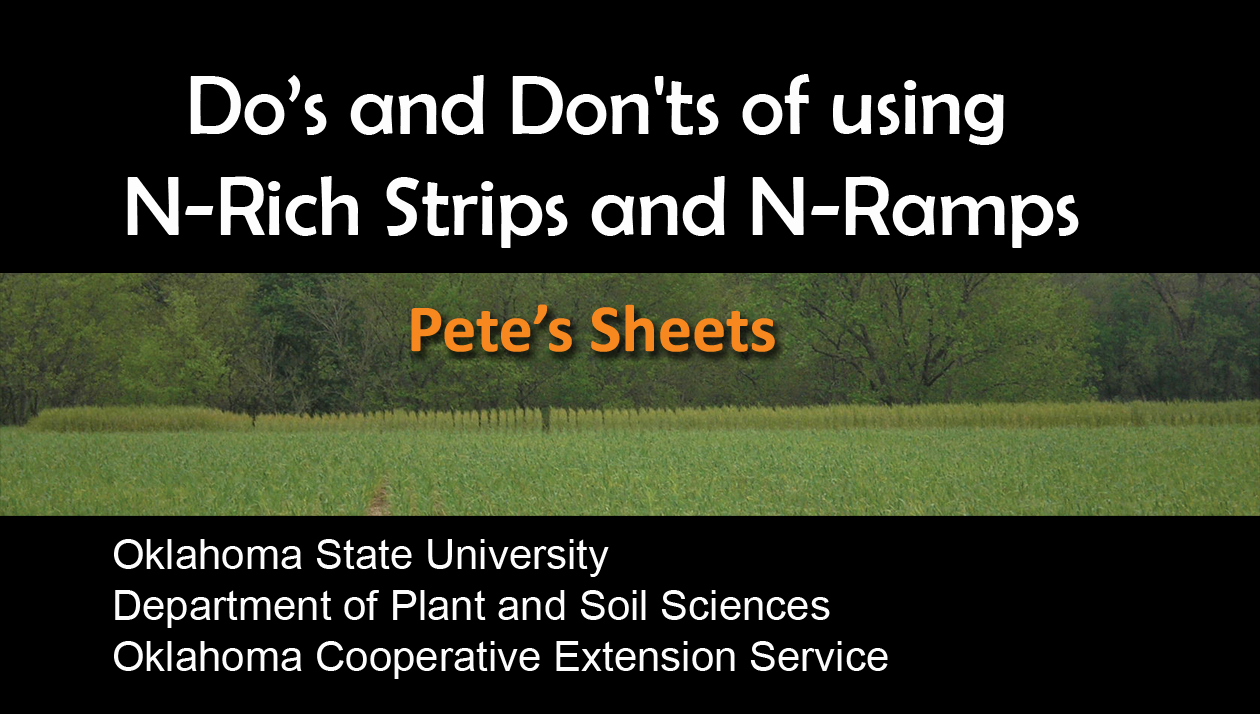
Cover of the first Pete’s Sheets produced.
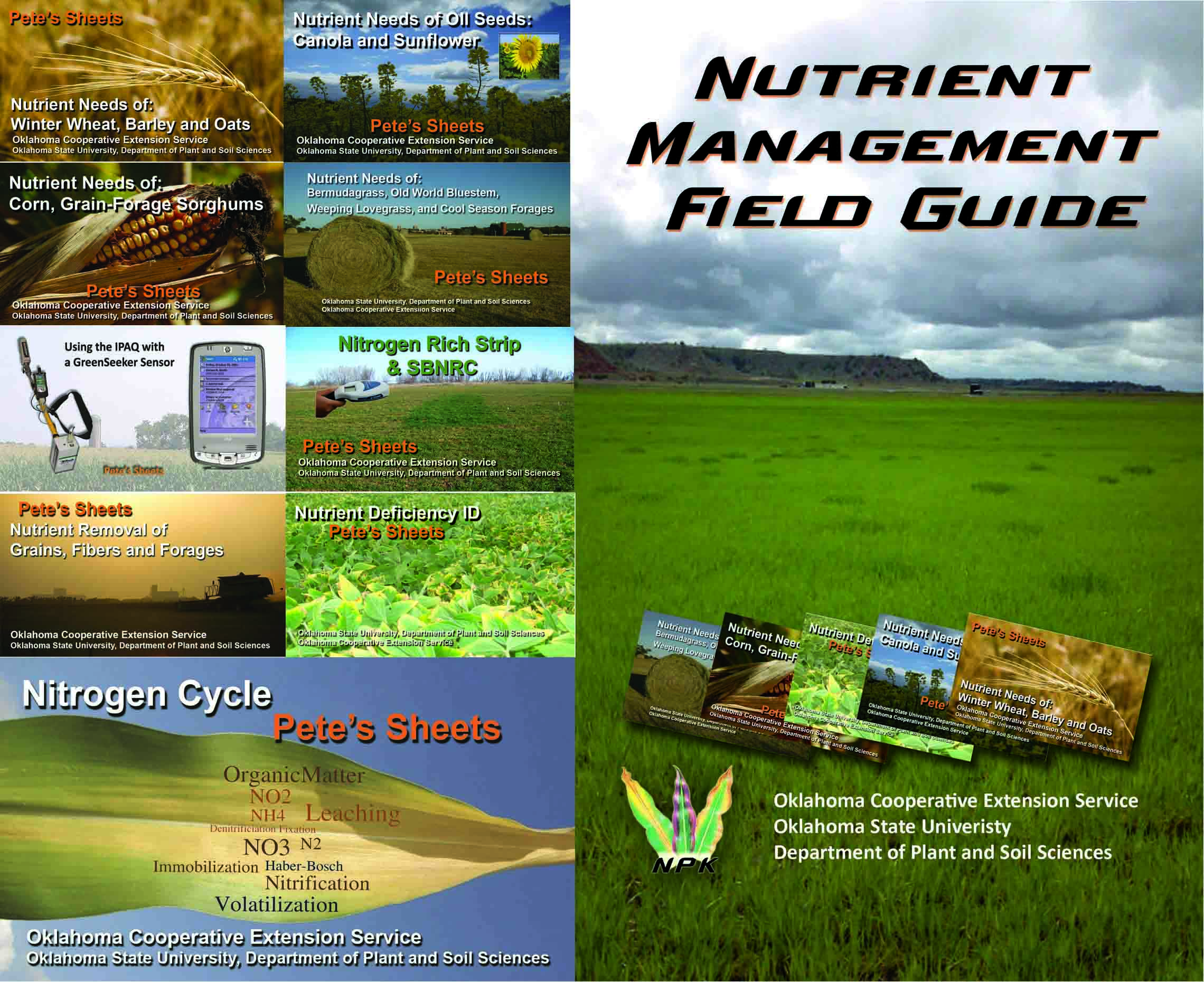
Pete Sheets for business card size tent cards Fact-Sheet/Research based information.
The Nutrient Management Field Guide is a spiral bound compilation.
I am able to travel to meetings and speaking engagements with relevant Pete’s Sheets easily in tow, and I also provide bulk quantities for free via request. Another enjoyable aspect of the Pete’s Sheets is I am able to place them in a tray on my office door. It is always a good day when I have the need to refill card holders, and this happens surprisingly often.
The spin-off from the PS has also been quite impressive. One of the best complaints I have ever received was from a producer who quipped he could no longer carry all of the Pete’s Sheets in his wallet. I took that as a major complement and went to work at compiling the cards immediately. The outcome was the 5″x 8″ spiral bound Nutrient Management Field Guide which has been equally successful. Not only did I “borrow” the tent card concept from PPI/IPNI, but I have also “borrowed” the idea of providing a customized logo just as Purdue has with its fields guides. The most famous is probably the Purdue Corn and Soybean Field Guide. While the custom logo has not been widely utilized, the times it has the revenue has been used to purchase more standard cards.

Office door with the Pete’s Sheets tray. Always free to a good home.
My take home from this experience is in extension old ideas can easily be incorporated into new educational tools. Often, it takes just a little time and imagination to be successful. Pete’s Sheets now greatly aid both my extension and teaching programs.
Now to the self-serving portion of the blog an announcement for the newest card titled Nitrogen Cycle. Within the Pete’s Sheet is a visual representation of the N-cycle, which every student enrolled in my Soil Nutrient Management course must learn, and the back of has a list of important N-cycle terms with definitions. I will mail Pete’s Sheets to anyone requesting a set, with a maximum of 100 per style. I continuously look for new ideas and topics and welcome any suggestions. View pdfs of the cards and booklets or download the custom order form on my NPK website at http://npk.okstate.edu/petesheets. To receive sets of the standard Pete’s Sheets, simply email me your request and provide a mailing address.
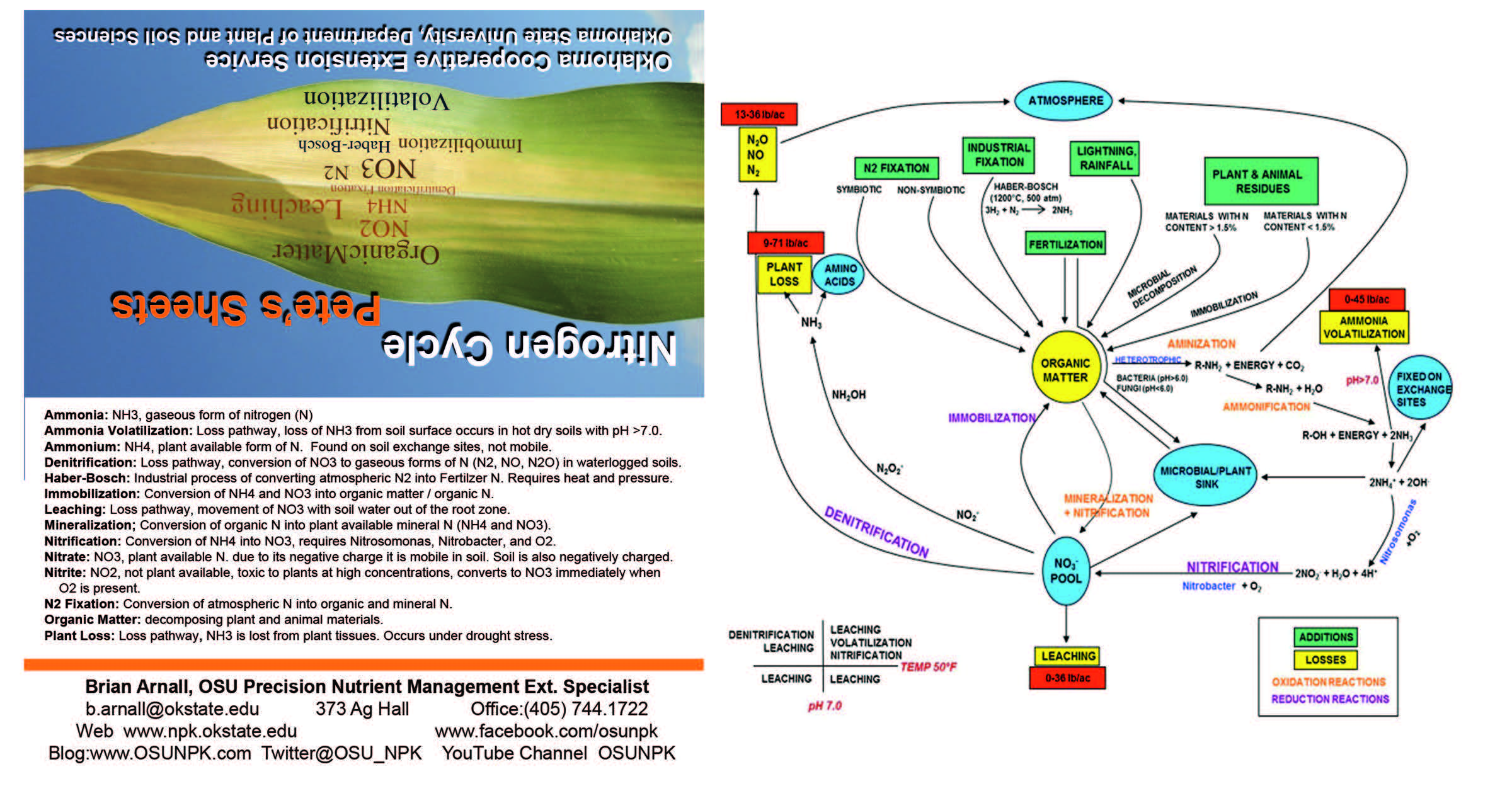
Nitrogen Cycle Pete’s Sheet
Time to start topdressing wheat
Great write up by Dr. Edwards.

There are few crop inputs that deliver as much return on investment as nitrogen fertilizer. It takes approximately two pounds of nitrogen, costing approximately $1.00, to produce one bushel of grain worth about $6.00. Of course, nitrogen is not the only yield determining factor in a wheat crop. Also, the law of diminishing marginal returns eventually kicks in, but nitrogen fertilizer is still one of the safest bets in the house.
Top dress nitrogen fertilizer is especially important because it is applied and utilized at a time when the plant is transitioning from vegetative to reproductive growth. Several things, including the number of potential grain sites, are determined just prior to jointing and it is imperative that the plant has the fuel it needs to complete these tasks. Jointing also marks the beginning of rapid nitrogen uptake by the plant which is used to build new leaves, stem, and the…
View original post 659 more words
Ag Apps Updated
Since my Ag App post in July I have presented on the topic an additional five times and have two more on the books for 2014. A good thing about doing talks is that you have to update the information to remain current. Which in all honesty, when it comes to technology of any kind this is quite challenging and even more so for Smart Phone Apps. In July when I first blogged on the subject I had 76 apps on my iPad. Today (1.3.14) I have 111 apps on my iPad, for both the iPhone and iPad, that I deem to be Ag related. Since the summer I have found new favorites, changed some, and added categories but for the most part I still maintain my 2 minute rule stated in the first blog. I have allowed a bit more leniency in that I now say “If I cannot figure it out in 3 minutes it’s GONE. An app should be intuitive, easy to use and have a purpose. They only exception to the 3 minute rule is the Scouting and Mapping Apps. Because of their complexity I allow them 5 minutes, and then I am done. Any app with GIS in its name gets much more time” I guess I am just getting soft.
Again I must make the obligatory statement; I am not a developer, designer, or expert. I am just a user who has had a chance to look at a few apps. Almost all of the apps I have are free and I am sure I have missed a few. Please share those with me. I am also not discussing Mobi’s, this is another large group of quality decision aid tools. I am also not discussing none apples apps. This is not because they are not relevant or important, it is because I do not have that technology.
I now have nine Ag folders on my iPad:
Ag News/Weather/Markets, Scouting/Mapping, Record Keeping, ID Tools, Crop Tools, Calculators, Sprayer/Chemicals, Fertilizer, Seed Select.
Apps are nice because the majority are stand alone and do not need internet or cell connection. This means they can be used when you are in the middle of nowhere, which is a great deal of Oklahoma, and have no service. This will exclude many of the Ag News/Weather/Markets, Scouting/Mapping, and Record Keeping apps that need positioning or location information.
Now let’s discuss some of the new and old apps.
Ag News/Weather/Markets


Not much change in this group however I have added one or two.
Scouting/Mapping



This category has changed the most. Record keeping apps have been removed and several new apps added. The only free apps which can create boundaries are still Scout and Sirrus. To date Scout remains to be my favorite app for in field scouting notes. Pictures tagged with Lat Long and a note is very useful. My knock on is app is its boundary creation. It is a challenge every time as it is hard to remember the steps and not make a mistake. That is where Sirrus comes to play, by far the best boundary creation app. Sirrus has easy to use tools for both point and pivot boundaries. I like the edit vertex zoom in tool that resembles a rifle scope. I was able to add 12 fields in a matter of 20 minutes. Being able to create grid soil sampling scheme and record samples is also a very nice tool. My favorite part of the app, the UNDO button, and all apps should include this. The drawback to Sirrus is that it has no ability to take notes such as Scout. An additional nice scouting tool is South Dakota States NPIPM (North Plains IPM) app. This app provides not only a pest id tool with morphological drop down, I will discuss this in the ID Tools cat, but also management recommendation for the identified insect.
Record Keeping,

The majority of the apps in this category are “Pay to Play”, which makes since as they deal with data management and storage. Many would also fit the Scouting/Mapping category. As I do not pay for many apps I do not have experience with any of these. However this is the category that I would recommend any group to look at as they should be the all-inclusive app. However, PeRK by the University of Nebraska is a free app designed for field records of pesticide applicators.
ID Tools,

I have added a few apps to this category but my favorites have not changed. I regularly use Plant Images, ID Weeds, and the Pestbook as references. I will add more discuss to app ID tools. The importance of being able to ID weeds and Pest via morphological drop down menus (ID Weeds and NPIPM) is extremely important. Many of the ID tools just have pictures and names. Well is I am using an ID Tool I likely do not know what I am looking at or what it is called.
Crop Tools,
Crop Tools includes my second “Paid in Full” app. And this one hurt a bit more. Not because it cost money but because I have multiple versions of the hard copy. However Field Guide by Purdue is one of my most recommended apps. Field Guide is the electronic version of the Purdue Corn and Soybean Field Guide, which the majority of consultants in the Corn Belt likely have this sitting in their truck. The Stoller apps also have nice very nice image bank of plant developmental phases. FieldGuide and CornAdvisor, another good app, are great examples of what I expect to be coming out of the majority of the Land Grant Universities very soon. Cooperative Extension has hundreds if not thousands of quality hard copy publications just waiting to be turned in to handy dandy apps. To be honest I am working on turning my Nutrient Management Field Guide into an app right now.
Calculators,
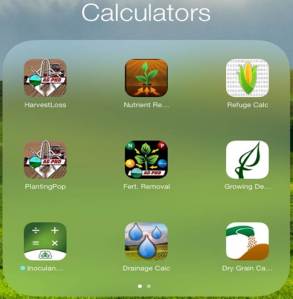

Only two apps has been added to this category. I am still using Fert.Removal, HarvestLoss and Growing Degrees on a regular basis.
Sprayer/Chemicals,

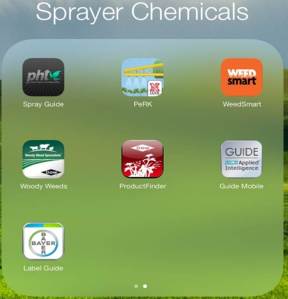
Many apps have been added to this group but none of them have been good enough to kick TankMixCalc and SpraySelect of my favorites list.
Fertilizer,


Similar to the Sprayer/Chemicals category several apps have been added to this group, including several from Ok State. For me the Fert Cost Calc is still very useful. I do not get to use the Manure Calc I am very impressed by its layout and user friendliness. This app allows for applicator calibration, nutrient recs and manure value estimator.
Seed Select,

It is no surprise the apps in this category are company created. I will say for the central Great Plains Pioneer’s Canola Calc is very useful tool for selecting canola planting rate providing input for row spacing live plants, seed weight, Germ percent, and survival percent.
To wrap up this blog I want to share with you may new Favorite none ag app. Bump is a huge time saver for anyone who takes pics with your iPhone or iPad. Bump allows easy transfer between mobile devices but more importantly between your mobile device and desktop by a simple tap of the space bar. This file share will go both directions. This means no more emailing pictures from your phone so that you can have them on your desktop. Bump is a iPhone app that can work on the iPad.
When searching with an IPad, remember to switch the search to include IPhone apps, there are some good ones out there that are IPhone only. Check out www.npk.osktate.edu/presentations to see screen shots from many of my favorite apps.
Nitrogen Rich Strips
The Nitrogen Rich Strip, or N-Rich Strip, is a technique/tool/process that I spend a great deal of time working with and talking about. It is one of the most simplistic forms of precision agriculture a producer can adopt. The concept of the N-Rich strip is to have an area in the field that has more nitrogen (N) than the rest. Due to our fertilizer applicators this is typically a strip. The approach maybe somewhat new but at one point most producers have had N-Rich Strips in their fields, albeit accidentally. Before the days of auto-steer it was not uncommon, and honestly still is not, to see a area in the field that the fertilizer applicator either doubled up on or skipped. In our pastures and dual purpose/graze out wheat every spring we can see the tell-tale signs of livestock deposits. When over laps or “Cow Pox” become visible we can assume the rest of the field is behind in nitrogen. I like to tell producers that the goal of the N-Rich strip is to make a really big cow pie.

- Cow Pox, Image courtesy Kaitlyn Nelson
What I like most about the N-Rich Strip approach is its Simplicity. The N-Rich Strip is applied and; Scenario 1. The N-Rich Strip becomes visible (Greener) you APPLY NITROGEN, Scenario 2. The strip is not visible you Option A. DON’T APPLY NITROGEN Option B. Apply Nitrogen Anyways. The conclusion to apply N or not is based on the reasoning that the only difference between the N-Rich Strip and the area 10 ft from it is nitrogen, so if the strip is greener the rest of the field needs nitrogen. If there is no difference N is not limiting and our research shows N does not have to be applied. However producers who decide to be risk adverse (in terms of yield) can apply N but it would be advised to do so at a reduce the rate. Now is a good time to note that the N-Rich Strip alone provides a Yes or No, not rate recommendation. At OSU we use the GreenSeeker optical sensor and Sensor Based Nitrogen Rate Calculator (SBNRC) to determine the rate, but that discussion will come later. I equate the change from using yield goal N rate recs to the N-Rich Strip as to going from foam markers to light bars on a sprayer. Not 100% accurate but a great improvement.

N-Rich Strip in no-till wheat near Hobart OK.
Now that we have covered the WHY, lets get down to the nuts and bolts HOW, WHEN, WHERE.
How the strip is applied has more to do with convenience and availability than anything else but there are a few criteria I suggest be met. The strip should be at least 10 ft wide and 300 ft long. The rate should be no less than 50 lbs N (above the rest of the field) for grain only wheat and canola, 80 lbs N for dual purpose wheat. The normal recommendation is that when applying pre-plant either have a second, higher rate programmed into the applicator or make a second pass over an area already fertilized. Many will choose to rent a pull type spreader with urea for a day, hitting each field.
Becoming more popular are applicators made or adapted for use. ATV sprayers are the most common as they can be multi-purpose. In most cases a 20-25 gallon tank with a 1 gpm pump is placed on the ATV with an 8-10ft breakover boom. The third applicator is a ride away sprayer with a boom running along the rear of the trailer. In all cases when liquid is the source I recommend some form of streamer nozzle. In most cases there is not a great deal of thought put into what source. I recommend whichever source is the easiest, cheapest, and most convenient to apply.

Vincent N-Rich Strip Applicator, Ponca City OK
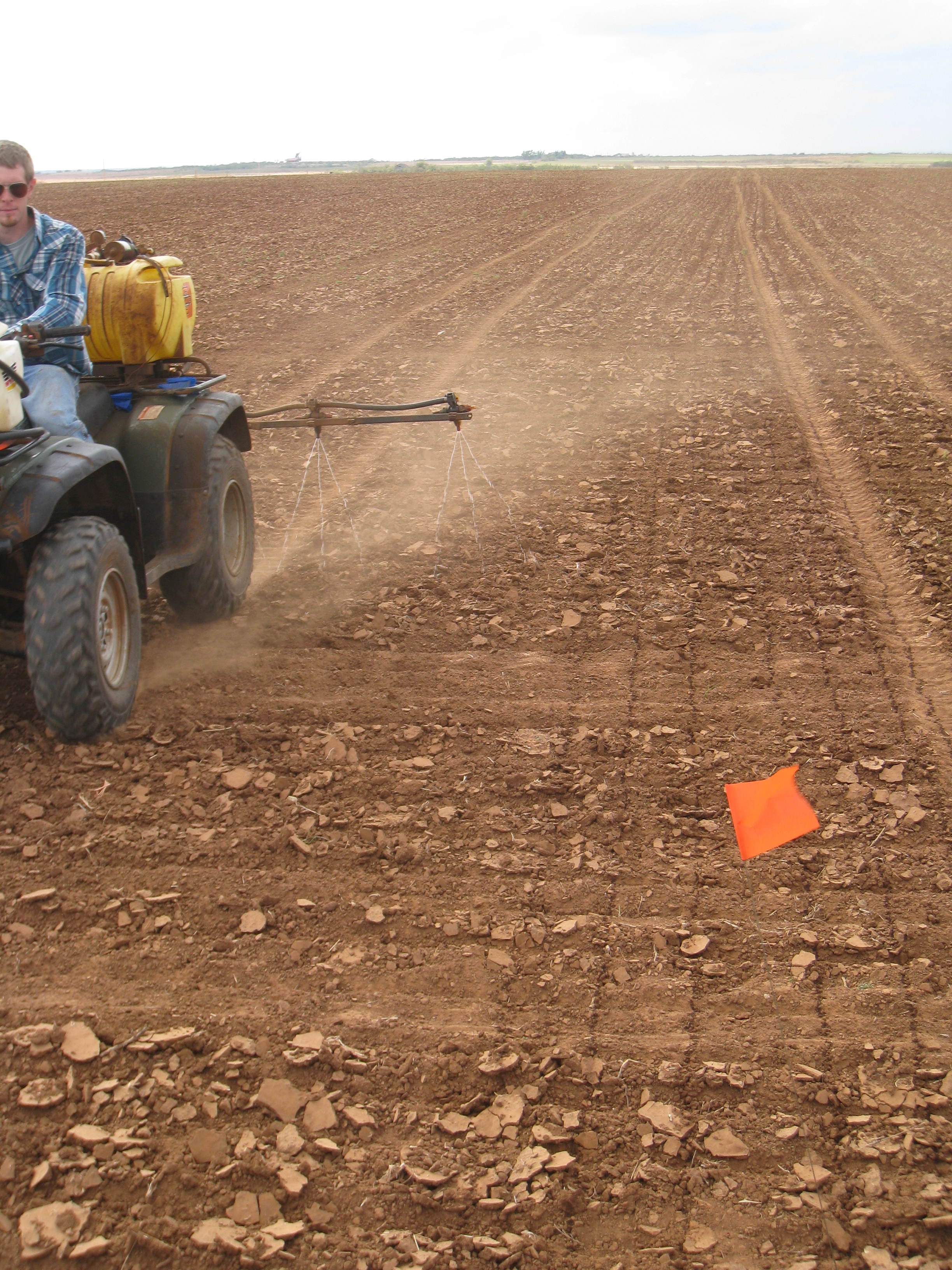
Oklahoma State Univ. N-Rich Strip Applicator
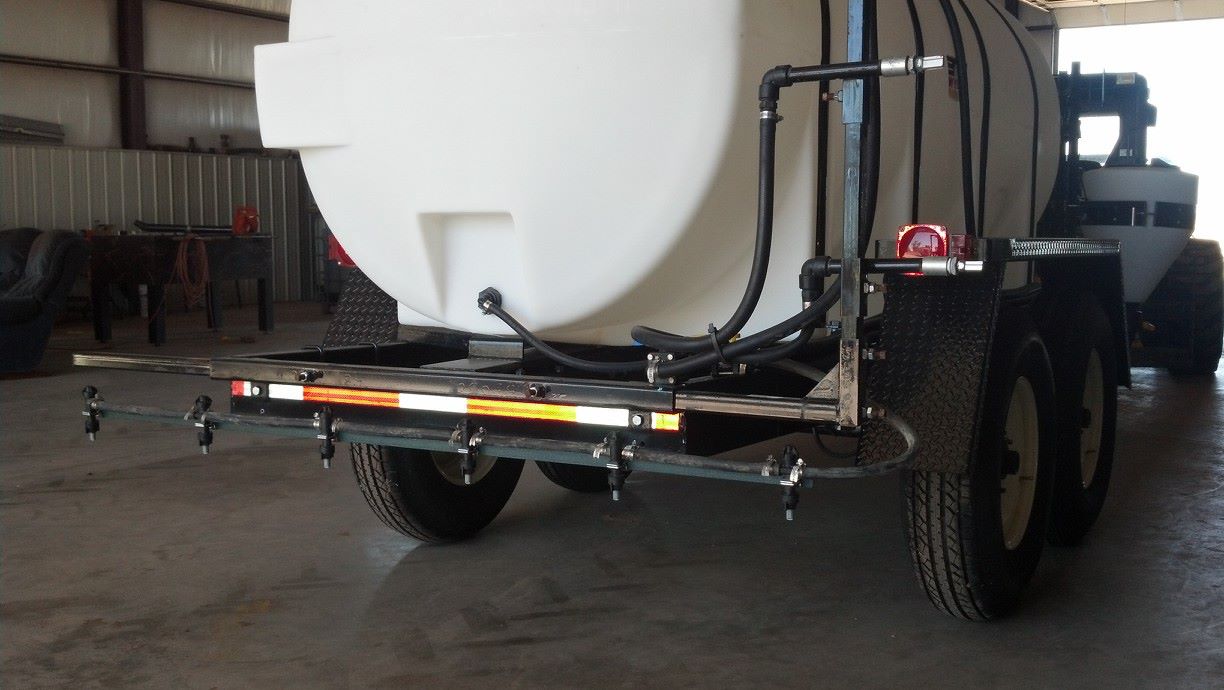
Gard N-Rich Strip Applicator, Fairview Ok
When the strip is applied in winter crops proper timing is regionally dependent. For the Central Great Plains, ideally the fertilizer should be applied pre-plant or soon after. However, in most cases as long as the fertilizer is down by the first of November everything works. This does not say a strip applied after this time doesn’t work but it leaves more room for error. There is a chance the crop could already be stressed or the nitrogen tied up and not release in time. However when the N-Rich Strip approach is used on the Eastern Shore in Virginia and Maryland the strips have to be applied at green up. The soils in that region are very deep sands and nitrogen applied in the fall may not make it to the spring. Also most wheat producers in the area make three or more applications of nitrogen unlike the two (pre and top) of the Great Plains. It is always important to make the tools fit your specific regional needs and practices and not the other way around.
Where is actually the biggest unknown. The basic answer is to place the N-Rich Strip in the area that best represents the field. Many people question this as it doesn’t account for spacial variability in the field, and they are correct. But my response is that in this case spatial variability is not the goal, temporal variability is. Keeping in mind the goal is to take a field which has been receiving a flat yield goal recommendation for the last 30+ years and make a better flat rate recommendation. My typically request is that on a field with significant variability either apply a strip long enough to cross the zones or apply smaller strips in each significant area. This allows for in-season decisions. I have seen some make the choice to ignore the variability in the field, made evident by the strip, and apply one rate and others choose the address the variability by applying two or more rates. One key to the placement of N-Rich Strips is record keeping. Either via notes or GPS, record the location of every strip. This allows for the strips to be easily located at non-response sites. It is also recommended to move the strip each year to avoid overloading the area with N.
I hear a great deal of talk about how it would take to much time to put out the N-Rich Strip. However the majority of producers that do it once on one field, end up doing it every year on every field. There is very likely someone in your area who is using the N-Rich Strips. As top-dress grows closer keep an eye out for a blog “Using the GreenSeeker Sensor and Sensor Based Nitrogen Rate Calculator”.
For more information on N-Rich Strips check out the YouTube video below, visit http://www.npk.okstate.edu or contact me directly at b.arnall@okstate.edu. I have lots of material I am happy to share and distribute.
See the YouTube Video http://www.youtube.com/watch?v=kJ3DSwWYgE8
Agriculture Apps for the IPad and IPhone
So I am going to approach a subject in this blog that is Not in my wheelhouse. At the first of the year I was asked by a friend to speak on Ag Apps at the 2013 InfoAg meetings. His thought was, hey this guy teaches Precision Ag and uses a IPad, he must know apps. Well, not so much. From January to the day before the talk in July I spent a great deal of time scouring the App store and working, my wife described it as playing, on my IPad. At info Ag I gave two talks, at the time of first talk on Tuesday I had 53 Free apps (1 paid), by the next morning and my second talk I had 60.
Since the meeting I have had numerous request for the slides and etc, so I thought this would be a good opportunity for a blog. Since InfoAg (7.17.2013) I have picked up even more apps, the total is now 76. However many of the new apps require registration.
On my IPad I have organized the apps into 8 basic folders:
ID Tools, Calculators, Seed, Sprayer/Chemical, Fertilizer, New/Weather/Markets, Scouting, Ag Apps (apps I don’t know what to do with).
While I have 76 Apps I of course don’t use them all. What follows is basically my Editors Choice from each group. Please note I have not had the time to work with all 76 Apps. And I am by no means an expert in Apps or the use of them.
I do have a basic require of any App I use. If I can not figure it out in 2 minutes its GONE. An app should be intuitive, easy to use and have a purpose. They only exception to the 2 minute rule is the Scouting Apps. Because of their complexity I allow them 5 minutes, then I am done.
ID Tools:

This Category holds the One and Only App I paid for, Plant Images, a library of Nutrient Deficiency photos. I mean I am a Soil Fertility guy.
I regularly use Plant Images, ID Weeds, and the Pestbook as references. ID weeds is a true ID tool as you can use attributes to ID your weed, while the other two are visual reference tools.
Calculators:

I personally use the two Nutrient Removal Apps the most, but after the latest update AG-PhDs Fert. Removal has become my favorite as it allows you to entire any yield level.
Harvest loss is also a handy App that lets you put $ to combine inefficiencies.
Seed:

I do not use these often as I only do plot work, but I can see there usefulness in a operation.
Sprayer/Chemical:
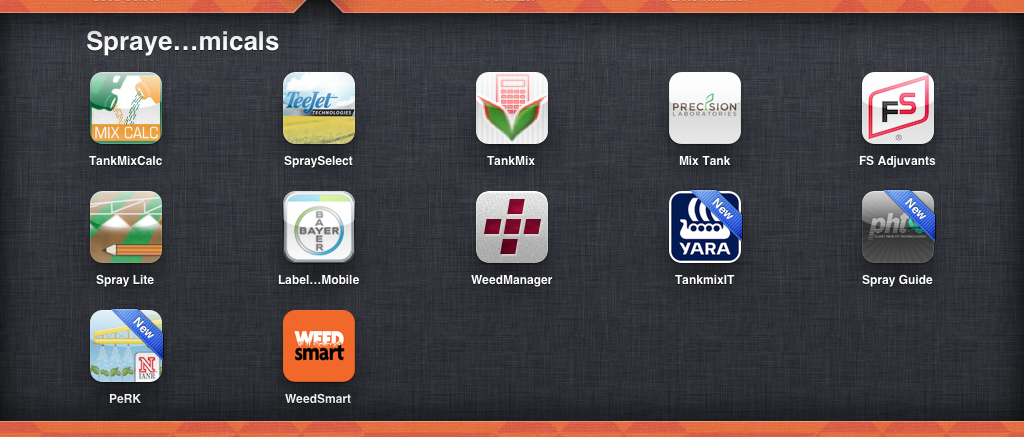
This group contains two of my first Ag Apps and most frequently used.
Being a fertilizer guy herbicides are not my forte however I use the often.
TankMixCalc and SpraySelect has been in my App arsenal from the beginning.
The nice item about many of the Sprayer Apps is the ability to save/store mixes or provide record keeping.
Fertilizer:

Now the Fertilizer Apps are right up my alley. But the only ones I use are the Cost Calcs. As far as fertilizer recommendations go you must remember they are quite regionally specific so the Wisconsin Corn N rate Calculator does me little to no good.
New/Weather/Markets:

This is the category that I have the most apps. My first was Agriculture (DTN/PF), so I fall back to it often but I also like AgIndex and AgWeb. With the news/marketing ext apps the biggest key is find one that a) reports on topics of interest to you, they do differ and b) has a layout and design that is easy to use and enjoy.
Scouting

The Scouting tools are a bit different, most but not all require registration of some kind. I like most that I have tried but each has their own high and low points. The use of a scouting tool will be highly dependent upon uses, goals, and what companies you currently work with. For example Field Notes 360 has some nice points, you can make notes on photos, but you have to be a Pioneer employee or customer to get full use, I like Scout (Connected Farm) note taking capability and the fact you can input GreenSeeker NDVI values. I have the beta version of Sirrus but I can all ready tell you it is shaking out to be my favorite. Two wins for Sirrus, its method of creating and editing boundaries is top notch but what I like the most is its ability to set up a direct grid sampling.
Ag Apps:

This folder holds my Scientific Pub app the Web Soil Survey app, ArcGis app and the loan Ag game that snuck its way in with a official sounding name FarmGenius.
I don’t expect any app to change my life or yours, but it may make it easier.
The ID Tools, Calculators, Sprayer/Chem and Fertilizer apps are nice when I am in the field with a producer and just break out the IPad for easy demo/explanation.
There is a multitude of apps available and more being produced every day. Just as everything else find what suites you regardless of others opinions. When searching with an IPad remember to switch the search to include IPhone apps, there are some good ones out there that are IPhone only.
If you want to see my presentation from InfoAg, checkout their website www.infoag.org/program3 or go to the http://www.NPK.osktate.edu website and download the PDF of the slides under the Presentation tab.
 Down and Dirty with NPK