
Time to start topdressing wheat
Great write up by Dr. Edwards.

There are few crop inputs that deliver as much return on investment as nitrogen fertilizer. It takes approximately two pounds of nitrogen, costing approximately $1.00, to produce one bushel of grain worth about $6.00. Of course, nitrogen is not the only yield determining factor in a wheat crop. Also, the law of diminishing marginal returns eventually kicks in, but nitrogen fertilizer is still one of the safest bets in the house.
Top dress nitrogen fertilizer is especially important because it is applied and utilized at a time when the plant is transitioning from vegetative to reproductive growth. Several things, including the number of potential grain sites, are determined just prior to jointing and it is imperative that the plant has the fuel it needs to complete these tasks. Jointing also marks the beginning of rapid nitrogen uptake by the plant which is used to build new leaves, stem, and the…
View original post 659 more words
Freeze Injury and N-Rich Strips,
Dr. Jeff Edwards “OSUWheat” wrote about winter wheat freeze injury in a receive blog on World of Wheat, http://osuwheat.com/2013/12/19/freeze-injury/. As Dr. Edwards notes injury at this stage rarely impact yield, therefore the fertility requirements of the crop has not significantly changed. What will be impacted is how the N-Rich Strip and GreenSeeker™ sensor will be used. This not suggesting abandoning the technology in fact time has shown it can be just as accurate after tissue damage. It should be noted GreenSeeker™ NDVI readings should not be collected on a field that has recently been damaged.
A producer using the N-Rich Strip, GreenSeeker™, Sensor Based N-Rate Calculator approach on a field with freeze damage will need to consider a few points. First there need to be a recovery period after significant tissue damage; this may be one to two weeks of good growth. Sense areas that have had the same degree of damage as elevation and landscape position often impacts the level of damage. It would be misleading to sense a area in the N-Rich strip that was not significantly damaged but an area in the Farmer Practice that took a great deal of tissue loss.
Finally we must consider how the SBNRC, available online at http://nue.okstate.edu/SBNRC/mesonet.php, works. The calculator uses NDVI to estimate wheat biomass, which is directly related to grain yield. This predicted grain yield is then used to calculate nitrogen (N) rate. So if biomass is reduced, yield potential is reduced and N rate reduced. The same issue is seen in dual purpose whet production. So the approach that I recommend for the dual purpose guys is the same that I will recommend for those who experienced significant freeze damage. This should not be used for wheat with just minimal tip burn.
To account for the loss of biomass, but not yield, planting date needs to be adjusted to “trick” the calculator into thinking the crop is younger and has greater potential. Planting date should be move forward 7 or 14 days dependent For example the first screen shot shows what the SBNRC would recommend using the real planting date. In this case the potential yield is significantly underestimated.
The second and third screen shots show the impact of moving the planting date forward by 7 and 14 days respectively. Note the increase in yield potential, which is the agronomically correct potential for field considering soil and plant condition, and increase in recommended N-rate recommendation. Adjust the planting date, within the 7 to 14 day window, so that the yield potential YPN is at a level suitable to the field the yield condition and environment. The number of days adjusted is related to the size and amount of loss. The larger the wheat and or greater the biomass loss the further forward the planting date should be moved. In the example below YPN goes from 37 bu ac on the true planting date to 45 bu ac with a 14 day correction. The N-rate changes from 31 lbs to 38 lbs, this change may not be as much as you might expect. That is because YP0, yield without additional N, also increases from 26 to 32 bushel.
 Image 1. Planting date 9/1/2013. YPN 37 bu ac-1 and N-Rec 31 lbs ac-1.
 Image 2. Planting date 9/8/2013. YPN 40 bu ac-1 and N-Rec 34 lbs ac-1.
 Image 3. Planting date 9/15/2013. YPN 45 bu ac-1 and N-Rec 38 lbs ac-1.
This adjustment is only to be made when tissue has been lost or removed, not when you disagree with the yield potential. If you have any questions about N-Rich Strips, the GreenSeeker™, or the online SBNRC please feel free to contact me at b.arnall@okstate.edu or 405.744.1722.
Ag Apps Updated
Since my Ag App post in July I have presented on the topic an additional five times and have two more on the books for 2014. A good thing about doing talks is that you have to update the information to remain current. Which in all honesty, when it comes to technology of any kind this is quite challenging and even more so for Smart Phone Apps. In July when I first blogged on the subject I had 76 apps on my iPad. Today (1.3.14) I have 111 apps on my iPad, for both the iPhone and iPad, that I deem to be Ag related. Since the summer I have found new favorites, changed some, and added categories but for the most part I still maintain my 2 minute rule stated in the first blog. I have allowed a bit more leniency in that I now say “If I cannot figure it out in 3 minutes it’s GONE. An app should be intuitive, easy to use and have a purpose. They only exception to the 3 minute rule is the Scouting and Mapping Apps. Because of their complexity I allow them 5 minutes, and then I am done. Any app with GIS in its name gets much more time” I guess I am just getting soft.
Again I must make the obligatory statement; I am not a developer, designer, or expert. I am just a user who has had a chance to look at a few apps. Almost all of the apps I have are free and I am sure I have missed a few. Please share those with me. I am also not discussing Mobi’s, this is another large group of quality decision aid tools. I am also not discussing none apples apps. This is not because they are not relevant or important, it is because I do not have that technology.
I now have nine Ag folders on my iPad:
Ag News/Weather/Markets, Scouting/Mapping, Record Keeping, ID Tools, Crop Tools, Calculators, Sprayer/Chemicals, Fertilizer, Seed Select.
Apps are nice because the majority are stand alone and do not need internet or cell connection. This means they can be used when you are in the middle of nowhere, which is a great deal of Oklahoma, and have no service. This will exclude many of the Ag News/Weather/Markets, Scouting/Mapping, and Record Keeping apps that need positioning or location information.
Now let’s discuss some of the new and old apps.
Ag News/Weather/Markets
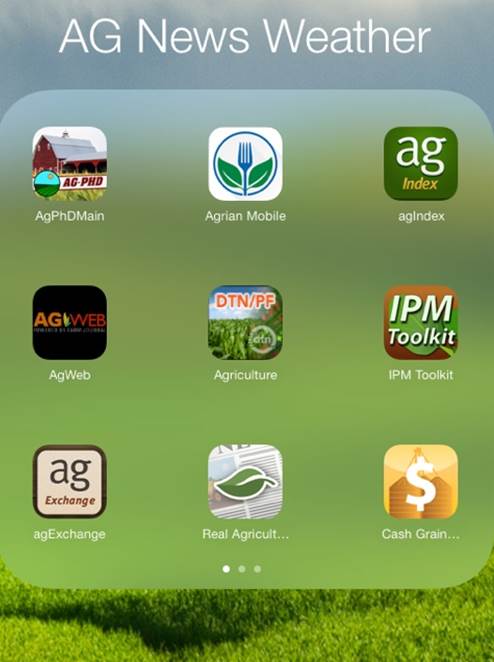


Not much change in this group however I have added one or two.
Scouting/Mapping


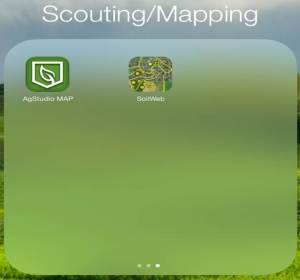
This category has changed the most. Record keeping apps have been removed and several new apps added. The only free apps which can create boundaries are still Scout and Sirrus. To date Scout remains to be my favorite app for in field scouting notes. Pictures tagged with Lat Long and a note is very useful. My knock on is app is its boundary creation. It is a challenge every time as it is hard to remember the steps and not make a mistake. That is where Sirrus comes to play, by far the best boundary creation app. Sirrus has easy to use tools for both point and pivot boundaries. I like the edit vertex zoom in tool that resembles a rifle scope. I was able to add 12 fields in a matter of 20 minutes. Being able to create grid soil sampling scheme and record samples is also a very nice tool. My favorite part of the app, the UNDO button, and all apps should include this. The drawback to Sirrus is that it has no ability to take notes such as Scout. An additional nice scouting tool is South Dakota States NPIPM (North Plains IPM) app. This app provides not only a pest id tool with morphological drop down, I will discuss this in the ID Tools cat, but also management recommendation for the identified insect.
Record Keeping,
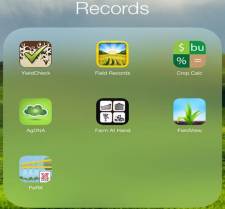
The majority of the apps in this category are “Pay to Play”, which makes since as they deal with data management and storage. Many would also fit the Scouting/Mapping category. As I do not pay for many apps I do not have experience with any of these. However this is the category that I would recommend any group to look at as they should be the all-inclusive app. However, PeRK by the University of Nebraska is a free app designed for field records of pesticide applicators.
ID Tools,

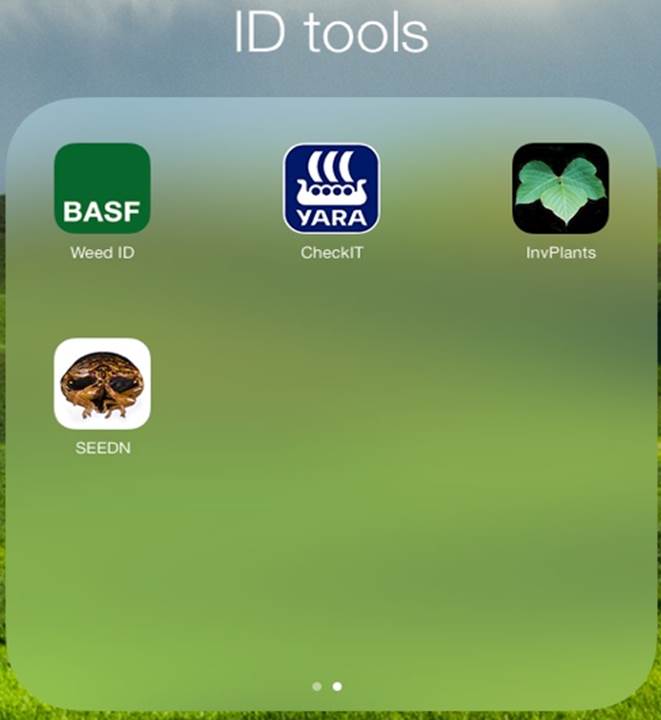
I have added a few apps to this category but my favorites have not changed. I regularly use Plant Images, ID Weeds, and the Pestbook as references. I will add more discuss to app ID tools. The importance of being able to ID weeds and Pest via morphological drop down menus (ID Weeds and NPIPM) is extremely important. Many of the ID tools just have pictures and names. Well is I am using an ID Tool I likely do not know what I am looking at or what it is called.
Crop Tools,
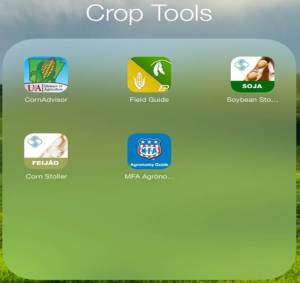
Crop Tools includes my second “Paid in Full” app. And this one hurt a bit more. Not because it cost money but because I have multiple versions of the hard copy. However Field Guide by Purdue is one of my most recommended apps. Field Guide is the electronic version of the Purdue Corn and Soybean Field Guide, which the majority of consultants in the Corn Belt likely have this sitting in their truck. The Stoller apps also have nice very nice image bank of plant developmental phases. FieldGuide and CornAdvisor, another good app, are great examples of what I expect to be coming out of the majority of the Land Grant Universities very soon. Cooperative Extension has hundreds if not thousands of quality hard copy publications just waiting to be turned in to handy dandy apps. To be honest I am working on turning my Nutrient Management Field Guide into an app right now.
Calculators,
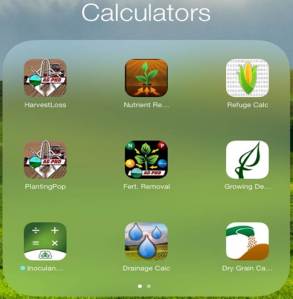

Only two apps has been added to this category. I am still using Fert.Removal, HarvestLoss and Growing Degrees on a regular basis.
Sprayer/Chemicals,

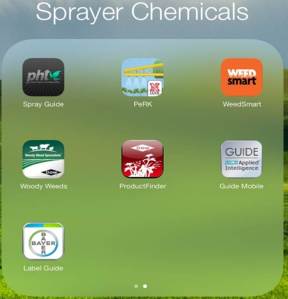
Many apps have been added to this group but none of them have been good enough to kick TankMixCalc and SpraySelect of my favorites list.
Fertilizer,


Similar to the Sprayer/Chemicals category several apps have been added to this group, including several from Ok State. For me the Fert Cost Calc is still very useful. I do not get to use the Manure Calc I am very impressed by its layout and user friendliness. This app allows for applicator calibration, nutrient recs and manure value estimator.
Seed Select,

It is no surprise the apps in this category are company created. I will say for the central Great Plains Pioneer’s Canola Calc is very useful tool for selecting canola planting rate providing input for row spacing live plants, seed weight, Germ percent, and survival percent.
To wrap up this blog I want to share with you may new Favorite none ag app. Bump is a huge time saver for anyone who takes pics with your iPhone or iPad. Bump allows easy transfer between mobile devices but more importantly between your mobile device and desktop by a simple tap of the space bar. This file share will go both directions. This means no more emailing pictures from your phone so that you can have them on your desktop. Bump is a iPhone app that can work on the iPad.
When searching with an IPad, remember to switch the search to include IPhone apps, there are some good ones out there that are IPhone only. Check out www.npk.osktate.edu/presentations to see screen shots from many of my favorite apps.
Freeze injury
Our recent extreme shifts in temperature have resulted in moderate to severe freeze injury in some Oklahoma wheat fields. To be honest, the damage is not as widespread or severe as I thought it would be given that most of our wheat had not had an opportunity to harden off. The dry soil conditions in western and southern Oklahoma did not help the situation, as there was not sufficient soil moisture to buffer the temperature shift in the top few inches of soil.
Freeze injury at this stage of growth (tillering) rarely impacts grain yield, but, as always, there are a few exceptions. Wheat that was very small or late-sown is more susceptible to winter kill. Similarly, wheat that does not have a good root system or that was shallow sown due to crop residue is more susceptible to winter kill. It is best to wait until after a few…
View original post 34 more words
Nitrogen Rich Strips
The Nitrogen Rich Strip, or N-Rich Strip, is a technique/tool/process that I spend a great deal of time working with and talking about. It is one of the most simplistic forms of precision agriculture a producer can adopt. The concept of the N-Rich strip is to have an area in the field that has more nitrogen (N) than the rest. Due to our fertilizer applicators this is typically a strip. The approach maybe somewhat new but at one point most producers have had N-Rich Strips in their fields, albeit accidentally. Before the days of auto-steer it was not uncommon, and honestly still is not, to see a area in the field that the fertilizer applicator either doubled up on or skipped. In our pastures and dual purpose/graze out wheat every spring we can see the tell-tale signs of livestock deposits. When over laps or “Cow Pox” become visible we can assume the rest of the field is behind in nitrogen. I like to tell producers that the goal of the N-Rich strip is to make a really big cow pie.

- Cow Pox, Image courtesy Kaitlyn Nelson
What I like most about the N-Rich Strip approach is its Simplicity. The N-Rich Strip is applied and; Scenario 1. The N-Rich Strip becomes visible (Greener) you APPLY NITROGEN, Scenario 2. The strip is not visible you Option A. DON’T APPLY NITROGEN Option B. Apply Nitrogen Anyways. The conclusion to apply N or not is based on the reasoning that the only difference between the N-Rich Strip and the area 10 ft from it is nitrogen, so if the strip is greener the rest of the field needs nitrogen. If there is no difference N is not limiting and our research shows N does not have to be applied. However producers who decide to be risk adverse (in terms of yield) can apply N but it would be advised to do so at a reduce the rate. Now is a good time to note that the N-Rich Strip alone provides a Yes or No, not rate recommendation. At OSU we use the GreenSeeker optical sensor and Sensor Based Nitrogen Rate Calculator (SBNRC) to determine the rate, but that discussion will come later. I equate the change from using yield goal N rate recs to the N-Rich Strip as to going from foam markers to light bars on a sprayer. Not 100% accurate but a great improvement.

N-Rich Strip in no-till wheat near Hobart OK.
Now that we have covered the WHY, lets get down to the nuts and bolts HOW, WHEN, WHERE.
How the strip is applied has more to do with convenience and availability than anything else but there are a few criteria I suggest be met. The strip should be at least 10 ft wide and 300 ft long. The rate should be no less than 50 lbs N (above the rest of the field) for grain only wheat and canola, 80 lbs N for dual purpose wheat. The normal recommendation is that when applying pre-plant either have a second, higher rate programmed into the applicator or make a second pass over an area already fertilized. Many will choose to rent a pull type spreader with urea for a day, hitting each field.
Becoming more popular are applicators made or adapted for use. ATV sprayers are the most common as they can be multi-purpose. In most cases a 20-25 gallon tank with a 1 gpm pump is placed on the ATV with an 8-10ft breakover boom. The third applicator is a ride away sprayer with a boom running along the rear of the trailer. In all cases when liquid is the source I recommend some form of streamer nozzle. In most cases there is not a great deal of thought put into what source. I recommend whichever source is the easiest, cheapest, and most convenient to apply.

Vincent N-Rich Strip Applicator, Ponca City OK
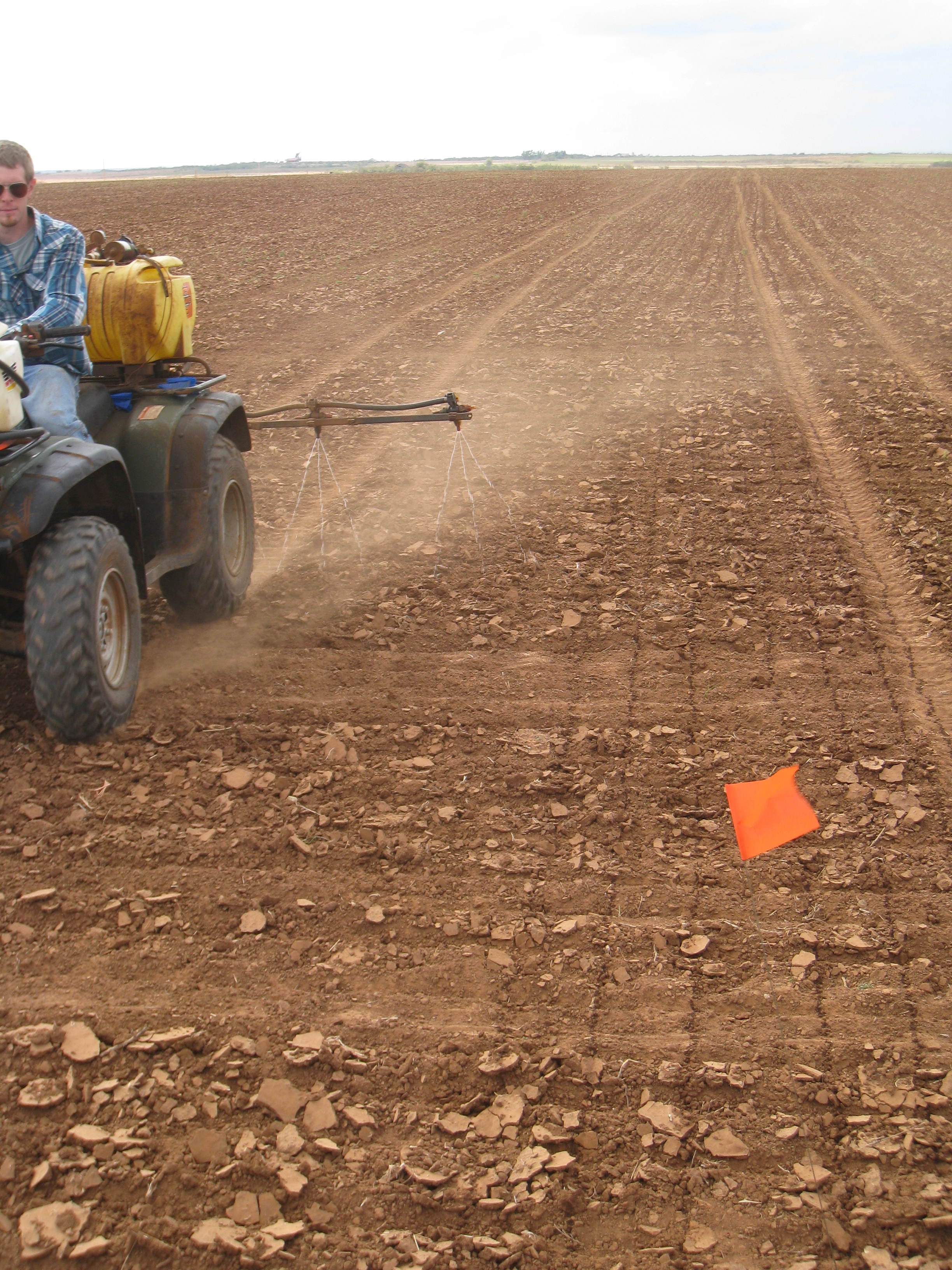
Oklahoma State Univ. N-Rich Strip Applicator
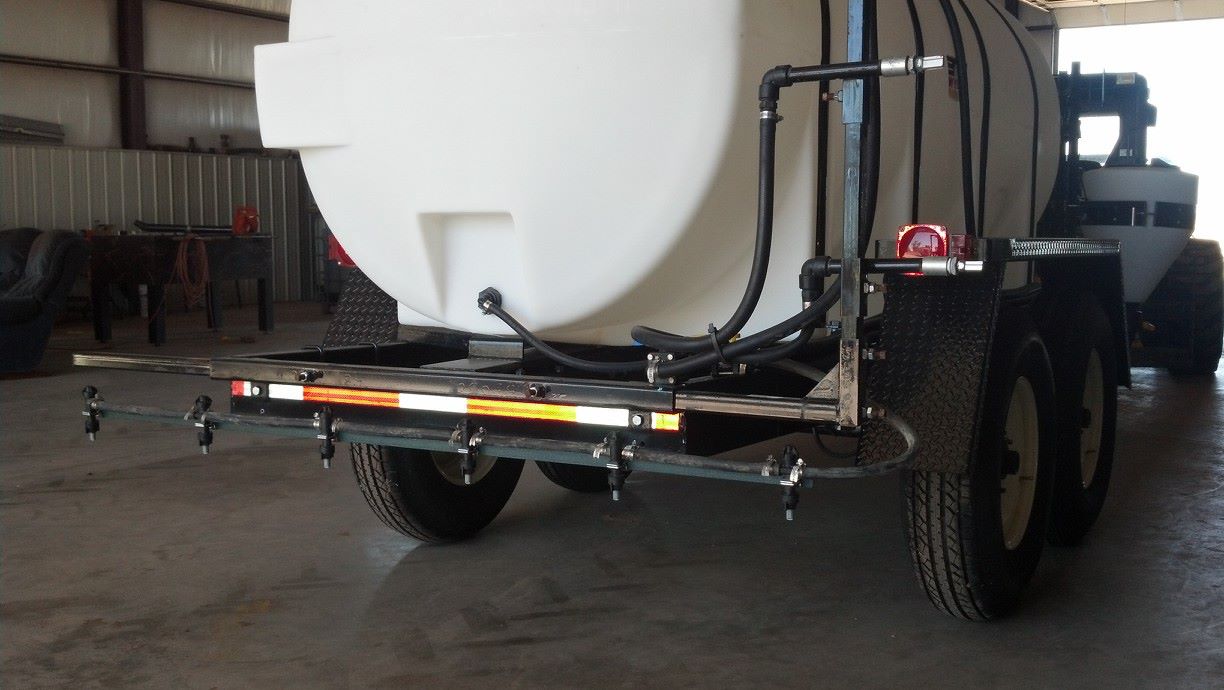
Gard N-Rich Strip Applicator, Fairview Ok
When the strip is applied in winter crops proper timing is regionally dependent. For the Central Great Plains, ideally the fertilizer should be applied pre-plant or soon after. However, in most cases as long as the fertilizer is down by the first of November everything works. This does not say a strip applied after this time doesn’t work but it leaves more room for error. There is a chance the crop could already be stressed or the nitrogen tied up and not release in time. However when the N-Rich Strip approach is used on the Eastern Shore in Virginia and Maryland the strips have to be applied at green up. The soils in that region are very deep sands and nitrogen applied in the fall may not make it to the spring. Also most wheat producers in the area make three or more applications of nitrogen unlike the two (pre and top) of the Great Plains. It is always important to make the tools fit your specific regional needs and practices and not the other way around.
Where is actually the biggest unknown. The basic answer is to place the N-Rich Strip in the area that best represents the field. Many people question this as it doesn’t account for spacial variability in the field, and they are correct. But my response is that in this case spatial variability is not the goal, temporal variability is. Keeping in mind the goal is to take a field which has been receiving a flat yield goal recommendation for the last 30+ years and make a better flat rate recommendation. My typically request is that on a field with significant variability either apply a strip long enough to cross the zones or apply smaller strips in each significant area. This allows for in-season decisions. I have seen some make the choice to ignore the variability in the field, made evident by the strip, and apply one rate and others choose the address the variability by applying two or more rates. One key to the placement of N-Rich Strips is record keeping. Either via notes or GPS, record the location of every strip. This allows for the strips to be easily located at non-response sites. It is also recommended to move the strip each year to avoid overloading the area with N.
I hear a great deal of talk about how it would take to much time to put out the N-Rich Strip. However the majority of producers that do it once on one field, end up doing it every year on every field. There is very likely someone in your area who is using the N-Rich Strips. As top-dress grows closer keep an eye out for a blog “Using the GreenSeeker Sensor and Sensor Based Nitrogen Rate Calculator”.
For more information on N-Rich Strips check out the YouTube video below, visit http://www.npk.okstate.edu or contact me directly at b.arnall@okstate.edu. I have lots of material I am happy to share and distribute.
See the YouTube Video http://www.youtube.com/watch?v=kJ3DSwWYgE8
Agriculture Apps for the IPad and IPhone
So I am going to approach a subject in this blog that is Not in my wheelhouse. At the first of the year I was asked by a friend to speak on Ag Apps at the 2013 InfoAg meetings. His thought was, hey this guy teaches Precision Ag and uses a IPad, he must know apps. Well, not so much. From January to the day before the talk in July I spent a great deal of time scouring the App store and working, my wife described it as playing, on my IPad. At info Ag I gave two talks, at the time of first talk on Tuesday I had 53 Free apps (1 paid), by the next morning and my second talk I had 60.
Since the meeting I have had numerous request for the slides and etc, so I thought this would be a good opportunity for a blog. Since InfoAg (7.17.2013) I have picked up even more apps, the total is now 76. However many of the new apps require registration.
On my IPad I have organized the apps into 8 basic folders:
ID Tools, Calculators, Seed, Sprayer/Chemical, Fertilizer, New/Weather/Markets, Scouting, Ag Apps (apps I don’t know what to do with).
While I have 76 Apps I of course don’t use them all. What follows is basically my Editors Choice from each group. Please note I have not had the time to work with all 76 Apps. And I am by no means an expert in Apps or the use of them.
I do have a basic require of any App I use. If I can not figure it out in 2 minutes its GONE. An app should be intuitive, easy to use and have a purpose. They only exception to the 2 minute rule is the Scouting Apps. Because of their complexity I allow them 5 minutes, then I am done.
ID Tools:

This Category holds the One and Only App I paid for, Plant Images, a library of Nutrient Deficiency photos. I mean I am a Soil Fertility guy.
I regularly use Plant Images, ID Weeds, and the Pestbook as references. ID weeds is a true ID tool as you can use attributes to ID your weed, while the other two are visual reference tools.
Calculators:

I personally use the two Nutrient Removal Apps the most, but after the latest update AG-PhDs Fert. Removal has become my favorite as it allows you to entire any yield level.
Harvest loss is also a handy App that lets you put $ to combine inefficiencies.
Seed:

I do not use these often as I only do plot work, but I can see there usefulness in a operation.
Sprayer/Chemical:
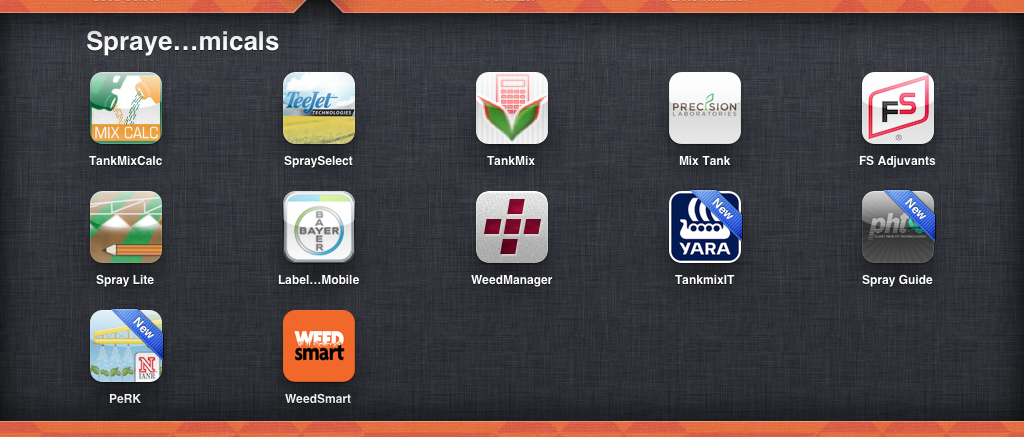
This group contains two of my first Ag Apps and most frequently used.
Being a fertilizer guy herbicides are not my forte however I use the often.
TankMixCalc and SpraySelect has been in my App arsenal from the beginning.
The nice item about many of the Sprayer Apps is the ability to save/store mixes or provide record keeping.
Fertilizer:

Now the Fertilizer Apps are right up my alley. But the only ones I use are the Cost Calcs. As far as fertilizer recommendations go you must remember they are quite regionally specific so the Wisconsin Corn N rate Calculator does me little to no good.
New/Weather/Markets:

This is the category that I have the most apps. My first was Agriculture (DTN/PF), so I fall back to it often but I also like AgIndex and AgWeb. With the news/marketing ext apps the biggest key is find one that a) reports on topics of interest to you, they do differ and b) has a layout and design that is easy to use and enjoy.
Scouting

The Scouting tools are a bit different, most but not all require registration of some kind. I like most that I have tried but each has their own high and low points. The use of a scouting tool will be highly dependent upon uses, goals, and what companies you currently work with. For example Field Notes 360 has some nice points, you can make notes on photos, but you have to be a Pioneer employee or customer to get full use, I like Scout (Connected Farm) note taking capability and the fact you can input GreenSeeker NDVI values. I have the beta version of Sirrus but I can all ready tell you it is shaking out to be my favorite. Two wins for Sirrus, its method of creating and editing boundaries is top notch but what I like the most is its ability to set up a direct grid sampling.
Ag Apps:
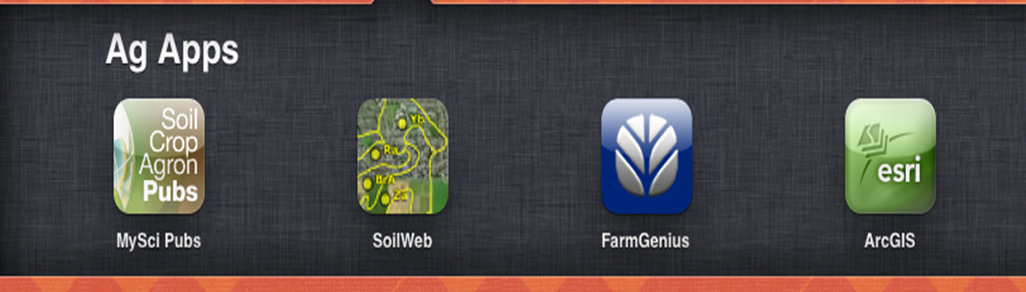
This folder holds my Scientific Pub app the Web Soil Survey app, ArcGis app and the loan Ag game that snuck its way in with a official sounding name FarmGenius.
I don’t expect any app to change my life or yours, but it may make it easier.
The ID Tools, Calculators, Sprayer/Chem and Fertilizer apps are nice when I am in the field with a producer and just break out the IPad for easy demo/explanation.
There is a multitude of apps available and more being produced every day. Just as everything else find what suites you regardless of others opinions. When searching with an IPad remember to switch the search to include IPhone apps, there are some good ones out there that are IPhone only.
If you want to see my presentation from InfoAg, checkout their website www.infoag.org/program3 or go to the http://www.NPK.osktate.edu website and download the PDF of the slides under the Presentation tab.
Response to NPKS strips across Oklahoma
From the fall of 2011 to about a week ago one of my grad students, Lance Shepherd, has spent A LOT of time burning up the highways and back roads of Oklahoma. Lance’s project was titled “NPKS Strips in Oklahoma winter wheat”, basically an extension of the N-Rich Strip concept. We wanted to see if we could or would find a response to added nitrogen (N), phosphorus (P), potassium (K), or sulfur (S) fertilizer on top of the farmer’s fertilizer applications. Over the two crop years lance applied NPKS strip on more than 80 fields from the Kansas border to the Red River. Of those 80+ Lance was able to collect, by hand, grain samples from 59 sites. Over the next few weeks I will be sharing some of the juicy tidbits we are gleaming from this fantastic data set.

NPKS applicator. Gandy boxes hold each fertilizer and a pto driven fan blew the fertilizer down the boom.
For the project at every site Lance collected soil samples to 18”, documented soil type and collected producer fertilizer, variety, and field history information. Over the 59 locations there were essentially 236 trials. The yield of each strip (N,P,K, and S) was compared back to a sample collected from the field, referred to as Farmer Practice. Of the 236 comparisons there were a total of 17 positive responses. Of these 17 responses seven were to N, seven to P, three to K, with no responses to S.

N-Rich strip very evident in field west of Alva. N-Rich 70 bu/ac Farmer Practice 38 bu/ac.
We are learning a great deal from these 17 locations. The biggest take home was that in most instances soil test results identified the yield limiting factors. For example of the seven responsive P locations six had either a low soil pH or low soil P index, some both. At only one site was there a response not predicted by soil test. Of all 59 harvested fields more than just six had low P or pH levels however most producers had applied enough fertilizer to reach maximum yield. For nitrogen two items proved to be the most likely reason for loss of yield, under estimated yield goal or environment conducive to N loss. As for the K responses we look at both K and chloride (Cl) as KCl, 0-0-62 potash, was applied in the K strip. Just looking at the soils data K was not low at any of the three sites. However, two sites are in sandy loam soils, which is conducive to Cl deficiencies. The lack of response to S was not surprising as soil tests indicated S was sufficient at all 80 locations were strips were applied. So again what did we learn from these plots, soil testing is key in maximizing yield and profitability and in most of the N responsive sites the N-Rich strip indicated a need for added fertilizer in February.
Placing Fertilizer with Canola at planting has positives and negatives.
With all things holding constant the last canola trials of our project should be picked up by the plot combine Thursday 6-20-13. Before the first yield results comes to my desk I can tell you that we are learning a great deal from the trials this year. In particular the DAP (18-46-0) placed with seed trail that was supported by the Oklahoma Oilseed Commission. This past year at the no-till site in Perkins, which has a low soil pH, the check plots that did not receive any fertilizer, preplant or banded, did not survive the winter. Additionally at both of our locations, Lahoma (low soil test P) and Perkins, we have documented that oil content was reduced when phosphorus was left out of the treatment.
Additionally out of the four site years, that is two locations over two years, the addition of DAP with the seed in-row reduced stand. The graph below shows just how much stand was reduced on a relative basis. Relative stand is a way to compare the DAP treated to the Check (no DAP) which we assume is 100%. So if we look at the graph below the plots were at 75% relative stand (i.e. 25% loss) at approx 5 lbs N per ac. By about 15 lbs N the stand was down to 50%.
There are a few things to keep in mind first, in the case of these trials stand loss did not always mean yield loss. Canola is a great compensatory crop, if there is open space it will grow into it. I will have to run the final yield data to get more answers. These trials were planted on 15″ rows putting down 5 lbs seed per ac, or at least that was the target rate. Many have shown that the seeding rate does not have to be that high if sown properly. I believe in a few cases we may have actually benefited from thinning the stand. However if you were planting 2.5 lbs seed per acre a small loss of stand may be a bigger yield loss. This is one of the question we will have to answer in the future.
And finally it should be noted that canola is planted on a wide range of spaces 6″,7.5″, 12″, 15″, 30″ are some of the most common. As the row width changes the amount of N placed with the seed changes. In other words if the goal is 50 lbs DAP per acre you will put twice as much in a 15″ row than you do a 7.5″ row. The Table at the bottom provide a guide for equivalent rate based on 15″ rows. For example if your target a excepted stand loss of 25% (5 lbs N according to the Figure) but you are planting on 6″ row spacing the recommendation would be apply no more than 13 lbs N per ac in the row or 72 lbs DAP/ac (13/.18)

Impact of DAP (18-46-0) placed in-row on canola stand in terms of lbs N ac-1.

Equivalent amount of N based on 15″ row spacing.
 Down and Dirty with NPK