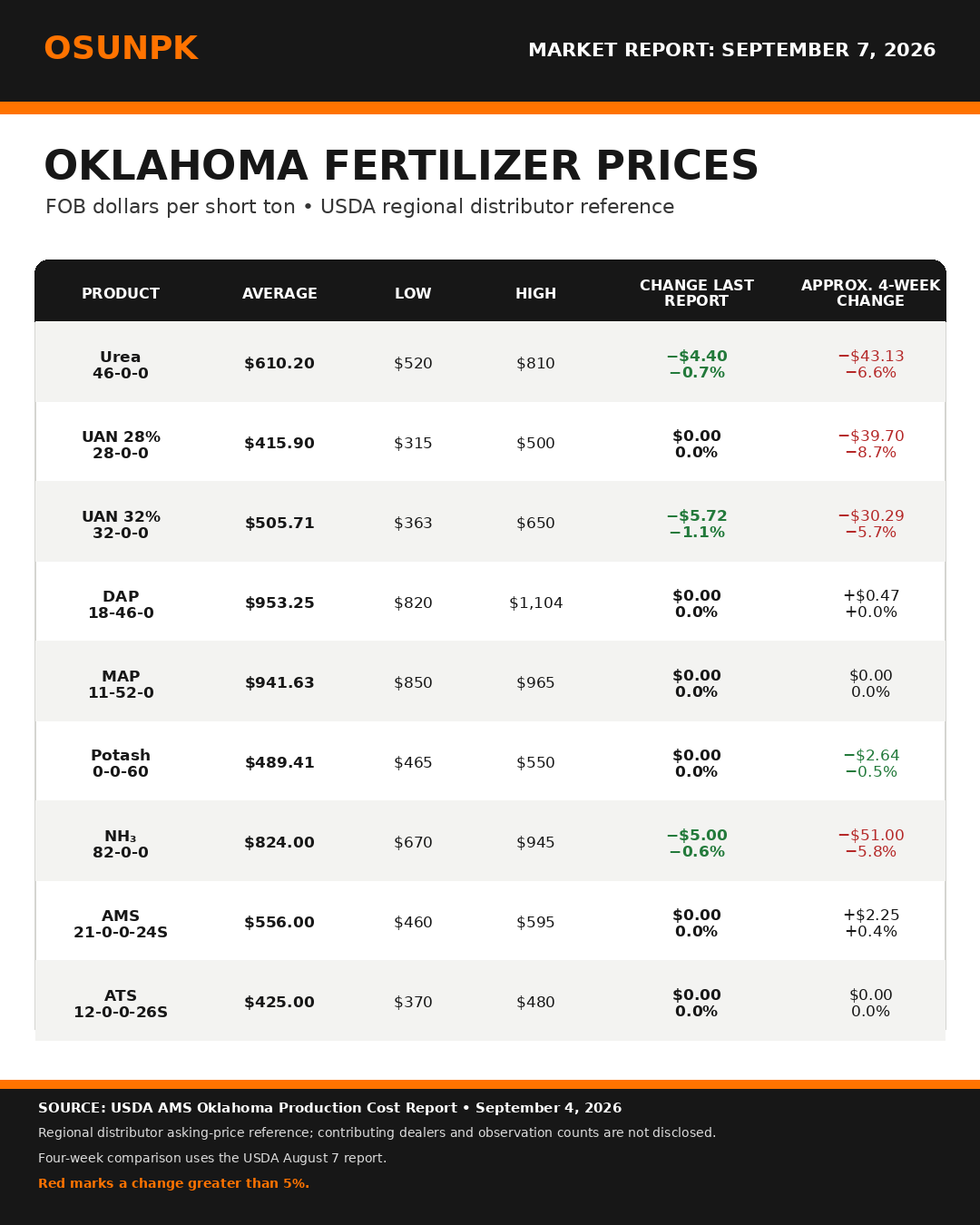
The most important fertilizer-market development of the past two weeks is not another sharp price move, but the pause that followed August’s nitrogen decline. Oklahoma’s September 4 report shows urea down only $4.40 per ton, UAN 32% down $5.72, and anhydrous ammonia down $5.00. UAN 28%, phosphate, potash, AMS, and ATS were unchanged. Looking back four weeks, however, the nitrogen correction remains substantial: urea is down 6.6%, UAN 28% is down 8.7%, UAN 32% is down 5.7%, and NH3 is down 5.8%.
Price-source note: The accompanying graphic’s Oklahoma average, minimum, and maximum come from the USDA Agricultural Marketing Service Oklahoma Production Cost Report. USDA does not identify contributing dealers. Named public dealer cash quotes, including Two Rivers Cooperative, are tracked separately and are not blended into USDA statistics.
USDA attributes the quiet local market to weak demand under persistent heat and drought. That distinction matters. Stable prices caused by limited field activity do not necessarily indicate that replacement costs or global supply risks have settled. As fall demand develops, local bids may respond differently depending on dealer inventory, transportation, and when replacement tons were purchased.
Nitrogen markets continue to balance large international buying programs against improved availability. In recent public commentary, StoneX fertilizer analyst Josh Linville pointed to India’s 1.7-million-ton urea purchase and identified Brazil as the next major demand cycle to watch. A completed Indian tender can absorb prompt supply, but the next direction depends on whether Brazilian demand arrives strongly enough to keep exporters engaged. Product type also matters because Brazil typically needs granular urea, while much of China’s available export supply has been prilled.
Phosphate remains a different story. Oklahoma DAP and MAP prices were unchanged, but the global market still carries support from restricted Chinese exports and elevated sulfur and ammonia costs. Linville also highlighted the arrival of Moroccan phosphate cargoes following the suspension of U.S. countervailing duties, including an MAP vessel that is more relevant to U.S. demand than the earlier TSP shipment. Additional import competition could improve availability, but one or two vessels do not by themselves reset the market.
Sulfur is part of that phosphate equation. It is required to manufacture phosphoric acid, so constrained sulfur trade can support DAP and MAP production costs. The same global pressure does not translate directly into identical local movement for AMS and ATS; both remained unchanged in Oklahoma this period. Those products should therefore be evaluated on actual sulfur need, formulation, and local cash price rather than assumed movement from phosphate headlines.
The next items to watch are Oklahoma rainfall and fall field activity, Brazilian urea purchasing, additional Indian tenders, Chinese export volumes, Moroccan phosphate arrivals, sulfur availability, and inland freight. These forces remain capable of moving in opposite directions, so the current pause should not be read as a firm price forecast.
For Oklahoma producers, this is a good time to compare products on both dollars per ton and cost per pound of the needed nutrient. Quotes should be placed on the same pickup or FOB basis, with application, blending, delivery, and tax separated before making comparisons.
Fertilizer markets, local prices, and availability can change quickly. Confirm current prices and terms with local dealers before purchasing.
Market Sources
- USDA Agricultural Marketing Service. Oklahoma Production Cost Report, September 4, 2026. https://www.ams.usda.gov/mnreports/ams_3621.pdf
- Josh Linville, StoneX. Public fertilizer-market commentary on India’s urea tender, Brazil’s demand cycle, and Moroccan phosphate arrivals. https://www.linkedin.com/posts/joshua-linville-9555a711_indias-urea-tender-just-gave-a-fading-rally-activity-7488273113961476098-Mepg
- CoBank. Why Higher Fertilizer Prices Are Here to Stay, August 13, 2026. https://www.cobank.com/knowledge-exchange/why-higher-fertilizer-prices-are-here-to-stay
- World Trade Organization. Fertilizer Trade Impacted by Strait of Hormuz Conflict, July 10, 2026. https://www.wto.org/english/blogs_e/data_blog_e/blog_dta_10jul26_451_e.htm
This report is produced via Chat GPT Plus Work, with review by Brian Arnall.

