I often say that in K–12 education we teach a lot of things in black and white. Students first need to understand the basic concepts: plants need nutrients, microorganisms decompose organic matter, and soils are biologically active. Then somewhere through a bachelor’s degree, or simply through enough years of experience, we learn that agriculture is rarely that black and white. There are a lot of shades of gray. Keep studying, researching, farming, or advising long enough and you eventually realize there aren’t just 256 shades of gray. There is also ROYGBIV. There is a whole spectrum of interactions and conditions that determine what happens in the soil.
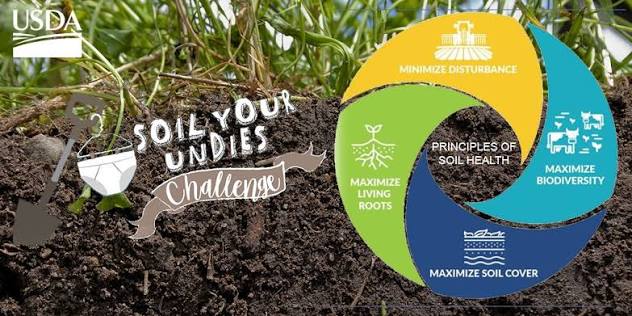
I think the “Soil Your Undies” demonstration fits that progression perfectly. It is a great black and white teaching tool. Bury a pair of 100% cotton underwear, wait several weeks, and dig them back up. Sometimes there isn’t much left besides the elastic waistband. Students can see that something happened belowground, and that opens the door to conversations about microorganisms, decomposition, carbon cycling, and the fact that soil is a living system. As a teaching demonstration, that is hard to beat.
Where I become more cautious is when we take that intentionally simple lesson and make a much more complicated conclusion: the pair with less cotton remaining came from the healthier soil or represents the better management practice. That is where we need to move beyond black and white.
To begin with we must know what the microbes are eating.
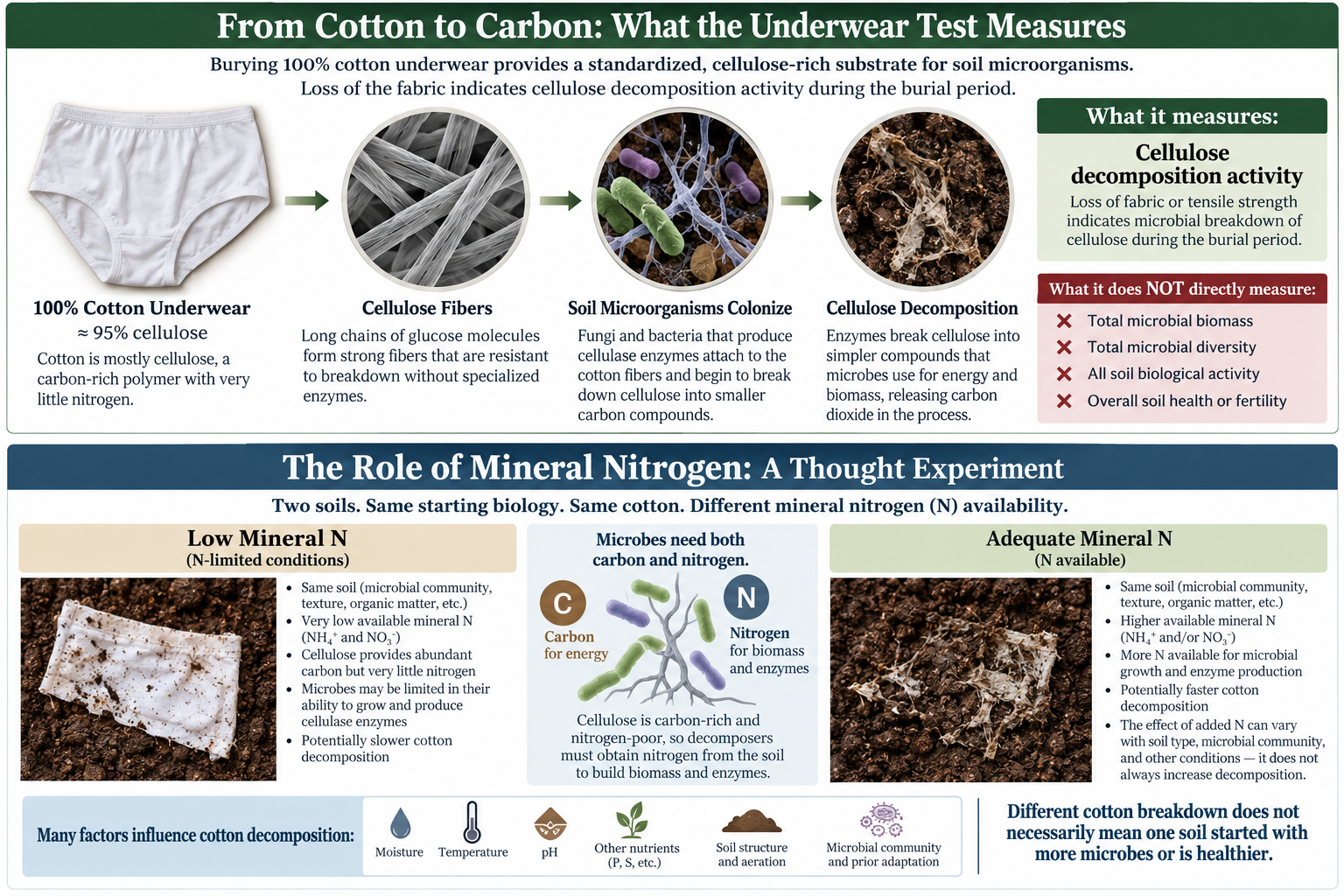
Cotton fiber itself gives us the first clue about what this test measures. Cotton is approximately 95% cellulose, and standardized cotton strips have been used by soil scientists for decades specifically as an index of cellulose decomposition (Latter et al., 1988; Tiegs et al., 2013). Cellulose is a long chain of glucose molecules and one of the major structural components of plant material. Its decomposition depends on organisms capable of producing cellulolytic enzymes that break those chains into smaller compounds that microorganisms can use.
Therefore, when cotton underwear disappears, we can make a scientifically defensible statement: the soil environment supported cellulose decomposition during the time the underwear was buried. That is useful information but notice how specific that statement is. We did not measure the total number of microorganisms, microbial diversity, or every biological process occurring in that soil, and we certainly did not measure everything encompassed by the much broader term soil health. Research comparing cotton-strip decomposition with microbial biomass illustrates that distinction. Walton and Allsopp (2007) found a relatively poor relationship between cotton-strip measurements and microbial biomass measured by substrate-induced respiration (r² = 0.26). They recommended using cotton strips alongside other physical and chemical soil indicators rather than as a stand-alone biological measurement. Soil can contain a substantial microbial population without necessarily destroying a pair of underwear quickly.
Is breaking down cellulose what the soil needs to be doing?
Cellulose decomposition is important. Crop residues contain cellulose, and their decomposition is part of carbon and nutrient cycling. But agriculture does not necessarily need every microbial process operating at its maximum rate all the time. Depending on the production system, time of year, and management objective, we may be more interested in nutrient mineralization or immobilization, aggregate formation, disease suppression, nitrogen transformations, carbon stabilization, or simply keeping residue on the soil surface. Faster cellulose decomposition is therefore not automatically better; it tells us that this specific biological process was occurring more rapidly under those conditions. This does not make the cotton test wrong. It means we need to be precise about the question it answers.
The scientific cotton-strip assay has successfully detected differences in cellulose decomposition among soils and management systems. Nachimuthu et al. (2022), for example, found differences in cotton-strip degradation among long-term crop rotation and tillage treatments. That supports the conclusion that management can affect cellulose decomposition. It does not automatically establish that the management practice producing the fastest cellulose decomposition created the healthiest soil. Margenot and Wade (2023) raised a similar concern about the interpretation of soil enzyme activities, cautioning against taking a measurement of a specific biological process and assuming that it scales directly to broader soil functions or outcomes. Measuring a process and determining what that process means for the functioning of the soil are two different questions.
Now add some gray: nitrogen
This is where the soil fertility specialist in me starts asking questions. Cotton provides microorganisms with a lot of carbon but almost no nitrogen. Yet microorganisms cannot live on carbon alone. They need nitrogen to produce proteins and enzymes and to build new microbial biomass. The microorganisms colonizing that cotton therefore must obtain much of what they need from the surrounding soil. Imagine taking one soil and thoroughly mixing it. We start with the same microbial community, organic matter, texture, pH, temperature, and water content. Divide it into two treatments and bury identical pieces of cotton. The only major difference is mineral nitrogen: one treatment has very little available NH₄-N and NO₃-N, while the other has an adequate supply. Would the underwear necessarily decompose at the same rate? There is good reason to believe it may not.
Nottingham et al. (2018) examined nutrient limitation during cellulose decomposition by adding cellulose and individual nutrients to soils. Nitrogen addition produced the largest fungal growth response associated with cellulose, and the researchers concluded that nitrogen was an important limitation to fungal growth and cellulose decomposition in the soils they studied. The implication for our underwear is important. Cotton in the higher N soil could potentially disappear faster without that soil starting with more microorganisms or a “healthier” microbial community. The organisms capable of decomposing cellulose may simply have better access to the nitrogen required to grow and produce the enzymes needed to exploit this large carbon source. That does not mean adding nitrogen fertilizer will always make underwear disappear faster. Microbial responses to N depend on the soil, microbial community, nutrient status, substrate, and environment. Other nutrients may become limiting, and long-term N additions can alter microbial communities and decomposition processes in ways that are very different from a short-term response to available N. That complexity is exactly the point: we started with a black-and-white demonstration of biological activity, but bringing in the mineral N conversation now add many shades of gray.
Then comes pH—and more color
Soil pH adds another layer because it does more than simply make microbes “more” or “less” active. It can change which groups of microorganisms are most active. I have plenty of work discussing how quickly soil pH can change across landscape and how much our management also significantly impacts soil pH. Across agricultural soils, bacterial growth and diversity generally increase as strongly acidic soils approach neutral conditions, while fungi tend to become relatively more important as pH declines. Rousk et al. (2009, 2010), working across soils ranging from approximately pH 4 to 8, documented substantial shifts in bacterial and fungal growth and in the fungal relationship across the pH gradient. That distinction matters for an underwear test because both bacteria and fungi participate in cellulose decomposition. A lower-pH soil may have reduced bacterial growth while maintaining a comparatively greater fungal contribution. At a higher pH, the balance can shift toward bacteria. The microbial community doing the work can therefore change substantially without a corresponding black-and-white change from “poor biology” to “good biology.”
There is also evidence that pH can affect cellulose decomposition itself. Work with volcanic soils found that cellulose decomposition potential was related to both soil pH and microbial N availability, rather than simply to the amount of microbial biomass present. This creates an interesting possibility for the underwear demonstration: two soils could contain similar amounts of microbial biomass but decompose cotton at different rates because one provides a more favorable chemical and nutritional environment for the organisms capable of using cellulose. I would also be careful about turning that into another simple rule such as “higher pH equals faster cotton decomposition.” As soils move from strongly acidic conditions toward the range where many agricultural crops are grown, bacterial activity generally increases, but fungi, bacteria, extracellular enzymes, nutrient availability, and cellulose decomposition do not all respond to pH in exactly the same way. Very acidic conditions can suppress some processes while favoring organisms better adapted to acidity. That is a much more interesting biological story than simply labeling one soil as having more microbial activity than another.
Then comes ROYGBIV
Nitrogen and pH are only two variables. Soil moisture determines whether microorganisms can remain active and whether substrates and nutrients can move through the soil. Texture influences water retention, aeration, nutrient availability, aggregation, and microbial habitat, so identical cotton buried in a sandy soil and a clay soil is not necessarily experiencing the same environment. Phosphorus, sulfur, or another nutrient can limit microbial growth even when carbon and nitrogen are abundant. Finally, the microbial community itself matters because different bacterial and fungal populations differ in their ability to produce the enzymes needed to attack cellulose.
What we see when we dig up the underwear is therefore the integrated result of microbial community × substrate × nitrogen × other nutrients × moisture × pH × texture × time, along with interactions among them. A difference in cotton decomposition is real, but the underwear alone cannot tell us which of those factors produced the difference. More importantly, it cannot tell us whether the difference represents better or worse management. That distinction between a soil health indicator and the soil function or outcome it is intended to represent is increasingly being emphasized in the soil health literature (Maharjan et al., 2024).
That is no longer black and white. That is ROYGBIV.
Keep burying the underwear
None of this is an argument to stop Soil Your Undies. Keep doing it. Use it in classrooms, bury underwear at field days, have students predict what will happen, and put underwear in contrasting soils so they can see that decomposition happens below ground. It makes an invisible biological process visible, and that makes it a great teaching tool.
Where I think we need to be more careful is when we turning that demonstration into a scorecard for soil health or management practices. A producer should not dig up two pairs of underwear and conclude that the field with less cotton remaining necessarily has more microorganisms, better management, greater fertility, or healthier soil. Too many biological, chemical, and environmental factors influence cellulose decomposition for the underwear alone to support those conclusions.
Perhaps that distinction provides an even better way to use the demonstration. With younger students, Soil Your Undies can teach the black and white: microorganisms live in soil and decompose organic materials. With more advanced students, farmers and agronomists, the same demonstration can teach the gray by asking, why did these two pieces of cotton decompose differently? Once we start asking about water, nitrogen, pH, texture, nutrients, microbial communities, and all of the possible interactions, we get to ROYGBIV.
This distinction becomes especially important when the demonstration is used with students or audiences without an agricultural or soil science background. If two management systems are compared and the one with less cotton remaining is presented as the “better” practice, we may be teaching a conclusion the test cannot support. Those audiences may not yet have the background to recognize the effects of moisture, nitrogen, pH, texture, or microbial community on cellulose decomposition. The demonstration can then unintentionally introduce bias toward management practice rather than teach how complex soil biological processes really are.
So, keep burying the underwear. Just don’t ask it to answer more than it can.
References
- Chew, I., Obbard, J.P., & Stanforth, R.R. 2001. Microbial cellulose decomposition in soils from a rifle range contaminated with heavy metals. Environmental Pollution 111:367–375. doi:10.1016/S0269-7491(00)00094-4.
- Latter, P.M., Bancroft, G., & Gillespie, J. 1988. Technical aspects of the cotton strip assay in soils. International Biodeterioration 24:25–47. doi:10.1016/0265-3036(88)90073-5.
- Maharjan, B., Das, S., Thapa, V.R., & Sharma Acharya, B. 2024. Soil health cycle. Agrosystems, Geosciences & Environment 7:e20504. doi:10.1002/agg2.20504.
- Margenot, A.J., & Wade, J. 2023. Getting the basics right on soil enzyme activities: A comment on Sainju et al. (2022). Agrosystems, Geosciences & Environment 6:e20405. doi:10.1002/agg2.20405.
- Nachimuthu, G., Hundt, A., Palmer, B., Schwenke, G.D., & Knox, O.G.G. 2022. Cotton strip assay detects soil microbial degradation differences among crop rotation and tillage experiments on Vertisols. Journal of Microbiological Methods 200:106558. doi:10.1016/j.mimet.2022.106558.
- Nottingham, A.T., Hicks, L.C., Ccahuana, A.J.Q., Salinas, N., Bååth, E., & Meir, P. 2018. Nutrient limitations to bacterial and fungal growth during cellulose decomposition in tropical forest soils. Biology and Fertility of Soils 54:219–228. doi:10.1007/s00374-017-1247-4.
- Rousk, J., Brookes, P.C., & Bååth, E. 2009. Contrasting soil pH effects on fungal and bacterial growth suggest functional redundancy in carbon mineralization. Applied and Environmental Microbiology 75:1589–1596.
- Rousk, J., Bååth, E., Brookes, P.C., Lauber, C.L., Lozupone, C., Caporaso, J.G., Knight, R., & Fierer, N. 2010. Soil bacterial and fungal communities across a pH gradient in an arable soil. ISME Journal 4:1340–1351.
- Tiegs, S.D., Clapcott, J.E., Griffiths, N.A., & Boulton, A.J. 2013. A standardized cotton-strip assay for measuring organic-matter decomposition in streams. Ecological Indicators 32:131–139. doi:10.1016/j.ecolind.2013.03.013.
- Walton, N.G., & Allsopp, D. 2007. Comparison of methods for measuring soil microbial activity using cotton strips and a respirometer. Journal of Microbiological Methods 69:322–329.

