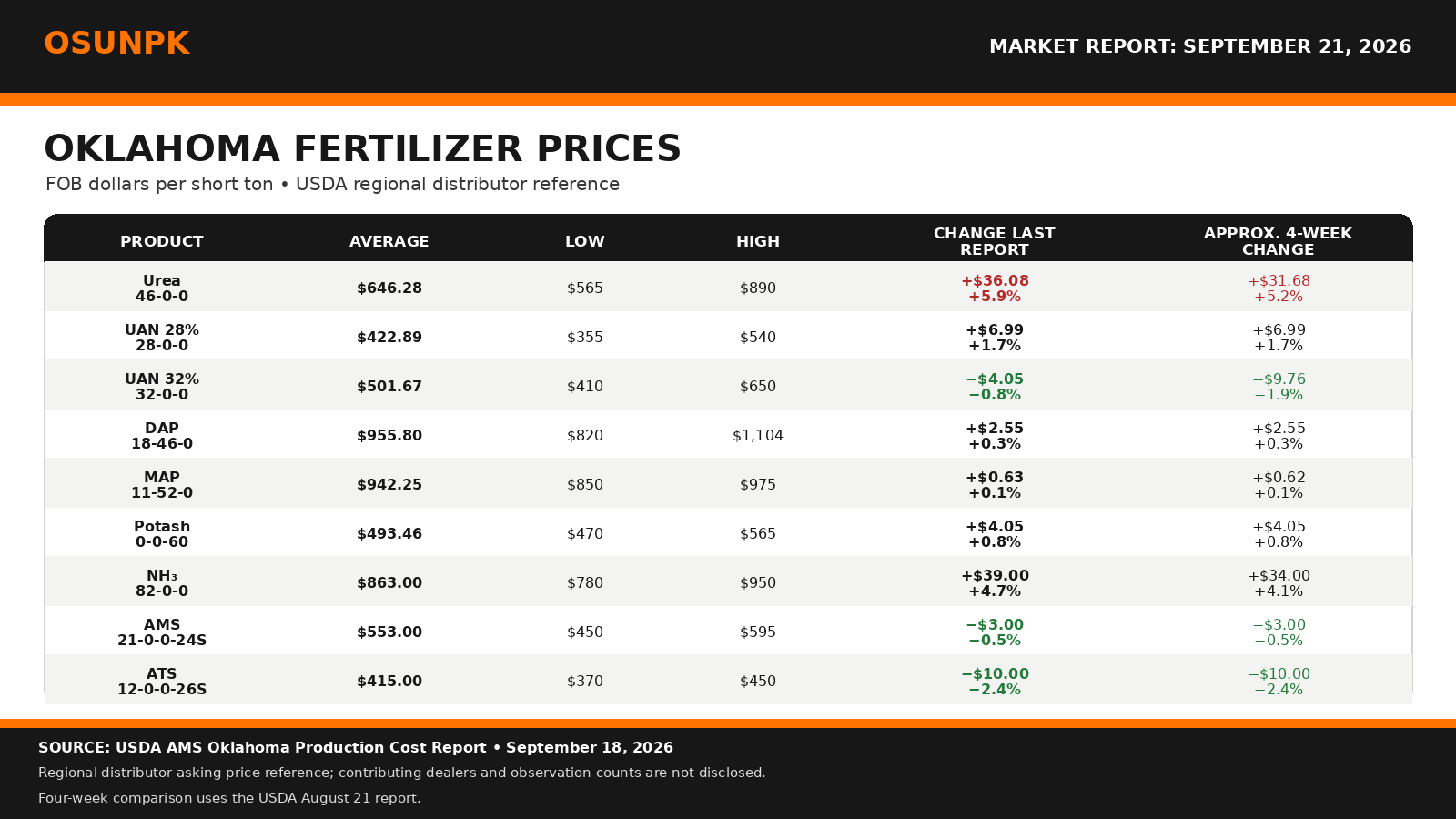
Oklahoma’s clearest fertilizer move over the past two weeks was urea’s return to higher ground. The September 18 USDA average rose $36.08 per ton, or 5.9%, to $646.28. Anhydrous ammonia also increased $39 per ton, while UAN 28% edged higher and UAN 32% slipped. The split among nitrogen products is a useful reminder that one product’s direction does not automatically describe the whole nitrogen market.
Price-source note: The accompanying graphic’s Oklahoma average, minimum, and maximum come from the USDA Agricultural Marketing Service Oklahoma Production Cost Report. USDA does not identify contributing dealers. Named public dealer cash quotes, including Two Rivers Cooperative, are tracked separately and are not blended into USDA statistics.
USDA described urea as the clear exception in an otherwise uneven market, with increases reported consistently across its contacts. That local move contrasts with recent evidence of softer international urea values. India’s landed import cost reportedly fell to about $406 per metric tonne in August, 57% below its May peak, while Indian stocks reached 7.51 million tonnes—78% above a year earlier. Those numbers suggest improved global availability, but they do not guarantee lower Oklahoma replacement costs. Timing, inland freight, dealer inventory position, product form, and the price paid for the next load can create a different local signal.
Anhydrous ammonia’s increase deserves attention as fall application approaches, even though it remained below its July level. UAN’s mixed movement also fits a market in which inventory coverage differs by product. In August, fertilizer analyst Josh Linville noted that UAN and ammonia manufacturers had strong forward sales positions even as urea benchmarks weakened. That observation remains relevant to the current divergence, though it should be treated as market context rather than a forecast.
Phosphate prices barely moved in the Oklahoma report, but the cost picture underneath them is less quiet. USDA said phosphorus-fertilizer production inputs have risen sharply, adding upward pressure and near-term uncertainty. International reporting also placed August DAP values above April levels, with freight disruptions cited as a factor. Ammonia and sulfur are major variable inputs in phosphate production, so strength or supply disruption in either market can eventually affect DAP and MAP replacement values. AMS and ATS moved lower locally this period, but sulfur-market risk remains relevant to both products and to phosphate manufacturing.
Another cost pressure sits outside the fertilizer table. USDA reported Oklahoma farm diesel up $0.72 per gallon in two weeks to a record $5.44 average for this series. The fertilizer graphics exclude delivery and application charges, as they should, but higher fuel costs can still raise the total cost of getting product to the field.
Over the next several weeks, watch whether Oklahoma urea gains persist across another report, whether fall NH₃ demand strengthens, and whether phosphate input pressure reaches posted retail values. India’s purchasing pace, global urea availability, sulfur and ammonia supply, freight, and local moisture conditions all remain important. These forces are pulling in different directions, so the present data support caution rather than a definitive price call.
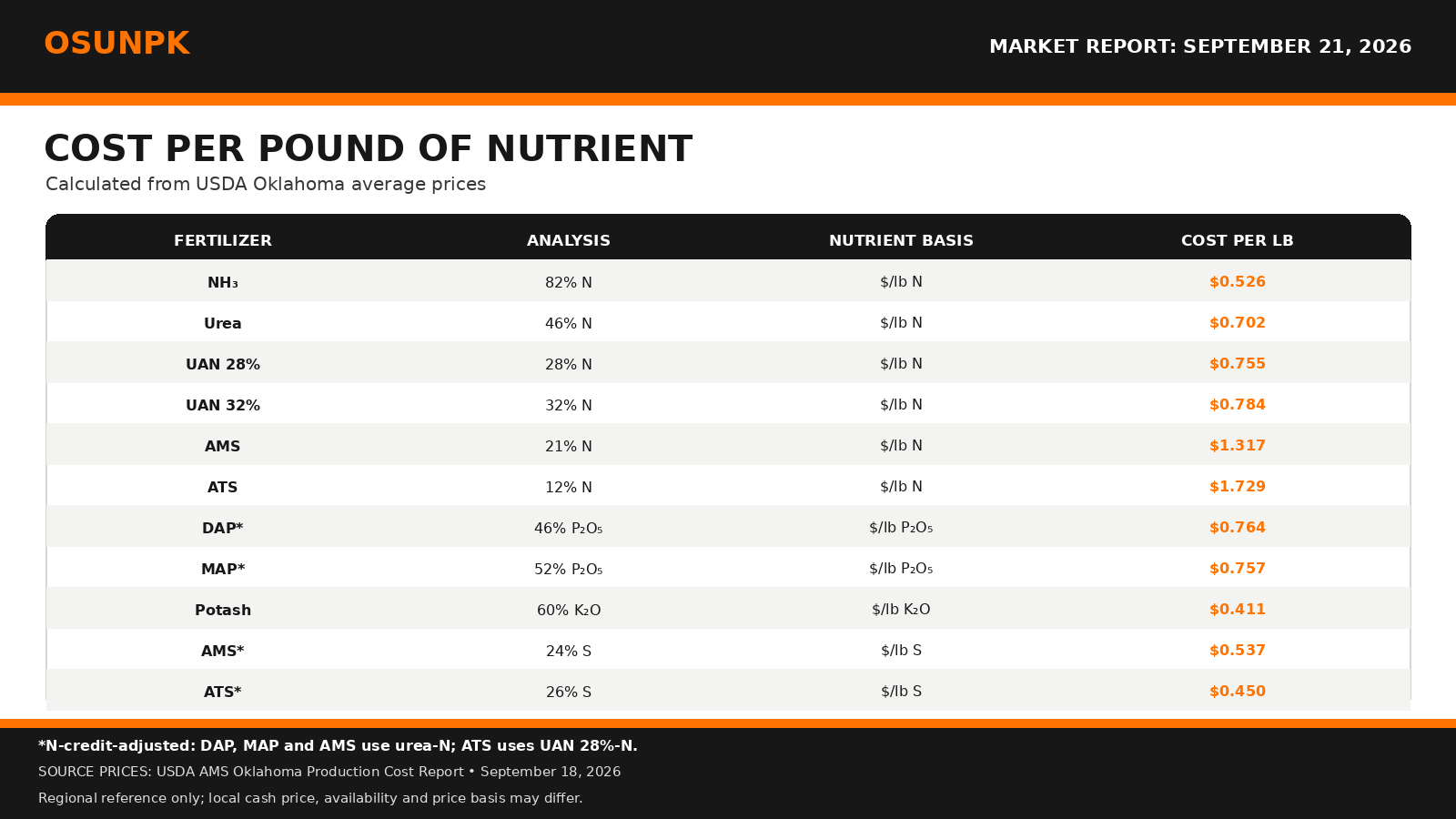
For Oklahoma producers and dealers, compare products on both a cash-per-ton and nutrient-cost basis, then verify pickup or FOB terms and all service charges. Where soil tests allow flexibility, product fit, timing, and availability may matter as much as the posted price.
Fertilizer markets, local prices, and availability can change quickly. Confirm current prices and terms with local dealers before purchasing.
Market Sources
- USDA Agricultural Marketing Service. Oklahoma Production Cost Report, September 18, 2026. https://www.ams.usda.gov/mnreports/ams_3621.pdf
- Financial Express. “Import prices of urea down 57% since May peak,” September 15, 2026. https://www.financialexpress.com/policy/economy/import-prices-of-urea-down-57-since-may-peak/4339998/
- Hoosier Ag Today. “Fertilizer Markets at a Crossroads: StoneX’s Josh Linville Reveals the Biggest Risks—and Where Growers Should Buy Now,” August 12, 2026. https://www.hoosieragtoday.com/2026/08/12/josh-linville-fertilizer-markets/
- CoBank. “Why higher fertilizer prices are here to stay,” August 13, 2026. https://www.cobank.com/knowledge-exchange/why-higher-fertilizer
This report is produced via Chat GPT Plus Work, with review by Brian Arnall.

