Kelby Linn, MS Precision Nutrient Management
Emily Staton, MS Precision Nutrient Management
Josh Lofton, Cropping Systems Management
Brian Arnall, Precision Nutrient Management
Double crop (DC) corn is gaining attention in Oklahoma as producers look for opportunities to increase productivity following wheat harvest. While DC soybeans and sorghum remain common options, corn can serve as an alternative when planting windows are missed or when producers want to diversify their rotation. In Oklahoma systems, it is suggested DC corn is followed by a full season soybean crop the next year. This allows producers to maintain an intensive cropping system while maximizing land use. However, managing fertility in DC corn can be challenging because the crop is grown under a different environment than full season corn. One of the questions producers ask is how much nitrogen (N) is needed to maximize returns. Nitrogen is typically the largest fertilizer expense in corn production, but applying more N does not always result in higher yields. Recent Oklahoma research suggests DC corn may require less N than many would expect.
Understanding the System
To evaluate N requirements under Oklahoma DC conditions, field trials were conducted across 11 site years during the 2024 and 2025 growing seasons (Table 1). Corn was planted directly into wheat residue following harvest, creating a true DC production system. Nitrogen was applied as urea (46-0-0) at 13 rates ranging from 0 to 180 lbs N/acre in 15 lb N increments. The following data was collected: biomass production, grain yield, and grain quality responses across environments. The goal was to identify how much N is needed to maximize yield and profitability in Oklahoma DC corn.
Table 1. Field study locations for the 2024 and 2025 double crop corn trials in Oklahoma. Each location is listed with respective planting dates, corn varieties, planting populations and harvest date.
| Location | Planting | Variety | Population | Harvest |
| Perkins | 6/28/2024 | DK119-30 | 20k | 11/9/2024 |
| 7/11/2025 | DKC117-27RIB | 20k | 11/14/2025 | |
| Stillwater | 6/30/2024 | DK119-30 | 20k | 11/11/2024 |
| 7/12/2025 | DKC117-27RIB | 20k | 11/13/2025 | |
| Perry | 6/28/2024 | DK119-30 | 20k | 11/16/2024 |
| 7/7/2025 | DKC117-27RIB | 20k | 11/12/2025 | |
| Perry (Irrigated) | 7/7/2025 | DKC117-27RIB | 28K | 11/12/2025 |
| Lahoma | 7/9/2025 | DKC117-27RIB | 20k | 11/18/2025 |
| Fort Cobb (Irrigated) | 7/2/2025 | DKC117-27RIB | 28K | 11/15/2025 |
Yield Response: Nitrogen Helped, But Only to a Point
Across all harvested site years, N applications significantly influenced grain yield when environment was not the limiting factor. Average yields ranged from 40 to 94 bu/ac, demonstrating how variable DC corn performance can be from year to year and field to field (Staton, 2026) (Figure 1). While some locations responded positively to N fertilizer, others showed little response even when rates reached 180 lbs N/ac. The consistent finding was yield responses often plateaued around 60 lbs N/ac. Once this point was reached, additional fertilizer rarely produced enough additional grain to justify the added cost. Across two Oklahoma studies representing 11 site-years, unfertilized double-crop corn averaged approximately 52 bu/ac. That finding highlights just how much nitrogen can be supplied by the soil through residual nitrate and mineralization before fertilizer is applied. These results suggesting existing soil N and nutrient mineralization contributed significantly to crop demand (Staton, 2026).
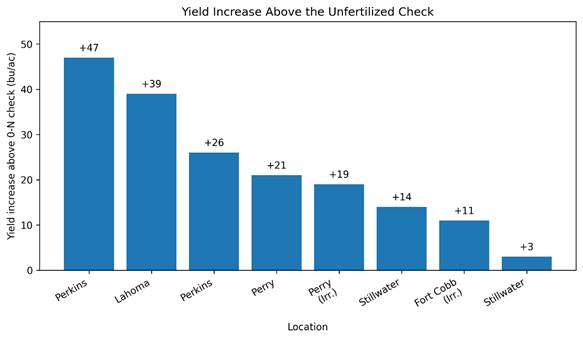
Figure 1. Increase in yield of the highest yielding treatment as compared to the non-fertilized check yields of each location. Adapted from Staton (2026)
The Real Story: Return on Investment
While producers naturally focus on maximizing yield, these fertilizer decisions should be based on profitability. Average economic return peaked near 60 lb N/ac. Beyond that rate, additional fertilizer consistently reduced profit (Figure 2). Although individual economic returns varied among environments, the agronomic data suggest producers should approach DC corn fertility programs with realistic yield expectations. Unlike high yielding full season corn, DC systems often encounter environmental limitations that reduce the return on additional fertilizer investment.
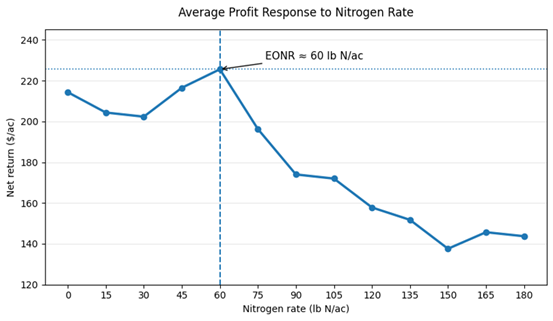
Figure 2. Average profit response to nitrogen rate in US dollars (USD)/ac. Adapted from Staton (2026).
What This Means for Oklahoma Producers
The results from this study closely align with previous Oklahoma research evaluating N response in DC corn. Wyma (2022) reported approximately one additional bushel of grain for every 1.8 lbs N applied above the unfertilized control, similar to Staton (2026) who observed one additional bushel for every 1.7 lbs N in responsive environments. Together these studies suggest Oklahoma DC corn requires approximately 1.75 lbs N for every additional bushel of expected yield above 50 bu ac-1.
The goal of nitrogen management is not to apply the most fertilizer, it is to apply the right amount. Two independent Oklahoma studies now indicate that double-crop corn often requires substantially less N than full-season corn. Matching N rates to realistic yield potential can improve profitability while reducing unnecessary fertilizer costs.
Take Home
- Double crop corn is a economically viable option in Oklahoma.
- Use lower total N rates than full-season corn.
- Across two independent studies’, the unfertilized corn averaged about 50 bushels per acre.
- 1.75 lb N per expected additional bushel above the unfertilized expectation.
- Base final N rates on realistic yield potential and expected moisture.
- Consider residual soil nitrate following wheat before increasing fertilizer rates.
- Avoid applying N beyond expected crop demand.
References
Alcoz, Mercedes M., Frank M. Hons, and Vincent A. Haby. 1993. “Nitrogen Fertilization Timing Effect on Wheat Production, Nitrogen Uptake Efficiency, and Residual Soil Nitrogen.” Agronomy Journal 85(6):1198–1203. doi:10.2134/agronj1993.00021962008500060020x.
Chang, Jen-Hu. 1981. “Corn Yield in Relation to Photoperiod, Night Temperature, and Solar Radiation.” Agricultural Meteorology 24:253–62. doi:10.1016/0002-1571(81)90049-2.
Kravchenko, Anatoliy G., and Kurt D. Thelen. 2007. “Effect of Winter Wheat Crop Residue on No-Till Corn Growth and Development.” Agronomy Journal 99(2):549–55. doi:10.2134/agronj2006.0192.
Liu, Zheng, Jia Gao, Fei Gao, Shuting Dong, Peng Liu, Bin Zhao, and Jiwang Zhang. 2018. “Integrated Agronomic Practices Management Improve Yield and Nitrogen Balance in Double Cropping of Winter Wheat-Summer Maize.” Field Crops Research 221:196–206. doi:10.1016/j.fcr.2018.03.001.
Staton, Emily. 2026. “Nitrogen Management in Double Crop Corn” M.S., Oklahoma State University, United States — Oklahoma.
Wyma, Rhiannon Nichole. 2022. “Corn Grain Yield Response to Nitrogen Rate and Plant Population in Full and Double-Crop Systems.” M.S., Oklahoma State University, United States — Oklahoma.

