Josh Lofton, Cropping Systems Specialist
In the last several years, warmer springs and higher/widespread rainfall have resulted in summer crops reaching with a high amount of vegetative growth. This season has been quite different for the most part, cooler temperatures and more sporadic rainfall has resulted in much smaller plants. So that begs the question, are larger or smaller plants better for yield in Oklahoma. While many that have spent time in Oklahoma will probably have a preference, there is no direct answer to this question.
Larger plants generally have more leaves, more stems, more branches, and more overall biomass. They often appear healthier and more productive throughout the growing season.
In higher rainfall and lower stress environments, this assumption is true. Greater vegetative growth can support higher yield potential because larger plants capture more sunlight, accumulate more photosynthates, and develop a greater capacity to support grain or seed production.
However, in Oklahoma and throughout the Southern Great Plains, yield potential and yield stability are not always the same thing.
The challenge facing producers across this region is that crops must balance the opportunity to maximize yield with the risk of running short on water during critical reproductive growth stages. As a result, the plant with the greatest theoretical yield potential is not always the plant that produces the most grain across a range of environmental conditions.
The Tradeoff Between Yield Potential and Yield Stability
Many may have heard of this difference. Even you if have not directly of these concepts, most in Oklahoma will be familiar with the trade-offs
Yield potential refers to the maximum yield a crop can achieve when environmental conditions are favorable, and resources are not limiting.
Yield stability refers to a crop’s ability to maintain performance across varying environmental conditions, including drought, heat stress, and erratic rainfall.
These two characteristics are often related, but they are not always aligned.
High vegetative growth frequently possesses greater yield potential because they can intercept more sunlight and support more reproductive structures. However, those same plants often require greater amounts of water throughout the season.
In contrast, plants with more moderate growth habits may have slightly lower maximum yield potential, but they often maintain more consistent performance when environmental stresses occur.
So the difference between excessive, adequate, and too low vegetative production is not consistent and is impacted by a part of the year not yet experienced.
For producers in the Southern Great Plains, where growing conditions can change dramatically from one season to the next, yield stability can be just as important as maximum yield potential.
Why More Growth Often Means More Yield Potential
The relationship between vegetative growth and yield begins with photosynthesis.
More leaves generally mean:
- Greater sunlight interception
- Greater photosynthetic capacity
- More carbohydrate production
- More potential reproductive sites
And when we are talking about farming, what we are often farming is the sunlight indirectly through the crops we are growing. Therefore, the higher amount of sunlight that can be captured, this higher potential yield can be.
In soybean, larger plants often produce more nodes and branches, creating additional locations for pod formation.
In grain sorghum, larger canopies can support greater grain production when moisture remains adequate through grain fill.
In corn, larger plants often contribute to greater kernel production and kernel weight under favorable conditions.
Because of these relationships, management practices that encourage vigorous growth are frequently associated with high yield environments.
The key phrase, however, is under favorable conditions.
The Hidden Cost of Large Plants
Every leaf that captures sunlight also loses water.
As plant size increases, so does transpiration demand. Larger plants require more water simply to maintain normal physiological activity.
This creates a challenge in many Oklahoma production environments.
Rainfall is often adequate during early vegetative development, allowing crops to establish large canopies and accumulate substantial biomass (often during the months of April and early May). However, the period from flowering through grain fill frequently coincides with:
- Higher temperatures
- Greater evaporative demand
- Less reliable rainfall
- Increasing soil moisture depletion
This can be a two-fold issue. One, higher vegetative production early could have utilized and drained total surface and subsurface moisture, which is now not available during reproductive growth. However, it also increased daily moisture demand. This can result in with similar soil moisture and rainfall, a smaller plant will have a lower moisture demand than a larger plant.
The consequence is often a reduction in grain or seed production precisely when yield is being determined.
Soybean: A Classic Example
Soybean perhaps provides the best illustration of this concept.
When moisture is abundant, larger soybean plants can be extremely productive. Additional nodes and branches create opportunities for greater pod production, and large canopies intercept significant amounts of sunlight.
However, soybean also possesses one of the longest reproductive periods among major summer crops.
A soybean crop must successfully retain flowers, maintain pods, and fill seeds over an extended period. Water stress at any point during this process can reduce yield.
Large soybean plants often consume considerable amounts of water during vegetative growth. If drought develops during pod set or seed fill, those plants may experience:
- Increased flower abortion
- Increased pod abortion
- Reduced seed size
- Premature canopy senescence
In contrast, a more moderate-sized soybean plant may use less water during early development and preserve soil moisture for reproductive growth.
While that plant may possess fewer nodes or branches and therefore slightly lower maximum yield potential, it may be better positioned to maintain yield under stressful conditions.
Seeing this in practice
As shown in Figure 1, plant growth regulation substantially reduced soybean height compared to untreated plants. Three weeks after treatment implementation, regulated plants ranged from 5–10 inches shorter than untreated plants. These reductions in height were accompanied by fewer mainstem nodes, but plants compensated by producing more branch nodes and increasing canopy coverage. The response was relatively consistent across both growing seasons, demonstrating that soybean plants can modify their growth habit when mainstem development is restricted.
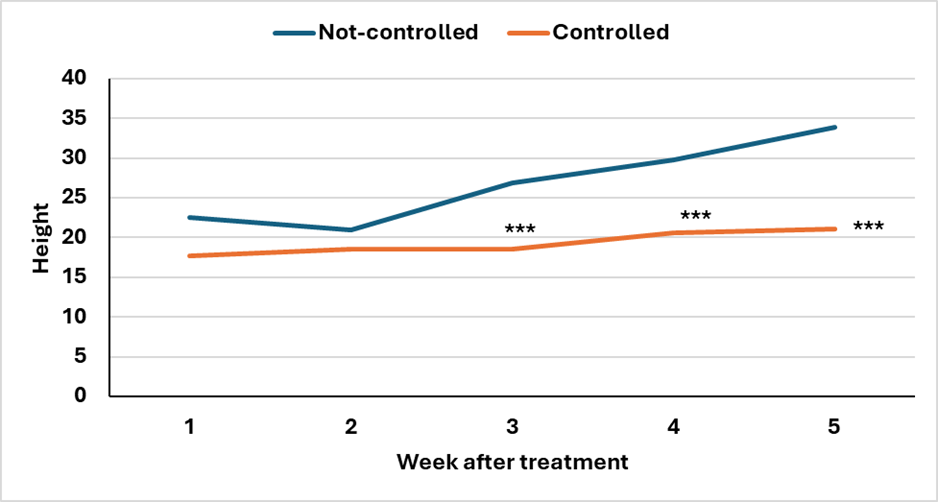
Figure 1. Impact of plant growth regulation (physical removal) on soybean plant height compared to untreated plants. Data were collected across the 2022 and 2023 growing seasons.
While reduced plant size altered canopy architecture, the impact on yield differed substantially between years (Figure 2). In 2022, when environmental conditions were generally favorable and resources were less limiting, plant growth regulation did not improve yield. In fact, yields were slightly lower than the untreated control. This response likely reflects the reduced yield potential associated with smaller plants, as larger soybean canopies often intercept more light, accumulate greater biomass, and support higher seed production when adequate moisture is available throughout the season.
However, the response was markedly different during 2023, when moisture became increasingly limiting later in the growing season. Under these conditions, regulated plants significantly outyielded the untreated plants. The smaller canopy likely reduced seasonal water use and delayed soil moisture depletion, leaving more water available during critical reproductive growth stages. In contrast, larger untreated plants developed greater vegetative biomass and therefore higher water demand earlier in the season. Although these larger plants possessed greater theoretical yield potential, they were more susceptible to late-season drought stress when water availability became limited.
These results illustrate an important principle for summer crop production systems in water-limited environments. Larger plants often possess higher yield ceilings because of their greater vegetative growth and capacity to capture resources. However, that same vegetative growth can increase transpiration demand and accelerate soil water depletion, increasing the risk of yield loss if drought develops later in the season. Smaller plants may not achieve the same maximum yield potential in favorable years, but they often provide greater yield stability by reducing water demand and preserving resources for reproductive development. Consequently, the optimal plant size is often a balance between maximizing yield potential and minimizing drought risk, particularly in environments such as Oklahoma where late-season moisture stress is common.
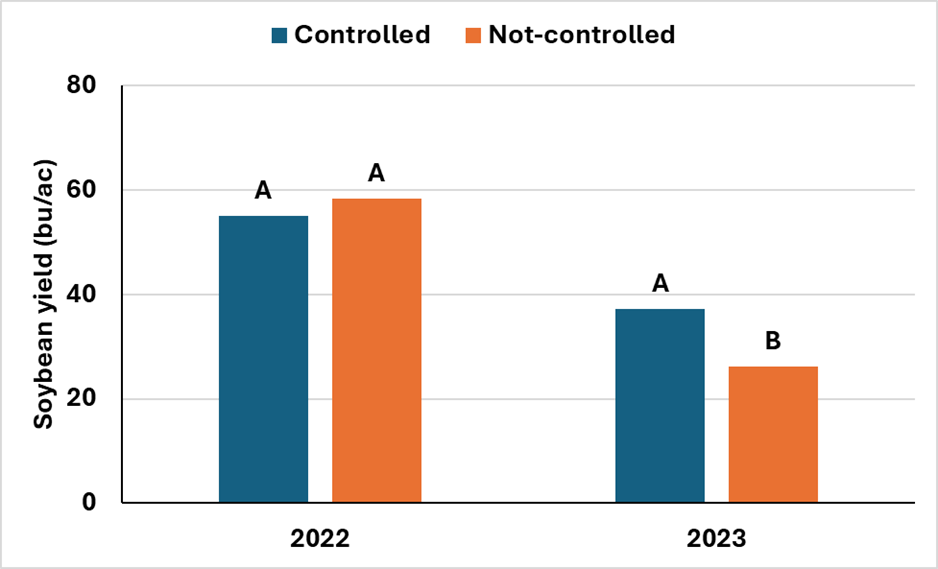
Figure 2. Impact of plant height regulation on soybean yield during the 2022 and 2023 growing seasons. Yield responses differed between years, highlighting the tradeoff between maximum yield potential and yield stability under water-limited conditions.
Lessons from Grain Sorghum
Grain sorghum offers another excellent example.
One reason sorghum has traditionally been viewed as a drought-adapted crop is its ability to regulate water use throughout the season. Traits such as leaf rolling, reduced transpiration, and stay-green characteristics help preserve plant function during grain fill.
Many of these mechanisms do not necessarily maximize growth early in the season. Instead, they improve the likelihood that the crop can complete grain development under stressful conditions.
This strategy may occasionally sacrifice maximum yield potential in highly favorable years, but it often improves yield stability across multiple growing seasons.
Managing for Consistency Versus Chasing Maximum Yield
One of the most important questions growers must answer is whether they are managing for maximum yield potential or maximum yield consistency.
In highly productive environments with irrigation or reliable rainfall, encouraging aggressive vegetative growth may be appropriate because water limitations are less likely to restrict grain fill.
In contrast, dryland production systems throughout much of Oklahoma often reward a more balanced approach.
The goal is not necessarily to produce the largest crop canopy possible. Rather, it is to produce enough canopy to efficiently intercept sunlight while preserving sufficient water to support reproductive growth later in the season.
Bigger Isn’t Always Better—Especially in Dryland Systems
This does not mean smaller plants are inherently superior.
A very small plant may lack sufficient leaf area to fully utilize available sunlight and may never achieve high yield potential regardless of rainfall conditions.
The ideal crop is rarely the smallest or the largest plant in the field.
Instead, the most successful crops are often those that achieve a balance between vegetative growth and resource conservation.
They develop enough biomass to support high levels of photosynthesis while avoiding excessive water consumption before reproduction begins.
Final Thoughts
Across Oklahoma and the Southern Great Plains, crop production is often a matter of managing risk as much as maximizing yield.
Larger plants frequently possess greater yield potential because they capture more sunlight and produce more biomass. However, that potential comes with increased water demand. When rainfall becomes limiting during flowering, grain fill, pod set, or seed development, those larger plants can become more vulnerable to stress.
Smaller or more moderately sized plants may not always produce the highest yields in ideal environments. However, they often provide greater yield stability because they conserve resources and maintain reproductive growth when environmental conditions deteriorate.
For soybean in particular, this tradeoff is frequently observed. The largest plants in July are not always the highest-yielding plants in October. More often, the most successful plants are those that balance growth with resource conservation, preserving enough water to support reproduction when it matters most.
In the Southern Great Plains, where late-season drought remains one of the greatest limitations to crop production, understanding the difference between yield potential and yield stability may be just as important as understanding yield itself.

