Ashleigh M. Faris, Maxwell Smith, & Jenny Dudak
While the cotton jassid (Amrasca biguttula), also known as the Two-Spot Cotton Leafhopper, has not yet been detected in Oklahoma, its rapid expansion across the Southern Cotton Belt in 2025 makes it a potential threat to the 2026 season. This pest is considered one of the most serious threats to U.S. cotton, with the potential for significant yield losses in untreated fields. Stay informed on if the cotton jassid may be moving from the south and into Oklahoma by signing up for Texas A&M AgriLife Extension text alerts: text COTTON to 833.717.0325.
Identification: The “Two-Spot” Difference
The cotton jassid can be confused with the native potato leafhopper, but its unique markings are the key to early detection (Figure 1).
- Adults: Approximately 1/8 inch (2mm) long, wedge-shaped, and green.
- Key Markings: Look for two small black spots on the crown of the head and one black spot on the tip of each forewing. These spots on the head can sometimes fade but are generally visible under magnification; the spots on the wings will be present in adults and do not fade.
- Nymphs: Wingless and pale green. They are best known for their “crab-like” sideways movement when disturbed on the leaf surface. Any nymphs spotted should warrant a thorough scouting for adult cotton jassids and damage.
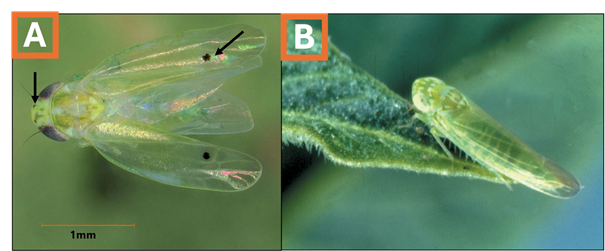
Figure 1. Cotton jassid adults (A) have one black dot on each wing and may have two small dots between their eyes (these dots on the crown can fade). The potato leafhopper (B), which is not a threat to cotton production but does occur in Oklahoma, does not have black dots on their wings or between their eyes. Image A courtesy of Isaac Esquivel, UF Extension, image B courtesy of DryBeanAgronomy.ca.
Biology and Host Range
The cotton jassid has a short life cycle, completing a generation in approximately two weeks under warm conditions.
- Reproduction: Eggs are inserted directly into leaf midveins and petioles, hatching in 3–4 days. Eggs will not be visible to the naked eye or through hand lens. Cotton jassids progress through 5 nymphal instars before becoming reproductive adults (Figure 2).
- Host Plants: This pest is polyphagous, meaning it feeds on many hosts. While cotton is a primary target, it also thrives on okra, eggplant, and ornamental hibiscus. It has also been found on native plants like Turk’s cap, as well as weeds like Ceasar weed and Florida pusley.
- 2025 Range on U.S. Cotton: The cotton jassid was detected on cotton in FL, GA, AL, MS, LA, TN, SC, NC, and TX. The TX detections in cotton were limited to southeastern TX in Grimes, Wharton, and Fort Bend counties. At the time of this article’s posting (March 2026), the cotton jassid has not been detected in OK.
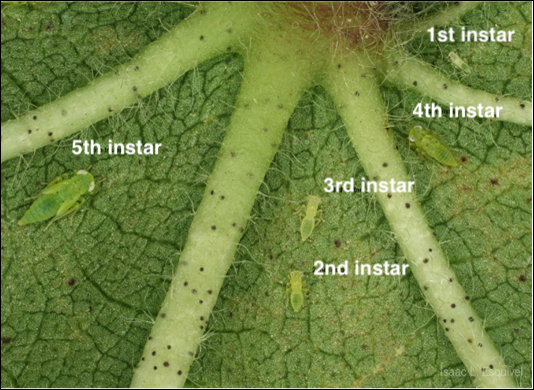
Figure 2. Cotton jassid nymphs on the underside of a cotton leaf. Image courtesy of Isaac Esquivel, UF Extension.
Damage: Recognizing Hopperburn
Unlike other leafhoppers, the cotton jassid injects a salivary toxin that disrupts the plant’s vascular system.
- Early Signs: Initial yellowing that resemble potassium deficiency with some upward curling of leaf margins (Figure 3, Rating 1).
- Progression: Characterized by hopperburn, a yellowing (chlorosis) that proceeds from leaf edges and turns red or brown as the tissue dies (Figure 3).
- Systemic Impact: Plants can go downhill quickly, often leading to complete desiccation and stunted growth (Figure 4).
A Hopperburn Injury Rating Scale has been developed by Extension Cotton Entomologists in the mid-South (Figure 3). You cannot let the cotton jassid get ahead of you. Once reddening starts on the leaf margins (Rating 2 in Figure 3) it is likely too late to rescue the cotton plant, damage will quickly progress and photosynthetic capabilities for the plant decline considerably.
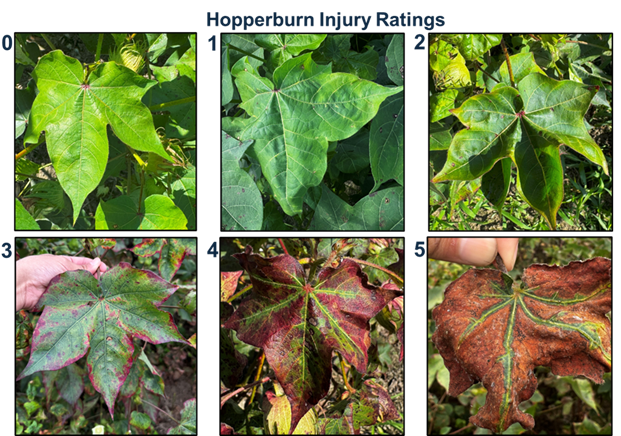
Figure 3. Hopperburn injury rating scale for cotton jassid damage. Damage increases from none (0) to severe damage of desiccated leaf (5). Slight yellowing and upward curling of leaf is shown in Rating 1, with increased yellowing, cupping, and beginnings of reddened leaf margins in Rating 2. Insecticide action should be taken prior to reaching Rating 2. Ratings 3 – 5 show increased spread of reddening and desiccation. Images courtesy of Phillip Roberts (UGA Extension) and Scott Graham (AU Extension).
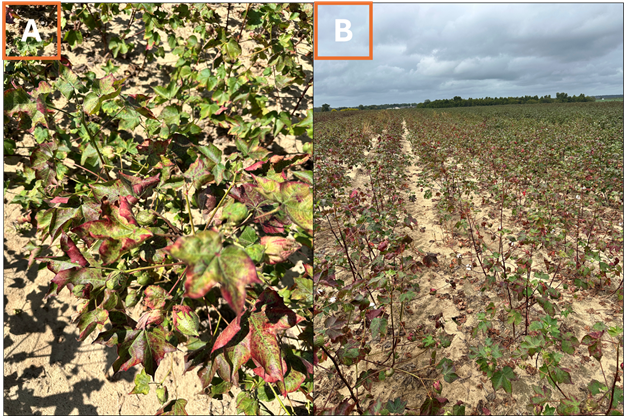
Figure 4. Cotton jassid hopperburn resulting in reddened, dried leaves (A) and stunted cotton plants (B). Image courtesy Isaac Esquivel, UF Extension.
Scouting Protocol
Scouting is mandatory for every cotton field in 2026 to prevent significant yield loss. Plants located at the edge of cotton fields can serve as good indicators, as cotton jassids will enter at field margins where damage is more likely to occur before further in field.
- Target Area: Inspect the undersides of leaves in the mid-to-upper canopy.
- Sample Leaf: Focus on the 4th mainstem leaf below the terminal, as this is where nymphs typically congregate.
- Visual Checks: Because adults fly quickly, count the flightless nymphs. Examine at least 25 leaves per field.
- Threshold: 1 cotton jassid per leaf, or early crop injury indicators (Figure 3, Rating 1) with cotton jassid confirmations nearby.
- Continue Scouting: Since green leaves are needed to fill bolls, growers should scout cotton up to at least 2 weeks prior to defoliation.
Management Guidance
Cultural Practices
- Plant Early: Trials indicate that earlier planting dates can help the crop “outrun” the peak pressure of migrating populations.
- Nutrient Management: Avoid excess Nitrogen, which attracts cotton jassids. Ensure adequate Potassium, as deficient plants crash much faster under cotton jassid stress.
- Varieties: Internationally, varieties with high trichome (hair) density on leaves offer natural resistance to feeding. However, varieties on the U.S. market are generally less hairy than those planted elsewhere. Currently, trials from 2025 do not indicate a varietal difference in terms of cotton jassid susceptibility.
Chemical Control
Based on 2025 research trials conducted by Mid-South Cotton Extension Entomologists, the following insecticides have shown varying levels of control (Table 1). Repeated insecticide applications may be warranted.
Table 1. Suggested foliar insecticides* and their observed control level for suppressing the cotton jassid. Efficacy lasted around 2 weeks.
| Control Level | Insecticides |
| High (>70% Control) | Carbine, Sefina, Sivanto, Bidrin, Venom, Plinazolin |
| Moderate (50-70%) | Transform, Centric, Assail, Orthene |
| Low (<50%) | Steward, Diamond, Bifenthrin, Admire Pro |
*Cotton jassids have shown resistance to every chemistry class in their native range; rotation of modes of action is critical. The mention, listing, or use of specific insecticides is not an endorsement of that product, nor is it a criticism of similar products not mentioned.
If you suspect cotton jassid activity or see hopperburn symptoms, contact the OSU Cotton IPM team: Maxwell Smith (maxwell.smith@okstate.edu), Ashleigh Faris (Ashleigh.faris@okstate.edu), and Jenny Dudak (jdudak@okstate.edu) immediately for confirmation. This team will be monitoring for the cotton jassid and will share updates on nearing threat, Oklahoma detections, and updated management guidance as it becomes available.
For more information on the cotton jassid in the U.S., click on this link to access Extension Factsheets, podcasts, and videos developed by Extension Entomologists managing the pest: https://drive.google.com/file/d/19IFT5c9b5JXEaBgf6X-weya07G56RXS5/view?usp=sharing.
 Down and Dirty with NPK